Sentinel-1 GRD vs RTC: Which SAR Product Should You Use?
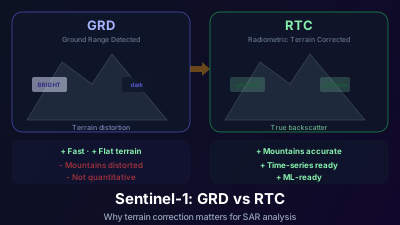
Quick Answer: GRD (Ground Range Detected) is Sentinel-1's standard product — fast to access but distorted in mountainous terrain. RTC (Radiometrically Terrain Corrected) uses a DEM to compensate for terrain effects, providing more accurate backscatter values. Use GRD for flat terrain, quick looks, and applications where relative change matters more than absolute values. Use RTC for mountainous areas, quantitative analysis, and time-series where terrain-induced brightness variations would confuse your results.
Two Products, Same Satellite
When you search for Sentinel-1 data, you'll encounter two main product types: GRD and RTC. Both come from the same satellite and the same raw radar measurements, but they've been processed differently — and that processing difference matters for your analysis.
What Is GRD?
Ground Range Detected (GRD) is Sentinel-1's standard Level-1 product. The processing chain:
- Raw SAR signal → focused into a single-look complex (SLC) image
- Multi-looked to reduce speckle noise
- Projected from slant range to ground range (the satellite's viewing geometry is removed)
- Detected (phase information is discarded, only amplitude/intensity remains)
The result is a raster where pixel values represent backscatter intensity, projected onto a flat Earth model.
GRD Strengths
- Widely available — The standard Sentinel-1 product in most archives
- Fast access — No additional processing required
- Suitable for flat terrain — Over plains, coastal areas, and low-relief landscapes, GRD is perfectly adequate
- Good for change detection — Relative changes between dates are preserved even without terrain correction
GRD Limitations
- Terrain distortion — In mountains, slopes facing the satellite appear compressed (foreshortening) and brighter, while slopes facing away appear stretched and darker
- Brightness varies with topography — A forest on a steep slope facing the radar appears much brighter than the same forest on a flat surface, even though the vegetation is identical
- Layover and shadow — Steep terrain causes radar layover (mountain tops appear to lean toward the sensor) and radar shadow (areas behind steep slopes receive no signal)
What Is RTC?
Radiometrically Terrain Corrected (RTC) products use a Digital Elevation Model (DEM) to compensate for terrain effects. The processing adds:
- Start with GRD (or SLC) data
- Use a DEM to calculate the local incidence angle at each pixel
- Normalize backscatter based on the actual illuminated area (accounting for slope)
- Orthorectify to correct geometric distortions
The result is a raster where pixel values represent backscatter that would be measured if the terrain were flat — the terrain's radiometric influence has been removed.
RTC Strengths
- Accurate backscatter values — Comparable across different terrain types
- No terrain-induced brightness bias — A forest is a forest, regardless of the slope it grows on
- Better for quantitative analysis — Biomass estimation, soil moisture retrieval, and classification are more accurate
- Cleaner time-series — Reduced variability from orbit-to-orbit incidence angle differences
RTC Limitations
- DEM dependent — The quality of terrain correction depends on the DEM resolution and accuracy
- Processing artifacts — In areas of very steep terrain or poor DEM data, RTC can introduce artifacts
- Slightly reduced availability — Not all archives provide pre-computed RTC products (though this is changing)
Visual Comparison
In flat terrain (Netherlands, Kansas, Ganges delta), GRD and RTC look nearly identical. The differences emerge in mountains:
| Feature | GRD Appearance | RTC Appearance |
|---|---|---|
| Slope facing radar | Artificially bright | Correctly calibrated |
| Slope facing away | Artificially dark | Correctly calibrated |
| Valley floors | Normal brightness | Normal brightness |
| Ridge tops | Possible layover artifacts | Geometrically corrected |
| Radar shadow zones | Black (no data) | Black (still no data — physics can't be corrected) |
Decision Guide
Use GRD When...
- Your area is flat — Over plains, deltas, and coastal zones, terrain correction adds complexity without benefit
- You need quick results — GRD is immediately available without additional processing
- You're doing visual interpretation — Comparing dates by eye to spot obvious changes (floods, ships, deforestation)
- Relative change is sufficient — You're comparing the same pixel over time, and the terrain doesn't change between dates
- You're working over water — Ocean surfaces have no terrain to correct
Use RTC When...
- Your area is mountainous — Alps, Andes, Himalayas, or any terrain with slopes > 10°
- You need quantitative backscatter values — Biomass estimation, soil moisture retrieval, land cover classification
- You're comparing different areas — Backscatter values must be comparable regardless of local terrain. This matters for SAR-based change detection
- You're building time-series from different orbits — Different orbit tracks have different incidence angles; RTC normalizes this
- You're training a machine learning model — Terrain-corrected data produces more generalizable models
How RTC Is Produced
Several organisations publish Sentinel-1 RTC. The most widely cited is the OPERA project (Observational Products for End-Users from Remote Sensing Analysis), distributed through ASF DAAC:
- Processing: Uses the Copernicus DEM at 30m resolution
- Output: Gamma-0 (γ⁰) normalized backscatter in decibels
- Coverage: Global land areas
- Latency: Typically available within days of acquisition
Practical Tips
Don't Mix GRD and RTC in Time-Series
If you're analyzing backscatter changes over time, use consistently either GRD or RTC. Mixing products introduces systematic offsets that look like real changes.
Check DEM Quality for RTC
In areas with poor DEM coverage (recently glaciated terrain, active volcanoes, newly reclaimed land), RTC may introduce more artifacts than it removes. Compare RTC against GRD to check for obvious DEM-related problems.
Consider the Incidence Angle
Even in flat terrain, the local incidence angle varies across the swath (near range vs far range). RTC corrects for this, producing more uniform brightness across the image. If you need consistent measurements across the full swath width, RTC is preferable even for flat areas.
Both Available in Off-Nadir Delta
Off-Nadir Delta provides access to both GRD and RTC products through the Sentinel-1 SAR viewer:
- Open the satellite search panel
- Select either Sentinel-1 GRD or Sentinel-1 RTC as your data source
- Search for imagery over your area of interest
- Load both products for the same date to compare them visually
- Use the layer manager to toggle between GRD and RTC views
For mountainous areas, try loading both products and switching between them — the terrain correction effect is immediately visible on steep slopes.
To learn more about interpreting SAR imagery, see How to Read a SAR Image and SAR Polarization Explained. For deciding between SAR and optical data, see SAR vs Optical: When to Use Which.

Remote sensing specialist with 10+ years in satellite data processing and AI. Founder of Off-Nadir Lab. Ph.D. in Informatics (Yokohama National University, 2026). Master's in Earth System Science and Technology (Kyushu University). Co-author, Remote Sensing Encyclopedia. More about the author →