
Blog
How to read geographic risk from satellite data — tutorials, case studies, and technical insights.
methodology
What an Event Severity Level Rests On: Public Thresholds and Where They Run Out
Which public scales define how severe a single event is, which kinds of events have no public scale at all, and how Off-Nadir Delta's Delta Impact Scale assigns a level from them.
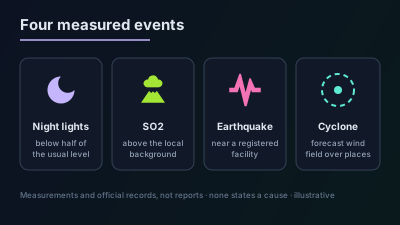
Night Lights, SO2, Earthquakes and Cyclones: Four Measured Events and What Each One Can and Cannot Tell You
Four kinds of event built from instruments and official records instead of news: a city's night lights, sulfur dioxide over a volcano, an earthquake near a facility, and a cyclone's forecast wind field. What each records, and what it leaves open.
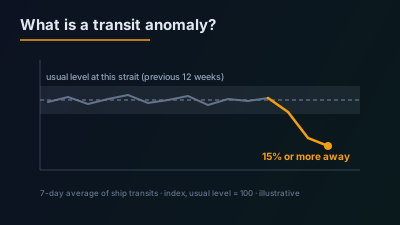
What Is a Transit Anomaly? Telling an Unusual Change in Ship Traffic at a Strait from Routine Variation
A transit anomaly is a count of ships through a strait or canal that has left that place's own usual level. How transits are counted from AIS, what moves the count besides a disruption, and how to read it without guessing a cause.
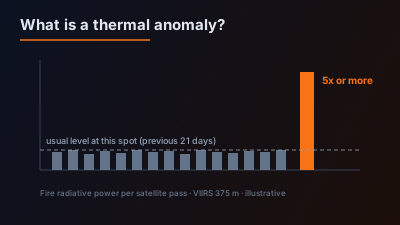
What Is a Thermal Anomaly? Telling an Unusual Heat Source from a Routine Flare in Satellite Data
A thermal anomaly is a satellite pixel flagged as hot. At a refinery or power plant most of them are routine. How NASA separates static heat sources, and how to compare a heat source with its own past.
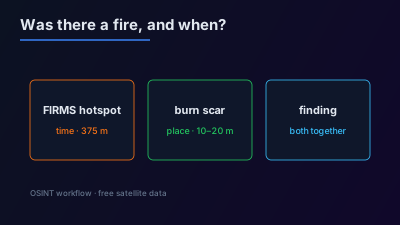
Was There a Fire, and When? Confirming and Dating a Reported Fire with Satellite Data
How to use NASA FIRMS fire detections and Sentinel-2 burn scars together to confirm that a reported fire or explosion happened, and to narrow down when, with the limits of each source.
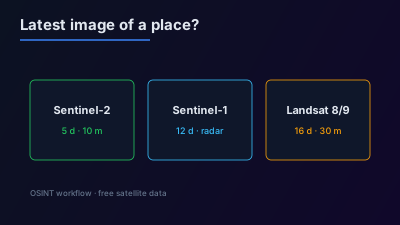
How to Find the Most Recent Satellite Image of Any Place
Where to look for the newest free satellite image of a location, how recent each source can be, why map apps are not live, and how to tell the date of the image in front of you.
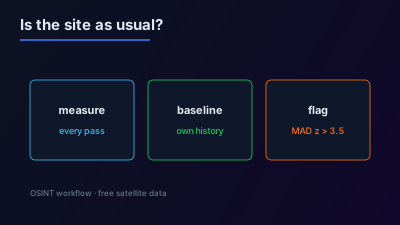
How to Keep Watch on a Facility with Free Satellite Imagery
How to monitor a port, airfield or plant over time with free Sentinel imagery: choosing what to measure, why a baseline matters, how unusual readings are flagged, and what a watch can and cannot tell you.
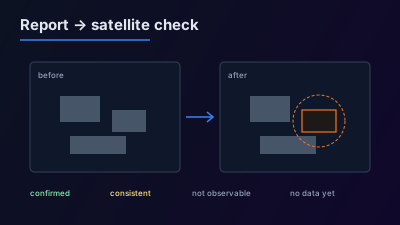
How to Verify a Reported Event with Free Satellite Imagery: An OSINT Workflow
A step-by-step OSINT workflow for checking a reported fire, strike, flood or build-up against free Sentinel-1, Sentinel-2 and NASA FIRMS data, and for writing down what the imagery can and cannot support.

What Can You Actually See in 10 m Satellite Imagery? An OSINT Guide by Target
What free 10 m Sentinel-2 and Sentinel-1 imagery can and cannot show for the things OSINT analysts ask about: vehicles, buildings, ships, airfields, fires, floods and earthworks.
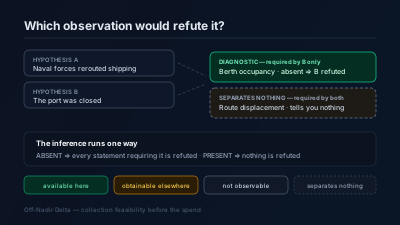
Which Satellite Observation Would Actually Refute Your Hypothesis?
Most collection planning asks when a place can be imaged. The harder question is whether the image could change anyone's mind. Here is how to compute the diagnostic value of an observation before you pay for it.
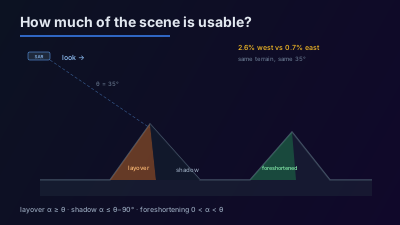
Layover and Shadow: How Much of a SAR Scene Is Actually Usable?
In relief, a large share of a SAR scene can be unmeasurable before you look at it. The geometry is arithmetic — slope against incidence angle — so it can be computed for a specific pass instead of guessed at.
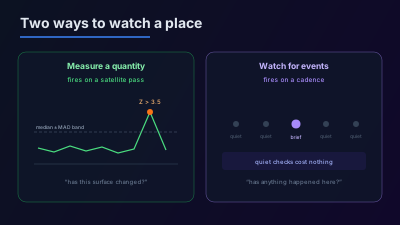
Watching a Place: Measuring a Number vs Watching for Events
Continuous satellite monitoring splits into two jobs that get confused constantly — measuring a quantity over a polygon and watching an area for events. Which one you set up decides whether your watch says nothing or says too much.
All Articles
Browse the full archive of 158 articles.
- What an Event Severity Level Rests On: Public Thresholds and Where They Run Out
- Night Lights, SO2, Earthquakes and Cyclones: Four Measured Events and What Each One Can and Cannot Tell You
- What Is a Transit Anomaly? Telling an Unusual Change in Ship Traffic at a Strait from Routine Variation
- What Is a Thermal Anomaly? Telling an Unusual Heat Source from a Routine Flare in Satellite Data
- Was There a Fire, and When? Confirming and Dating a Reported Fire with Satellite Data
- How to Find the Most Recent Satellite Image of Any Place
- How to Keep Watch on a Facility with Free Satellite Imagery
- How to Verify a Reported Event with Free Satellite Imagery: An OSINT Workflow
- What Can You Actually See in 10 m Satellite Imagery? An OSINT Guide by Target
- Which Satellite Observation Would Actually Refute Your Hypothesis?
- Layover and Shadow: How Much of a SAR Scene Is Actually Usable?
- Watching a Place: Measuring a Number vs Watching for Events
- When Can a Satellite Next Image This Place? Pass Prediction, Explained
- NISAR L-Band SAR vs Sentinel-1 C-Band: When Does Wavelength Decide the Answer?
- How to Connect an Event-Intelligence MCP Server to Claude, ChatGPT, Cursor, and the Command Line
- Build a Daily Situation-Briefing Agent with MCP Tools and Area Watch
- From a World Event to the Satellite Scenes Over It: One API & MCP Workflow
- Evidence-Based Event Intelligence: How Delta Signals Stays Source-Linked and Auditable
- How to Give an AI Agent Live World-Event Awareness (MCP + REST API)
- From News Feed to Intelligence Report: What Key Judgments and Confidence Add
- What Is Off-Nadir Satellite Imagery? Viewing Angle Explained
- Can AI Read a Satellite Image? The Reasoning Layer Above Pixel Models
- Watching Mines, Tailings Dams, and Industrial Sites from Space: Environmental and Operational Risk
- Port Congestion and Supply-Chain Risk: What Satellites See That Shipping Data Misses
- Unsupervised Anomaly Detection in Satellite Time Series: When AI Learns 'Normal'
- What Is Geospatial OSINT? Turning Open Sources Into a Picture of the Ground
- Why This Sensor? How the Delta Agent Explains Its Imagery-Tasking Choices
- How Accurate Is Satellite Data? A Practical Guide to Validation and Uncertainty
- MODIS Satellite Data: The Daily, Decades-Long View of Earth
- A Field Guide to Free Satellite Data Sources: Sentinel-1, Sentinel-2, VIIRS, and NASA FIRMS
- Synthetic Aperture Radar (SAR): The Complete Guide
- The Landsat Program: A Complete Guide to 50+ Years of Earth Observation
- What Is a Situational Awareness Dashboard? Fusing Global Events With Satellite Imagery
- Harmonized Landsat Sentinel (HLS): One Consistent Time Series from Two Sensors
- Introducing Delta Signals: Geospatial Event Intelligence for Satellite Monitoring
- How to Choose the Right Satellite Index for Your Monitoring Goal
- Environmental Compliance Monitoring with Satellite Imagery
- Multi-Index Satellite Monitoring: Why One Sensor Is Never Enough
- Flood Monitoring with Sentinel-1 SAR Time Series: Tracking Inundation from Space
- Wildfire Recovery Monitoring: From Burn Scar to Regrowth
- Coastal Change Monitoring with NDWI and SAR Time Series
- Seasonal Crop Monitoring with NDVI Time Series: From Planting to Harvest
- Post-Disaster Recovery Monitoring with Satellite Time Series
- Forest Health Monitoring with NDVI and SAR Vegetation Indices
- Monitoring Water Surface Changes with NDWI and MNDWI Time Series
- Monitoring Economic Activity and Infrastructure with VIIRS Nighttime Light Time Series
- Continuous Maritime Monitoring with SAR Ship Detection Time Series
- Satellite Anomaly Detection in Time Series Data: How It Works
- SAR Backscatter Time Series: Detecting Change with All-Weather Radar
- Vegetation Index Time Series Monitoring with Sentinel-2
- How to Monitor Any Area with Satellite Time Series: A Complete Guide
- NASA FIRMS Explained: VIIRS vs MODIS, FRP & Confidence
- SAR vs Optical Satellite Imagery: A Practical Guide to Choosing the Right Sensor
- Estimating Soil Moisture with SAR: Why Radar Sees What Optical Can't
- Orthorectification & Geometric Correction, Explained
- GeoTIFF and Cloud-Optimized GeoTIFF: What's the Difference and Why It Matters
- SAR Coherence for Change Detection: Finding What Changed Without Optical Data
- SAR Speckle Noise: What It Is and How to Filter It Without Losing Information
- VV, VH, HH, HV Polarization in SAR, Explained
- Hyperspectral Remote Sensing: What 200+ Bands Reveal That Multispectral Can't
- InSAR: How Satellites Measure Millimeter Ground Movement from 700 km Up
- How to Choose the Right Satellite Data for Your Project
- CO₂ and Carbon Monitoring from Satellites: Measuring the Invisible
- Land Surface Temperature: Measuring Earth's Heat from Space
- Change Detection from Space: Three Approaches That Actually Work
- Water Quality Monitoring with Sentinel-2: From Turbidity to Algal Blooms
- Coastal Erosion Monitoring from Satellites: Tracking Shoreline Change
- Browser-Based WebGIS vs. Desktop GIS Software: When Each Approach Makes Sense
- Chlorophyll and Red Edge Bands: Sentinel-2's Secret Weapon for Crop Health
- Pansharpening: How to Get High-Resolution Multispectral Imagery
- SAVI: The Vegetation Index That Accounts for Bare Soil
- SAR-Optical Data Fusion: Getting More from Two Sensors Than Either Alone
- What Nighttime Lights Tell Us About Cities (And What They Don't)
- Deep Learning for Earth Observation: From CNNs to Semantic Segmentation
- Dealing with Clouds in Sentinel-2 Data: Masking Techniques That Work
- Satellite Image Compositing and Mosaicking: Creating Cloud-Free Views from Multiple Scenes
- Sentinel-2 Band Combinations: RGB Recipes with Examples
- Sentinel-2 vs. Landsat 9: A Practical Comparison for Earth Observation
- False Color Composite (False Colour): How to Read It
- Free vs Commercial Satellite Imagery: Resolution & Cost
- Satellite Archaeology: Discovering and Monitoring Cultural Heritage from Space
- How to Read a SAR Image: What Bright and Dark Actually Mean
- Sentinel-2: The Complete Guide to Europe's Free Multispectral Satellite
- Supply Chain Monitoring from Space: How Satellites Track Global Commerce
- Satellite Imagery for Agriculture: What Actually Works at Field Scale
- Maritime Vessel Detection from Satellite SAR and Optical Imagery
- Mapping Floods with SAR: A Practical Workflow from Search to Analysis
- Supervised vs Unsupervised Classification in Remote Sensing
- Satellite Data for Precision Agriculture: Variable Rate Application and Yield Optimization
- Understanding NDVI: How to Monitor Vegetation Health from Space
- Satellite Monitoring of Mining Operations: Compliance, Environment, and Safety
- How Do Satellites Actually Capture Images? Pushbroom, Whiskbroom, and SAR
- Why SAR Can See Through Clouds (And Why That Matters More Than You Think)
- Satellite Data in Insurance: How Imagery Transforms Risk Assessment and Claims
- Five Common Mistakes Beginners Make with Satellite Imagery
- STAC Explained: The Standard That Makes Satellite Data Discoverable
- Radiometric Calibration: From Digital Numbers to Physical Measurements
- Machine Learning for Satellite Image Classification: From Random Forest to Deep Learning
- 4 Types of Resolution in Remote Sensing, Explained
- DEM Comparison: SRTM vs ALOS vs Copernicus DEM
- Atmospheric Correction: Why Raw Satellite Images Need Processing
- Getting Started with Sentinel-1 SAR Imagery: A Beginner's Guide
- Open Data Cube: Managing and Analyzing Satellite Time Series at Scale
- Google Earth Engine for Satellite Analysis: Power and Limitations
- Spatial vs Temporal Resolution: The Fundamental Trade-Off in Satellite Imaging
- Modern WebGIS Architecture: How Browser-Based Mapping Platforms Work
- Forest Type Classification from Satellite Imagery: Mapping What Grows Where
- Mapping Tree Canopy Height from Space: LiDAR, SAR, and the Global Canopy Height Map
- Satellite Orbit Types: SSO, Polar & GEO Explained
- Forest Degradation vs. Deforestation: Why Detecting Degradation Is Harder
- Electromagnetic Spectrum in Remote Sensing: Bands & Uses
- Mapping Burn Severity After Wildfires: NBR and Satellite-Based Assessment
- Estimating Forest Biomass from Satellite Data: Carbon Stock Mapping from Space
- What Is Remote Sensing? A Plain-Language Guide for 2025
- Tracking Groundwater Depletion from Space: The GRACE Gravity Mission
- Estimating Evapotranspiration from Satellites: The Invisible Water Flux
- Wetland Mapping with Satellite Data: Combining SAR and Optical for Complex Ecosystems
- Monitoring Reservoir Water Levels from Space with Satellite Altimetry
- Population Estimation from Satellite Imagery: Counting People from Space
- Ground Subsidence Monitoring with InSAR: Detecting Sinking Cities from Space
- Solar Farm Detection and Mapping from Satellite Imagery
- Construction Monitoring from Satellite Imagery: Tracking Projects from Space
- Tracking Urban Sprawl with Satellite Time Series: How Cities Grow from Space
- Urban Heat Islands from Space: Mapping City Temperatures with Thermal Satellites
- Rapid Damage Mapping: The Satellite Workflow from Disaster to Decision
- Post-Disaster Infrastructure Assessment: Roads, Bridges, and Lifelines from Space
- Oil Spill Detection with SAR: How Radar Spots Pollution on the Ocean
- Volcanic Eruption Monitoring from Space: Detecting Unrest Before Disaster
- Landslide Detection and Monitoring with Satellite Data
- Hurricane and Typhoon Tracking with Satellites: From Formation to Landfall
- Earthquake Damage Assessment from Satellite Imagery: Rapid Response from Space
- Land Cover Change Detection: Methods for Tracking How Earth's Surface Evolves
- Air Quality from Space: How Satellites Map NO₂, PM2.5, and Other Pollutants
- Detecting Methane Emissions from Space: How Satellites Track an Invisible Gas
- Ocean Color Monitoring: What Satellite Sensors Reveal About Marine Ecosystems
- Mangrove Mapping with Satellite Imagery: Protecting Coastal Forests from Space
- Tracking Glacier Retreat from Space: Four Decades of Satellite Evidence
- Reference Layers: Adding Geographic Context to Satellite Imagery
- Coral Reef Monitoring from Space: Mapping Underwater Ecosystems with Satellites
- Sentinel-1 GRD vs RTC: Which SAR Product Should You Use?
- Deforestation Monitoring with Satellite Data: How We Track Forest Loss Globally
- Geological Mapping from Space: Iron Oxide and Clay Mineral Detection with Sentinel-2
- Early Detection of Crop Stress from Satellite Imagery: Before the Damage Is Done
- Choosing the Right Colormap for Satellite Data Visualization
- Snow and Ice Monitoring from Space: How NDSI Maps the Cryosphere
- Drought Monitoring with Satellite Data: Indices, Methods, and Early Warning
- Multi-Temporal SAR Color Composites: See Change in a Single Image
- Mapping Soil Properties from Satellite Imagery: What's Possible and What's Not
- Satellite Image Difference Analysis: A Step-by-Step Practical Guide
- Crop Yield Estimation from Satellite Data: Methods, Accuracy, and Limitations
- How to Upload and Analyze Your Own GeoTIFF in the Browser
- Irrigation Monitoring from Space: Tracking Water Use Across Farmland
- Crop Type Mapping with Satellite Imagery: Telling Wheat from Corn from Space
- Precision Agriculture with Satellite Imagery: A Practical Guide
- MNDWI and NDWI Explained: Mapping Water Bodies from Space
- Understanding SAR Backscatter Coefficient (σ⁰): What the Numbers Actually Mean
- EVI vs NDVI: When NDVI Isn't Enough for Vegetation Analysis
- Ascending vs Descending Orbits in SAR: Why It Matters More Than You Think