How to Choose the Right Satellite Index for Your Monitoring Goal
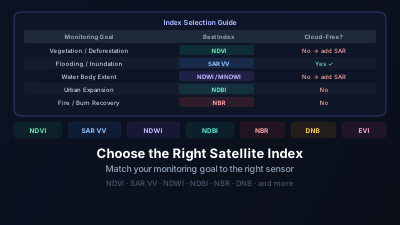
Quick Answer: The best satellite index depends on what you want to detect. NDVI is best for vegetation health and deforestation. SAR VV is best for flooding and urban change — it works through clouds. NDWI and MNDWI detect surface water extent. NDBI tracks urban expansion. NBR monitors fire damage and recovery. DNB from VIIRS tracks economic activity at night. If cloud cover is a concern in your region, always pair an optical index with SAR — optical gives higher quality when skies are clear, SAR fills gaps through clouds.
Start with Your Monitoring Goal
The right satellite index is the one most sensitive to the specific change you need to detect. For the bigger picture, see the Satellite Area Monitoring overview. Before selecting an index, answer two questions:
- What are you monitoring for? (vegetation health, flooding, urban growth, fire, economic activity, etc.)
- Does cloud cover affect your target region? (if yes, you need SAR or a cloud-independent source)
The tables and decision paths below map these answers to specific indices and satellite sources.
Vegetation and Land Cover
NDVI — The Default for Vegetation Health
Normalized Difference Vegetation Index is the starting point for almost all vegetation monitoring. It responds to chlorophyll density in green leaves.
Use NDVI when:
- Monitoring overall forest or grassland health
- Tracking crop growth cycles and harvest timing
- Detecting deforestation or large-scale vegetation loss
- Comparing vegetation condition across seasons and years
NDVI limitations:
- Saturates in very dense canopies (tropical forest, dense crops at peak)
- Affected by soil brightness in sparse vegetation
- Cloud cover creates gaps in Sentinel-2 time series
Best paired with: SAR VV (for cloud-independent backup and structural change detection)
EVI — When NDVI Saturates
Enhanced Vegetation Index is more sensitive in high-biomass environments where NDVI plateaus at ~0.8.
Use EVI when:
- Monitoring tropical or subtropical forests where NDVI frequently saturates
- Distinguishing between moderately dense and very dense vegetation
- Tracking fine-grained canopy changes in high-biomass areas
SAVI — Sparse and Dryland Vegetation
Soil-Adjusted Vegetation Index reduces the influence of bare soil on vegetation estimates.
Use SAVI when:
- Monitoring semi-arid or arid landscapes where bare soil is visible between plants
- Tracking rangeland health, savanna, or sparse crop cover
- Areas where NDVI appears artificially high due to bright soil reflectance
NBR — Fire and Burn Severity
Normalized Burn Ratio uses near-infrared and shortwave-infrared bands to measure fire impact.
Use NBR when:
- Monitoring areas where wildfires are a risk
- Tracking vegetation recovery (regrowth) after fire events
- Mapping burn severity across a recently burned area
An NBR time series shows the pre-fire baseline, the abrupt drop at fire occurrence, and the gradual recovery curve — which may take 1–5 years depending on ecosystem type.
Water and Floods
NDWI — Open Water Detection
Normalized Difference Water Index is the most direct measure of surface water extent using optical bands.
Use NDWI when:
- Tracking lake, reservoir, or wetland water levels
- Monitoring seasonal flooding in rice paddies or floodplains
- Detecting drought-driven shrinkage of water bodies
Cloud limitation: Sentinel-2 NDWI cannot see through clouds — which often coincide with the flooding events you want to detect. Pair with SAR VV for continuous monitoring.
MNDWI — Better Near Urban Areas
Modified NDWI replaces the NIR band with SWIR, suppressing the bright-building signal in urban environments.
Use MNDWI when:
- Monitoring water bodies near cities or dense infrastructure
- Mapping urban flood inundation extent
- Tracking canals, rivers, and drainage systems in developed areas
SAR VV — All-Weather Flood Detection
Sentinel-1 SAR VV backscatter is the only cloud-independent flood indicator.
Use SAR VV when:
- You need to detect floods during or immediately after storms (clouds will block optical)
- Monitoring areas with frequent cloud cover (tropics, maritime climates)
- You need a continuous, gap-free flood monitoring record
A sudden drop in SAR VV indicates open water inundation; SAR VH or the cross-ratio (CR = VH/VV) additionally detects flooded vegetation.
Urban and Infrastructure
NDBI — Urban Expansion
Normalized Difference Built-Up Index increases as vegetation is replaced by impervious surfaces (buildings, roads, pavement).
Use NDBI when:
- Monitoring urban sprawl and city growth
- Tracking new construction replacing agricultural or natural land
- Measuring urban heat island risk areas
SAR VV (Urban) — Construction and Structural Change
SAR VV is also sensitive to urban structure changes independent of vegetation:
Use SAR VV for urban monitoring when:
- Monitoring active construction sites (backscatter increases as buildings rise)
- Detecting building damage or collapse (backscatter changes abruptly)
- Cloud-independent monitoring of industrial facilities and infrastructure
DNB — Economic Activity at Night
VIIRS Day/Night Band radiance tracks artificial light.
Use DNB when:
- Monitoring economic development and industrial activity
- Tracking power outages during or after disasters
- Monitoring conflict-affected areas for population displacement
- Assessing post-disaster recovery speed (power restoration)
Geology and Minerals
Iron Oxide, Clay, Ferrous Indices — Sentinel-2
Sentinel-2's SWIR bands enable geological mineral mapping.
Use geological indices when:
- Monitoring mining sites for exposure of different rock types
- Mapping alteration zones in exploration contexts
- Tracking waste rock and tailings in extractive industry monitoring
Choosing Between Optical and SAR
The most important single factor in index selection is cloud cover frequency in your target region:
| Region Type | Recommendation |
|---|---|
| Arid / semi-arid (low cloud cover) | Optical (NDVI, NDWI, NDBI) — excellent temporal coverage |
| Temperate with seasonal cloud | Optical as primary + SAR as cloud-gap filler |
| Tropical (persistent cloud cover) | SAR as primary; optical when available |
| Maritime / monsoon climate | SAR primary; optical for seasonal snapshots |
Quick-Reference Decision Table
| Monitoring Goal | Best Index | Satellite | Cloud-Independent? |
|---|---|---|---|
| Deforestation / vegetation loss | NDVI | Sentinel-2 | No → add SAR VV |
| Drought and crop stress | NDVI + EVI | Sentinel-2 | No |
| Flooding | SAR VV | Sentinel-1 | Yes |
| Water body extent | NDWI / MNDWI | Sentinel-2 | No → add SAR VV |
| Wildfire recovery | NBR | Sentinel-2 | No |
| Urban expansion | NDBI | Sentinel-2 | No |
| Construction activity | SAR VV | Sentinel-1 | Yes |
| Economic activity | DNB | VIIRS | No (moonlight) |
| Forest degradation | NDVI + RFDI | Sentinel-2 + Sentinel-1 | RFDI is cloud-free |
| Maritime vessel activity | Ship detection | Sentinel-1 | Yes |
| Snow and ice extent | NDSI | Sentinel-2 | No |
| Mineral mapping | Iron Oxide / Clay | Sentinel-2 | No |
| Soil moisture proxy | NDMI | Sentinel-2 | No |
When to Use Multiple Indices
The single best improvement to any monitoring setup is to add a second index from a different sensor. The most valuable combinations:
- NDVI + SAR VV: Full ecosystem monitoring — optical quality when clear, radar coverage through clouds
- NDWI + SAR VV: Flood monitoring — water surface detection with all-weather backup
- NDVI + NDBI: Land cover transition monitoring — vegetation loss and urban gain simultaneously
- NDVI + DNB: Environmental change plus human activity — deforestation and economic effects together
Each additional index takes seconds to add and requires no additional analysis effort — the system automatically fetches and plots all indices from every overpass.
Summary
The right satellite index is the one that changes most sensitively and specifically in response to what you want to monitor. NDVI is the default for vegetation, but it has cloud limitations and no structural sensitivity. SAR VV is cloud-independent and responds to surface structure. Water indices (NDWI/MNDWI) track open water but benefit from SAR backup. For most real-world monitoring applications, a two-index setup (optical + SAR) provides substantially more diagnostic value than any single index alone.
To explore index combinations for your specific monitoring area, open the Monitoring Dashboard and add multiple indices to your polygon. For more background on each index, see Vegetation Index Time Series Monitoring, Flood Monitoring with SAR, and Multi-Index Satellite Monitoring.

Remote sensing specialist with 10+ years in satellite data processing and AI. Founder of Off-Nadir Lab. Ph.D. in Informatics (Yokohama National University, 2026). Master's in Earth System Science and Technology (Kyushu University). Co-author, Remote Sensing Encyclopedia. More about the author →