
Vegetation Index Time Series Monitoring with Sentinel-2
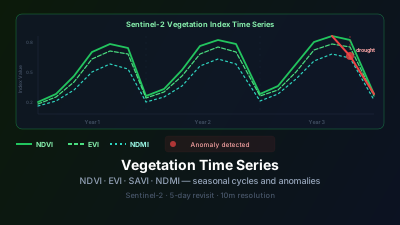
Quick Answer: Vegetation index time series uses repeated Sentinel-2 measurements to reveal how plant cover changes over time. NDVI tracks overall greenness; EVI handles dense canopy better; SAVI reduces bare soil interference. A healthy forest shows a stable seasonal curve; deforestation shows as an abrupt permanent drop; drought shows as a suppressed peak. Monitor any area by drawing a polygon and selecting one or more indices — the system automatically plots all available scenes.
From Snapshot to Story: Why Time Series Matters
A single Sentinel-2 NDVI image shows you the vegetation state on one particular day. That is useful — but it is like reading a single sentence from a book. The full story only emerges when you read the whole chapter.
Vegetation index time series converts repeated satellite observations into a continuous narrative about how plant cover evolves over days, months, and years. The same methods used to track Amazon deforestation from space can be applied to a single forest patch, agricultural field, or urban park — at 10-meter resolution, updated every five days.
The Main Vegetation Indices
NDVI — The Foundation
Normalized Difference Vegetation Index is calculated from the difference between near-infrared (NIR) and red reflectance:
NDVI = (NIR − Red) / (NIR + Red)
Green leaves absorb red light for photosynthesis and reflect NIR strongly. This makes NDVI the most direct measure of active photosynthesis from space.
Value interpretation:
| NDVI Range | Typical Cover |
|---|---|
| < 0 | Water, snow, bare rock |
| 0.0 – 0.2 | Bare soil, sand, sparse dry vegetation |
| 0.2 – 0.4 | Sparse or stressed vegetation, dry grassland |
| 0.4 – 0.6 | Moderate vegetation, pasture, shrubs |
| 0.6 – 0.8 | Dense healthy vegetation |
| > 0.8 | Dense tropical forest, peak crop canopy |
Known limitations: NDVI saturates above ~0.8, meaning you cannot distinguish a moderately dense forest from a very dense one. This is where EVI helps.
EVI — Enhanced Sensitivity in Dense Vegetation
Enhanced Vegetation Index adds corrections for atmospheric aerosols and canopy background:
EVI = 2.5 × (NIR − Red) / (NIR + 6×Red − 7.5×Blue + 1)
EVI remains sensitive in high-biomass regions where NDVI saturates and is less affected by atmospheric scattering. It is particularly valuable for:
- Tropical rainforest monitoring
- High-density crop canopies at peak growth
- Areas with frequent aerosol loading (dust, smoke)
SAVI — Soil-Adjusted Vegetation
In sparse vegetation environments, bare soil reflectance contributes substantially to the NDVI signal. Soil-Adjusted Vegetation Index incorporates a soil brightness correction factor L:
SAVI = ((NIR − Red) / (NIR + Red + L)) × (1 + L)
Where L = 0.5 for typical intermediate vegetation cover. SAVI is preferred in:
- Semi-arid grasslands and savannas
- Agricultural fields at early growth stages
- Dryland regions with high soil visibility
NDMI — Moisture Stress Detection
Normalized Difference Moisture Index uses SWIR instead of red:
NDMI = (NIR − SWIR) / (NIR + SWIR)
NDMI responds to water content within the vegetation canopy. It drops before NDVI during drought stress, making it an early warning indicator for water stress — useful for irrigation management and drought monitoring.
NBR — Post-Fire Assessment
Normalized Burn Ratio combines NIR and SWIR:
NBR = (NIR − SWIR) / (NIR + SWIR)
Healthy vegetation has high NIR and low SWIR reflectance, giving high NBR values. Burned areas have low NIR and high SWIR, giving low or negative NBR. Tracking NBR over time after a fire shows the rate of post-fire vegetation recovery.
Choosing the Right Index
| Index | Best For | Saturates? | Cloud Sensitive? | Key Advantage |
|---|---|---|---|---|
| NDVI | General vegetation health, deforestation | At LAI > 3–4 (NDVI > 0.8) | Yes | Most data available; broad ecosystem support |
| EVI | Dense tropical/subtropical canopy | No (effective to LAI ~8) | Yes | Better sensitivity in high-biomass areas |
| SAVI | Sparse vegetation, semi-arid | Similar to NDVI | Yes | Reduces bare soil bias in dry conditions |
| NDMI | Vegetation moisture / drought early warning | No | Yes | Detects water stress before NDVI declines |
| NBR | Post-fire damage and recovery tracking | No | Yes | Most fire-specific index; SWIR-based |
| RVI (SAR) | Forest canopy density, all-weather | No | No | Works through clouds; structural sensitivity |
When monitoring through persistent cloud cover (tropics, monsoon regions), pair any optical index with SAR RVI — they respond to different aspects of vegetation but together fill each other's gaps.
Characteristic Time Series Patterns
Understanding what "normal" looks like for each vegetation type is essential for anomaly detection.
Temperate Deciduous Forest
- Strong annual cycle: low in winter (leaf-off), peak in summer (full canopy)
- Consistent year-over-year peaks indicate a healthy forest
- A permanently lowered baseline after a peak suggests partial clearing or die-back
Tropical Evergreen Forest
- Relatively flat NDVI around 0.7–0.9 year-round
- Short-term drops are often cloud contamination or dry season stress
- A sustained drop below baseline that does not recover is a deforestation signal
Annual Cropland
- Rapid rise and fall within a 3–4 month growing season
- Multiple peaks per year indicate double-cropping
- A missing peak in an otherwise regular cycle may signal crop failure, fallow, or land use change
Perennial Grassland
- Low-amplitude annual cycle following precipitation
- Responds quickly to rainfall events (days-level response)
- Useful for pasture productivity and livestock carrying capacity estimation
Urban Green Space
- Relatively stable low-level NDVI
- Seasonal variation depends on tree species (deciduous vs. evergreen)
- A step decline may indicate clearing for construction
What Anomalies Look Like
The following patterns in a vegetation time series typically signal significant events:
Abrupt permanent drop: Deforestation, mining, urban development, or deliberate clearing. The key feature is that the index stays low after the drop — there is no recovery.
Abrupt drop with recovery: Fire, extreme drought, severe pest outbreak, or flood. If NBR drops sharply and then NDVI gradually recovers over months, this is consistent with post-fire regrowth.
Gradual multi-year decline: Chronic stress from groundwater depletion, progressive deforestation, or long-term drought. These slow changes are nearly invisible in single-image analysis.
Suppressed seasonal peak: A peak that should reach 0.7 only reaching 0.5 may indicate drought, nutrient stress, or reduced planting area.
Seasonal phase shift: An earlier or later green-up date year over year can indicate climate-driven phenological change.
Practical Monitoring Workflow
Setting Up a Vegetation Monitor
- Navigate to your area of interest on the map
- Open the Monitoring panel and click + New Monitor
- Draw a polygon over your target area (or upload a GeoJSON file)
- Select one or more Sentinel-2 indices: NDVI, EVI, SAVI, NDMI, NDWI, NBR
- Set a start date (12–24 months back for seasonal analysis; 3–5 years for trend analysis)
- Confirm the token estimate and start the analysis
Selecting Multiple Indices Simultaneously
Registering NDVI, EVI, and NDMI together for the same polygon allows you to:
- Cross-check whether a drop is real (all three should move together)
- Detect moisture stress early (NDMI drops before NDVI during drought onset)
- Capture both canopy structure (EVI) and plant health (NDVI)
Using SAR to Fill Cloud Gaps
In tropical or frequently cloudy regions, Sentinel-2 NDVI time series can have multi-week gaps. Pairing with Sentinel-1 RVI (Radar Vegetation Index) or VV/VH intensity from the same polygon fills these gaps — SAR sees through clouds.
The patterns will not be identical (radar measures structure, optical measures photosynthetic activity), but having SAR data during cloudy periods confirms whether a change seen in the optical data when clouds clear is real or a cloud artifact.
Interpreting Confidence and Data Quality
Not all points in a vegetation time series are equal. Factors affecting data quality include:
Cloud contamination — Even with cloud masking, thin cirrus or cloud edges can suppress apparent NDVI. Points with low quality flags should be treated cautiously.
Shadow effects — Mountain shadows and cloud shadows can create false NDVI dips, particularly at high latitudes in winter.
Phenological noise — In agricultural regions, neighboring fields with different crop calendars can contaminate a polygon's average if the polygon boundary overlaps multiple land use types.
Sensor calibration — Long time series crossing the 2015–2017 Sentinel-2A-only to Sentinel-2A+2B transition may show small step changes in some indices due to inter-calibration differences.
Summary
Vegetation index time series with Sentinel-2 is one of the most information-rich and accessible forms of remote sensing monitoring. NDVI, EVI, SAVI, NDMI, and NBR each capture a different aspect of plant condition, and tracking them continuously reveals seasonal rhythms, stress events, and long-term trends that are invisible in any single image. The key to effective monitoring is knowing what a "normal" time series looks like for your vegetation type so that genuine anomalies stand out clearly.
Start monitoring your own area in the Monitoring Dashboard, or explore real-time NDVI visualization for an immediate view of vegetation health in any region.

Remote sensing specialist with 10+ years in satellite data processing and AI. Founder of Off-Nadir Lab. Ph.D. in Informatics (Yokohama National University, 2026). Master's in Earth System Science and Technology (Kyushu University). Co-author, Remote Sensing Encyclopedia. More about the author →