
SAR Backscatter Time Series: Detecting Change with All-Weather Radar
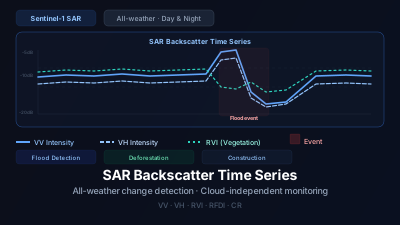
Quick Answer: SAR backscatter time series tracks radar reflectivity of the land surface over time, independent of clouds or sun angle. VV intensity is sensitive to surface roughness and large structures; VH responds more strongly to vegetation volume. Flooding shows as a sudden VV drop (water reflects away from sensor); deforestation shows as a VH decrease (loss of volume scatterers). RVI and RFDI further isolate vegetation change from other surface changes.
The All-Weather Advantage of SAR Time Series
Optical satellite monitoring has a fundamental constraint: clouds block the view. In tropical forests — where deforestation is most rapid — cloud cover can persist for weeks or months, leaving gaps exactly where continuous observation is most needed.
Synthetic Aperture Radar (SAR) transmits its own microwave pulses and measures what reflects back, making it completely independent of sunlight and cloud cover. A Sentinel-1 SAR time series provides observations every 6–12 days regardless of weather, giving you the most temporally complete picture of surface change.
How SAR Backscatter Works
SAR transmits microwaves in the C-Band (5.405 GHz, ~5.6 cm wavelength) and records the amplitude of the signal that returns to the sensor. This return — called backscatter — depends on:
- Surface roughness relative to the wavelength
- Dielectric properties (water content affects electrical response)
- Geometry of the scattering surface
- Vegetation structure (volume vs. surface scattering)
Unlike optical sensors that measure reflected sunlight, SAR literally measures how the land surface interacts with a microwave pulse — which is why it responds differently to water, bare soil, crops, forests, and buildings.
The Key SAR Indices for Monitoring
VV Intensity
VV (vertical transmit, vertical receive) backscatter is most sensitive to:
- Large flat surfaces — Roads, runways, calm water
- Urban structures — Buildings create strong double-bounce returns
- Surface roughness — Rough soil or crop residue scatter more than smooth bare soil
- Moisture — Wet soil has higher dielectric constant → stronger backscatter
Monitoring applications:
- Flood mapping (water reflects away → sudden VV drop)
- Construction tracking (new buildings → VV increase)
- Soil moisture estimation
VH Intensity
VH (vertical transmit, horizontal receive) measures cross-polarized backscatter, which requires volume scattering — the signal must bounce multiple times within a volume (like a forest canopy) before returning with changed polarization.
VH is sensitive to:
- Vegetation volume — Dense canopies produce strong VH
- Surface roughness at smaller scales
- Penetration depth into vegetation
Monitoring applications:
- Deforestation detection (VH drops as canopy is removed)
- Crop biomass estimation (VH grows as crops develop)
- Forest degradation before complete clearing
RVI — Radar Vegetation Index
Radar Vegetation Index isolates the vegetation signal from combined polarization measurements:
RVI = (4 × VH) / (VV + VH)
RVI ranges from 0 (bare surface) to 1 (dense random-volume vegetation). It is less sensitive to surface moisture than VV alone and provides a cleaner vegetation signal.
Key properties:
- Increases as vegetation density grows
- Decreases with canopy loss, drought stress, or harvest
- More robust to soil moisture variation than raw VH
RFDI — Radar Forest Degradation Index
Radar Forest Degradation Index is designed specifically for forest monitoring:
RFDI = (VV − VH) / (VV + VH)
In undisturbed forest, VH is relatively high (volume scattering dominates) → RFDI is low. When forest is degraded or selectively logged, VH decreases relative to VV → RFDI increases.
RFDI is particularly sensitive to partial degradation — the kind of damage from selective logging or illegal logging that does not show as complete clearing but still represents significant ecological impact.
CR — Cross Ratio
Cross Ratio is simply:
CR = VH / VV
High CR indicates volume scattering dominance (vegetation). Low CR indicates surface scattering dominance (water, bare soil). CR is useful for:
- Distinguishing flooded vegetation from open water (flooded vegetation has higher CR than open water)
- Monitoring crop development stages
Characteristic SAR Time Series Patterns
Open Water and Flooding
Water bodies have extremely low SAR backscatter — calm water acts like a mirror and reflects the radar pulse away from the sensor (specular reflection). This makes floods highly visible in SAR data.
Flood event signature:
- Sudden drop in VV intensity by 5–10 dB
- Often visible within one Sentinel-1 overpass (~6 days)
- CR increases for flooded vegetation (double-bounce through standing water)
Dense Forest
Undisturbed forest shows relatively stable, high VH and moderate VV:
- VH is high due to volume scattering from the canopy
- Year-to-year variation is low (unlike optical NDVI which has seasonal cycles)
- Sudden drops signal clearing events
Agricultural Fields
Crops show strong seasonal patterns in SAR:
- After harvest/tillage: low VV and VH (smooth bare soil)
- Early growth: gradual VH increase
- Peak canopy: high VH, moderate VV
- Senescence/harvest: rapid drop in both
The exact timing and magnitude differ by crop type, making multi-year SAR time series useful for crop type mapping.
Urban Environments
Urban areas show high and stable VV backscatter from buildings (double-bounce between vertical walls and the ground). New construction appears as a step increase; demolition as a step decrease.
Comparing SAR and Optical Monitoring
| Aspect | SAR (Sentinel-1) | Optical (Sentinel-2) |
|---|---|---|
| Cloud penetration | Yes | No |
| Night observation | Yes | No |
| Vegetation sensitivity | Volume structure | Photosynthesis (color) |
| Flood detection | Excellent | Limited (clouds during floods) |
| Crop type discrimination | Moderate | Good |
| Seasonal cycle visibility | Moderate | Strong |
| Fire/burn detection | Limited | Excellent (NBR) |
SAR and optical are complementary, not competitive. The most powerful monitoring systems use both.
Setting Up SAR Monitoring
For a comprehensive SAR monitoring workflow:
- Select VV + VH + RVI for a vegetation zone — this gives you both raw backscatter and a cleaner vegetation signal
- Add RFDI for forest areas where you suspect gradual degradation
- Use SAR alongside NDVI — when Sentinel-2 has cloud gaps, SAR fills in
- Set a start date 12+ months back to capture at least one full seasonal cycle for agricultural areas
Interpreting Anomalies in SAR Time Series
Unlike optical NDVI, SAR anomalies require understanding the direction of change:
| Change | VV | VH | RVI | Likely Cause |
|---|---|---|---|---|
| Drop | Low | Low | Low | Clearing, harvest, flood |
| Rise | High | — | — | Construction, soil wetting |
| VH drop, VV stable | — | Low | Low | Canopy loss (selective logging) |
| Both drop sharply | Low | Low | Low | Major flood or complete clearing |
| VH rise over season | — | High | High | Crop growing season |
Handling SAR Noise
SAR images contain inherent speckle noise — a grainy texture caused by coherent interference of radar waves from many small scatterers. This noise creates scatter around the true time series trend.
Time series analysis helps because:
- Multiple observations let you see the trend through the noise
- Averaging over a polygon area reduces single-pixel noise
- Statistical anomaly detection distinguishes real events from noise fluctuations
Summary
SAR backscatter time series provides an all-weather, day-and-night monitoring capability that optical sensors cannot match. VV intensity detects surface changes including flooding and construction; VH and RVI track vegetation volume and growth; RFDI isolates forest degradation. Understanding the expected "signature" of different land cover types in SAR time series is the key to correctly interpreting anomalies — combining SAR with optical NDVI gives the most complete and cloud-resilient monitoring system available from open satellite data.
Set up automated SAR time series monitoring for any region using the Monitoring Dashboard. To browse individual Sentinel-1 scenes, use the Sentinel-1 SAR Viewer.

Remote sensing specialist with 10+ years in satellite data processing and AI. Founder of Off-Nadir Lab. Ph.D. in Informatics (Yokohama National University, 2026). Master's in Earth System Science and Technology (Kyushu University). Co-author, Remote Sensing Encyclopedia. More about the author →