Multi-Index Satellite Monitoring: Why One Sensor Is Never Enough
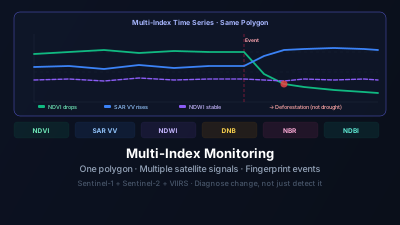
Quick Answer: Single-index monitoring has blind spots. NDVI drops during drought, harvest, and deforestation — but cannot tell them apart. Adding SAR VV (which drops during flooding but stays stable during harvest) and NDWI (which rises during inundation) gives you triangulation. Multi-index monitoring tracks multiple satellite signals over the same polygon simultaneously — different sensors respond to different physical processes, so combining them lets you distinguish cause from effect and catch events that any single index would miss.
Why isn't a single satellite index enough?
A single satellite index isn't enough because one number can have many causes. An NDVI drop over a forest could be deforestation, drought, a recent wildfire, or just cloud-shadow contamination — the index alone can't tell them apart. Adding indices that respond to different physical processes lets you triangulate the real cause. Imagine you are monitoring a tropical forest using NDVI. In August, you notice a sharp NDVI drop. Is it:
- Deforestation?
- A severe drought?
- A wildfire that happened last week?
- Unusual cloud shadow contamination in the optical data?
A single NDVI time series cannot answer that question. The same number — say, NDVI falling from 0.75 to 0.42 — could result from any of these causes. Without additional information, you are guessing.
Multi-index monitoring solves this by tracking multiple satellite signals for the same area simultaneously. Each index is sensitive to different physical properties. By examining how multiple indices change together (or don't), you can distinguish and diagnose change events with far greater confidence. (New to the topic? Start with the Satellite Area Monitoring overview.)
How do different indices respond to the same event?
Different indices respond to the same event in different directions because each senses a distinct physical property — greenness, surface roughness, water content, or emitted light. Deforestation drops NDVI but nudges SAR VV up; flooding drops SAR VV while NDWI spikes. Those contrasting fingerprints are what make an event identifiable:
| Event | NDVI | SAR VV | NDWI | DNB |
|---|---|---|---|---|
| Deforestation | Sharp drop | Slight increase (surface exposed) | No change | No change |
| Flooding | Moderate drop (vegetation stressed) | Sharp drop (smooth water) | Sharp rise | May drop if power lost |
| Drought | Gradual decline | Slight decrease (dry soil) | Decline | No change |
| Wildfire | Sharp drop | Decrease then increase (charred surface) | No change | Possible spike (fire glow) |
| Harvest | Moderate drop (seasonal) | Decrease (bare field) | No change | No change |
| Urban expansion | Permanent decline | Increase (buildings scatter) | No change | Permanent increase |
| Tropical storm | Temporary decline (wind damage) | Variable | Increase (flooding) | Sharp drop (power outage) |
This table shows why multi-index monitoring is so powerful: each event has a unique fingerprint across different satellite channels. Some events that look identical in NDVI become unmistakable when you add SAR VV and NDWI.
Deforestation vs Drought: A Classic Ambiguity
Both deforestation and drought cause NDVI to fall. But they behave differently in SAR:
- Deforestation removes the canopy, exposing bare soil or early regrowth. SAR VV typically increases or stays flat (rougher exposed surface scatters more). NDWI changes minimally.
- Drought stresses vegetation while it is still present. SAR VV shows a small decrease (drier soil, reduced canopy moisture). NDWI also declines gradually as vegetation water content drops.
When you see NDVI fall and SAR VV rise — that combination strongly suggests clearance, not drought. When both indices fall gradually together, drought is more likely.
Flooding vs Harvest: Another Common Confusion
In agricultural areas, both flooding and harvest cause sharp NDVI drops at similar timing (late growing season). But SAR tells them apart clearly:
- Flood: SAR VV drops sharply (smooth water surface). NDWI rises sharply. Both happen together.
- Harvest: SAR VV decreases moderately (bare field). NDWI unchanged. Timing matches known crop calendar.
Practical Example: Monitoring a Forest Edge
Consider a polygon over a forested area adjacent to an expanding agricultural frontier. You configure four indices:
- NDVI (Sentinel-2) — vegetation health
- SAR VV (Sentinel-1) — surface structure, cloud-independent
- NDWI (Sentinel-2) — moisture and water
- DNB (VIIRS) — nighttime lights
Over three years of monitoring, the time series reveals:
- NDVI slowly declining at the edges — gradual degradation
- SAR VV increasing in patches — clearance activity
- NDWI stable — no flood events
- DNB increasing — more lighting from agricultural operations at night
Each signal independently confirms that forest is being converted to agriculture. No single index tells the complete story, but together they make the diagnosis unambiguous.
Which Index Combinations Work Best?
The right pairing depends on what you're watching for; choosing indices for the job is the same skill whether you run one index or four. Some combinations that work well:
Environmental and Ecological Monitoring
| Goal | Primary | Secondary | Why |
|---|---|---|---|
| Deforestation | NDVI | SAR VV | Optical quality + cloud backup |
| Drought | NDVI | NDMI or EVI | Moisture-sensitive indices |
| Wildfire | NBR | NDVI | NBR most sensitive to burn severity |
| Wetland change | NDWI | SAR VV | Water surface + radar all-weather |
Agriculture
| Goal | Primary | Secondary | Why |
|---|---|---|---|
| Crop phenology | NDVI | EVI | Both track green-up and senescence |
| Irrigation | NDWI | NDMI | Water surface + vegetation moisture |
| Flood risk | SAR VV | NDWI | Cloud-independent flood detection |
Urban and Infrastructure
| Goal | Primary | Secondary | Why |
|---|---|---|---|
| Urbanization | NDBI | DNB | Built-up expansion + light growth |
| Construction site | SAR VV | NDVI | Surface change + vegetation loss |
| Post-disaster recovery | NDVI | DNB | Vegetation regrowth + power restoration |
Setting Up Multi-Index Monitoring
In the Monitoring Dashboard, each polygon can have multiple indices assigned to it. The steps are:
- Draw your polygon over the area of interest
- Add the first index (e.g., Sentinel-2 → NDVI)
- Use the "Add Index" option to add a second index (e.g., Sentinel-1 → VV)
- Repeat for additional indices (NDWI, DNB, etc.)
- All indices share the same polygon and analysis date range
- The dashboard displays a unified multi-series graph with color-coded lines
Each index is independently fetched and computed. Cloud-masked optical data and always-available SAR data fill in each other's gaps — the combined time series has fewer holes than either alone.
How do you read a multi-series graph?
To read a multi-series graph, watch how the lines move relative to one another rather than any single curve. Correlated drops across several indices flag a high-confidence event; diverging signals point to clearance or structural change; a SAR change with no optical response usually means cloud hid the optical overpass. The patterns:
- Correlated drops (multiple indices falling together): high-confidence event
- Diverging signals (NDVI falls, SAR rises): likely clearance or structural change
- SAR changes without optical changes: likely cloud obscured the optical overpass during the event
- Optical without SAR change: likely mild surface change (crop stress) without major structural change
Anomaly detection runs independently on each index. If both NDVI and SAR VV trigger anomalies on the same date — that date warrants immediate investigation.
Interpreting When Indices Disagree
Index disagreement is information, not noise. When SAR and optical diverge:
- SAR drops, NDVI unchanged: Flooding just started; optical overpass hasn't occurred yet (clouds or scheduling)
- NDVI drops, SAR unchanged: Drought stress or senescence — no structural change
- Both drop simultaneously: Major disturbance event (fire, heavy flood, clearance)
- SAR spikes, NDVI drops: Urban construction replacing vegetation
Learn to treat multi-index disagreement as a diagnostic clue, not a data quality problem.
Summary
Any single satellite index is a partial view of reality. Physical events leave fingerprints across multiple data streams: flooding is visible in SAR VV and NDWI simultaneously; deforestation appears in NDVI and SAR in opposite directions; drought depresses optical vegetation indices while barely affecting radar.
Monitoring multiple indices for the same area takes only a few seconds to configure and requires no additional effort to maintain — the system automatically collects and plots all configured indices from every available satellite overpass. Pairing indices this way is also what makes automated change detection reliable rather than noisy.
To configure multi-index monitoring for your area, open the Monitoring Dashboard and add your first polygon. Then use the Add Index button to layer SAR, NDWI, or nighttime lights on top of your NDVI baseline.
For deeper context on each index, see Vegetation Index Time Series Monitoring, SAR Backscatter Time Series, and Monitoring Water Surfaces with NDWI.

Remote sensing specialist with 10+ years in satellite data processing and AI. Founder of Off-Nadir Lab. Ph.D. in Informatics (Yokohama National University, 2026). Master's in Earth System Science and Technology (Kyushu University). Co-author, Remote Sensing Encyclopedia. More about the author →