
Monitoring Water Surface Changes with NDWI and MNDWI Time Series
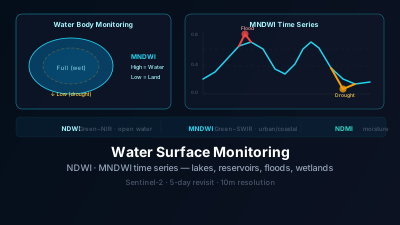
Quick Answer: NDWI (Green−NIR)/(Green+NIR) and MNDWI (Green−SWIR)/(Green+SWIR) measure the presence of open water in satellite imagery. Monitoring these indices over a polygon covering a lake, reservoir, or floodplain reveals seasonal water level cycles, drought-driven drawdown, and flooding events. MNDWI is more accurate near urban areas and coasts where soil and vegetation signals contaminate NDWI.
Water from Space: Why Index Monitoring Matters
Water bodies are among the most dynamic features on Earth's surface. Lakes rise and fall with seasons and droughts. Reservoirs fill and drain with demand and precipitation. Floodplains inundate and recede with storms and snowmelt. Wetlands expand in wet years and contract in dry ones.
Tracking all this variability with traditional field measurements is expensive and geographically limited. Satellite-based water indices provide continuous, area-wide monitoring at costs that are orders of magnitude lower than in-situ networks.
NDWI vs. MNDWI: Choosing the Right Index
NDWI — Normalized Difference Water Index
The original water index uses green and NIR bands:
NDWI = (Green − NIR) / (Green + NIR)
Water has high reflectance in green wavelengths and absorbs NIR strongly, so water bodies typically show NDWI > 0 while vegetation (high NIR reflectance) shows NDWI < 0.
Value interpretation:
| NDWI | Typical Surface |
|---|---|
| > 0.3 | Open water |
| 0.0 – 0.3 | Mixed/moist surface |
| < 0 | Vegetation, bare soil |
Limitation: In urban areas, buildings and roads can have positive NDWI values that contaminate water detection. Near vegetation-fringed water bodies, the vegetation signal may suppress NDWI.
MNDWI — Modified NDWI
MNDWI replaces NIR with SWIR (short-wave infrared):
MNDWI = (Green − SWIR) / (Green + SWIR)
SWIR is even more strongly absorbed by water than NIR, and SWIR reflectance from built-up areas is high (building materials reflect strongly in SWIR). This means:
- Water shows even more strongly positive MNDWI
- Built-up surfaces show strongly negative MNDWI
- Vegetation is also negative
MNDWI is preferred when:
- Monitoring urban water bodies surrounded by buildings
- Coastal monitoring where saltmarsh and tidal flats are present
- Areas with mixed land use near the water body
For simple open-water lake monitoring in rural areas, NDWI and MNDWI typically give similar results.
NDMI — Vegetation Moisture Index
While not strictly a water index, NDMI (Normalized Difference Moisture Index) measures water content in vegetation canopies:
NDMI = (NIR − SWIR) / (NIR + SWIR)
NDMI drops before NDVI during drought stress because leaf water content decreases before photosynthetic activity slows. For drought early warning monitoring, NDMI is often more sensitive than NDVI.
What Water Index Time Series Reveals
Reservoir Storage Levels
Draw a polygon over a reservoir and monitor MNDWI over time. As water levels drop, exposed shores and mudflats appear within the polygon — lowering the average MNDWI value. This gives you a proxy for reservoir storage level.
Comparing year-to-year MNDWI seasonal cycles reveals:
- Whether drought years show earlier drawdown
- Whether downstream water use is increasing
- Whether the filling pattern after monsoon or snowmelt is changing
Important caveat: MNDWI measures water surface area within the polygon, not volume. For reservoirs with sloped sides, smaller surface area means much less volume — the relationship is non-linear and site-specific.
Flood Extent Mapping
During and after major flooding events, NDWI/MNDWI spikes sharply upward as floodwaters cover normally dry land. The time series shows:
- Pre-flood baseline (normal dry-land values)
- Flood peak (high NDWI/MNDWI across the polygon)
- Recession (gradual return to baseline over days to weeks)
The rate of recession indicates drainage speed, which is relevant for agricultural loss assessment (crops flooded for longer suffer more damage) and disaster response planning.
Wetland Dynamics
Seasonal wetlands — marshes, playas, and ephemeral lakes — show strong NDWI/MNDWI cycles tied to precipitation. Monitoring these systems reveals:
- Whether wet season flooding extent is increasing or decreasing
- The duration of inundation within annual cycles
- Long-term drying trends associated with climate change or upstream diversions
Coastal and Tidal Zones
Tidal flats are alternately exposed and inundated twice daily, making single-image assessment highly dependent on tidal timing. Time series monitoring averages over many tidal states to reveal the mean intertidal zone and detect long-term changes from sea level rise, sediment dynamics, or land reclamation.
Practical Monitoring Setup
For Lake or Reservoir Monitoring
Draw your polygon to cover the entire water body including some buffer around the typical shoreline. This ensures that as water levels drop and the shoreline retreats, the exposed area remains within your polygon and suppresses the average MNDWI.
Set the start date to at least 12–24 months back to capture at least one full annual cycle.
For Flood Monitoring
For proactive flood monitoring, set up polygons over:
- Floodplains in flood-prone river basins
- Low-lying coastal areas
- Urban areas with known flooding history
Use SAR (CR or VV) monitoring alongside NDWI/MNDWI — SAR detects floods even during cloudy conditions that prevent optical satellite observation.
For Drought Monitoring
Combine:
- NDWI/MNDWI over the reservoir or lake to track storage
- NDMI over surrounding vegetation to track soil and plant moisture stress
- NDVI over agricultural areas to track crop condition
This multi-index approach gives a comprehensive picture of drought progression from water supply (reservoir) through soil moisture (NDMI) to plant stress (NDVI).
Interpreting Seasonal Patterns
Water index time series often show strong seasonal patterns that should not be confused with anomalies:
Monsoonal climates: Sharp NDWI rise during monsoon season followed by gradual drawdown. This is completely normal — the anomaly would be a smaller-than-normal monsoon peak.
Snowmelt-fed systems: Spring NDWI peak from snowmelt, followed by summer drawdown. Later or earlier peak timing reflects climate variation.
Semi-arid ephemeral lakes: These may be completely dry for most of the year with only brief inundation after major rainfall events. The time series shows long periods near zero with occasional spikes.
Cloud Contamination and Data Quality
Clouds over water bodies create a special challenge: clouds are also highly reflective, and poorly masked clouds can produce false high NDWI values. To check:
- Look at the true-color imagery for any data point with unexpectedly high NDWI
- Use SAR VV (which drops during actual flooding but is unaffected by cloud) as a cross-check
A sudden NDWI spike not matched by SAR VV drop is more likely cloud contamination than actual flooding.
Applications
Water resource management: Track reservoir storage trends for hydropower planning, irrigation water allocation, and municipal supply forecasting.
Flood disaster response: Detect flooding extent within days of an event and track inundation duration for damage assessment.
Wetland conservation: Monitor protected wetland extent over years, documenting whether conservation measures are working.
Climate change research: Track long-term changes in lake extent, wetland coverage, and seasonal water cycle timing.
Agriculture: Monitor irrigation canal and field flooding patterns for water use auditing.
Summary
NDWI and MNDWI time series monitoring provides continuous tracking of water surface extent for lakes, reservoirs, floodplains, and coastal wetlands. The time series reveals seasonal storage cycles, drought-driven drawdown, and flood events — changes that require months or years of data to distinguish normal variability from genuine long-term change. MNDWI is generally more accurate than NDWI near urban areas and coastlines, while NDMI provides complementary information on vegetation water stress. For flood monitoring specifically, pairing optical water indices with SAR ensures cloud-free detection even during the storm conditions that typically accompany floods.
Track water surface changes continuously with the Monitoring Dashboard, or for immediate flood extent mapping after an event, see SAR Flood Mapping.

Remote sensing specialist with 10+ years in satellite data processing and AI. Founder of Off-Nadir Lab. Ph.D. in Informatics (Yokohama National University, 2026). Master's in Earth System Science and Technology (Kyushu University). Co-author, Remote Sensing Encyclopedia. More about the author →