Forest Health Monitoring with NDVI and SAR Vegetation Indices
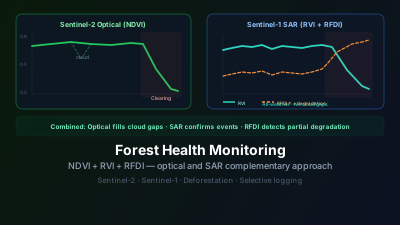
Quick Answer: Forest monitoring combines Sentinel-2 NDVI (photosynthetic activity) with Sentinel-1 RVI and RFDI (canopy structure and degradation). NDVI drops when leaves are absent or damaged; RVI drops when canopy volume decreases; RFDI increases when volume scattering is reduced relative to surface scattering (degradation signal). Using both optical and SAR fills cloud gaps and provides two independent change signals — a change visible in both systems is almost certainly real.
The Challenge of Forest Monitoring
Tropical forests — where deforestation rates are highest — are also among the cloudiest regions on Earth. Persistent cloud cover over the Amazon, Congo Basin, and Southeast Asian forests can prevent any usable optical satellite observations for weeks at a time. But deforestation does not pause for clouds.
A comprehensive forest monitoring system needs to:
- Detect clearing events rapidly (within days to weeks)
- See through clouds when necessary
- Distinguish complete clearing from selective logging or degradation
- Provide early warning of stress before visible damage occurs
No single satellite sensor achieves all four requirements. Combining Sentinel-2 optical data with Sentinel-1 SAR data comes close.
What Each Index Measures in Forest
NDVI (Sentinel-2) — Photosynthetic Activity
NDVI measures the fraction of absorbed photosynthetically active radiation — essentially, how actively the canopy is photosynthesizing. For forests:
- High stable NDVI (0.7–0.9) → Healthy closed-canopy forest
- Declining NDVI → Canopy thinning, leaf loss from drought or disease, or partial clearing
- Abrupt drop to low values → Complete clearing
- Slowly recovering NDVI → Regrowth after disturbance
The limitation: clouds. NDVI is useless on cloudy days, and many observations will be contaminated by cloud even after masking.
RVI — Radar Vegetation Index (Sentinel-1)
SAR RVI measures the ratio of cross-polarized to total backscatter:
RVI = (4 × VH) / (VV + VH)
In forest, multiple scattering through the canopy volume produces high VH backscatter → high RVI. When clearing removes the canopy:
- VH drops (no more volume scattering)
- VV may remain moderate (ground and edge scattering)
- RVI drops sharply
Key advantage over NDVI: Works through clouds. An RVI observation is available regardless of weather.
Key limitation: Does not distinguish healthy forest from very dense grassland or shrubland that also produces volume scattering. Context and baseline knowledge are important.
RFDI — Radar Forest Degradation Index (Sentinel-1)
RFDI is specifically designed to detect partial forest degradation — the selective logging, edge effects, and low-intensity disturbances that are invisible to complete-clearing detectors:
RFDI = (VV − VH) / (VV + VH)
In undisturbed dense forest: VH is high (volume scattering) → RFDI is low After selective logging or edge degradation: VH decreases, VV relatively stable → RFDI increases
This makes RFDI sensitive to:
- Selective logging that removes large trees without complete clearing
- Edge degradation around clearing perimeters
- Windthrow and storm damage that reduces canopy closure
- Progressive thinning before complete clearing
VV and VH Intensity
Raw backscatter values provide the underlying data for the derived indices. Monitoring VV and VH separately is useful for:
- Cross-checking index anomalies
- Detecting flooding under the forest canopy (CR increases significantly)
- Monitoring forest management activities (logging creates temporary high VV from slash piles)
The Multi-Index Approach
Setting up forest monitoring with multiple indices simultaneously gives you different "views" of the same ecosystem:
| Index | What It Detects | Cloud Impact |
|---|---|---|
| NDVI | Photosynthetic activity, leaf cover | Full (no observation in clouds) |
| RVI | Canopy volume, structure | None (all-weather) |
| RFDI | Degradation, partial disturbance | None (all-weather) |
Strategy: Use NDVI as the primary vegetation health indicator when cloud-free observations are available. Use RVI/RFDI to fill cloud gaps and confirm optical anomalies.
Confirmation logic:
- NDVI drop + RVI drop → Likely real vegetation loss
- NDVI drop + RVI stable → Possible cloud contamination or non-structural change
- RVI drop + NDVI cloudy → Real change probable; wait for next cloud-free observation to confirm
Characteristic Forest Monitoring Signatures
Complete Deforestation
Optical (NDVI): Sharp drop from ~0.7+ to <0.2, permanent SAR (RVI): Sharp drop from ~0.6 to <0.3, permanent SAR (RFDI): Moderate increase as VH drops
The combination of simultaneous NDVI and RVI drops is a very high-confidence deforestation signal.
Selective Logging
Optical (NDVI): Small to moderate drop, recovery over months as surrounding canopy grows in SAR (RVI): Moderate drop proportional to canopy removed SAR (RFDI): Clear increase — this index is most sensitive to partial disturbance
Selective logging often shows a clear RFDI signal before NDVI shows any significant change.
Drought Stress
Optical (NDVI): Suppressed values during dry season, more pronounced than historical average SAR (RVI): Minor change (canopy structure mostly intact, but may decrease slightly) SAR (RFDI): Slight increase if drought causes leaf drop or canopy thinning
Drought stress primarily shows in optical data; SAR is less sensitive to water stress without structural change.
Fire and Burn
Optical (NDVI): Sharp drop during/after fire, followed by gradual recovery SAR (VV/VH): Decrease after fire (canopy removed) then gradual increase as vegetation regrows Optical (NBR): Most sensitive fire damage indicator; monitor NBR + NDVI together
Post-Fire Recovery
One of the most ecologically important monitoring applications is tracking forest recovery after fire. NBR and NDVI together reveal:
- Rate of initial green-up from herbaceous regrowth
- Whether woody vegetation is recovering at expected rates
- Whether recovery stalls (indicating soil damage or repeat disturbance)
Setting up monitoring that starts 3–6 months before a known fire event and continues for 2–3 years afterward gives a full picture of disturbance and recovery dynamics.
Monitoring in Temperate vs. Tropical Forests
Temperate Deciduous Forest
Strong seasonal NDVI cycle (low in winter, high in summer) is normal. Forest health anomalies appear as:
- Suppressed summer peak
- Earlier-than-normal autumn NDVI decline
- Failure to reach expected summer NDVI levels
SAR time series in temperate deciduous forest also shows seasonal variation as leaf-on/leaf-off changes volume scattering.
Tropical Evergreen Forest
Relatively flat NDVI year-round at high values (~0.7–0.9). Anomalies are easier to detect because the stable baseline means any deviation is significant. SAR indices are also relatively stable, making change detection more straightforward.
Triaging Anomalies by Index Combination
Absolute index values are not portable: RVI and RFDI in particular depend on incidence angle, orbit, processing chain, and forest structure, so a threshold calibrated in one landscape will not transfer to another. What is portable is the combination of directions each index moves in. Use that to triage:
| What you observe | Likely cause | Alert priority |
|---|---|---|
| NDVI collapses, RVI collapses, RFDI rises sharply | Complete clearing | Critical |
| NDVI collapses with a burn signature (NBR drops hardest), SAR follows | Fire | Critical |
| NDVI barely moves, RFDI rises clearly, RVI drops moderately | Selective logging / partial degradation | Medium–High |
| NDVI suppressed, SAR essentially unchanged | Drought or leaf-level stress without structural loss | Low–Medium |
| NDVI and SAR both track a repeating annual pattern | Normal deciduous phenology | None (seasonal) |
| NDVI recovering slowly from a low, RFDI decaying back toward baseline | Regrowth after disturbance | Monitor |
| NDVI stable, VH rises, cross-ratio rises | Water under the canopy (flooded forest) | Identify cause |
Interpreting RFDI specifically: the value that matters is the departure from that polygon's own baseline, not any fixed number. A clear, sustained RFDI rise above the polygon's established range indicates a structural change in the canopy even when NDVI has barely moved — the diagnostic signature of selective logging, where partial tree removal reduces volume scattering while the remaining canopy keeps NDVI high. A sustained RFDI departure warrants investigation regardless of the optical signal.
Why SAR values are noisier than NDVI: individual Sentinel-1 pixels carry substantial speckle, so single-pixel readings fluctuate even when nothing on the ground has changed. Averaging over a polygon of many pixels suppresses most of it, but anomaly thresholds still have to be set against each polygon's measured variability rather than a global constant. The Monitoring Dashboard uses 2-standard-deviation thresholds derived from each polygon's own historical data for exactly this reason.
Practical Considerations
Polygon size for forest monitoring: For a meaningful forest patch assessment, you typically want a polygon covering at least 1–5 km². Smaller polygons are dominated by edge effects and single-pixel noise.
Start date for trend analysis: 2–3 years of history provides a good baseline for detecting subtle degradation trends. For event-based monitoring (recent fire or logging event), starting 6–12 months before the event is sufficient.
Combining with official data: Where available, deforestation alert systems can be overlaid to cross-check monitoring results. Comparing automated alert timing with your SAR time series confirms how quickly different methods detect the same event.
Summary
Comprehensive forest health monitoring combines Sentinel-2 NDVI (sensitive to photosynthetic activity, cloud-limited) with Sentinel-1 RVI and RFDI (sensitive to canopy structure and degradation, all-weather). NDVI detects clearing and drought stress when clouds allow observation; RVI fills cloud gaps with structural information; RFDI specifically responds to partial degradation before complete clearing. The two-sensor approach provides both cloud-free coverage and two independent change signals, making false alarms rare and real deforestation events nearly impossible to miss.
Monitor any forest using the Monitoring Dashboard — track NDVI, RVI, and RFDI simultaneously with automatic anomaly detection, or explore NDVI visualization for a real-time forest health overview.

Remote sensing specialist with 10+ years in satellite data processing and AI. Founder of Off-Nadir Lab. Ph.D. in Informatics (Yokohama National University, 2026). Master's in Earth System Science and Technology (Kyushu University). Co-author, Remote Sensing Encyclopedia. More about the author →