
Environmental Compliance Monitoring with Satellite Imagery
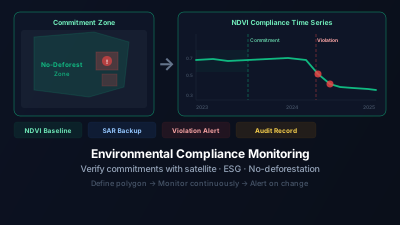
Quick Answer: Environmental compliance monitoring uses satellite time series to objectively verify whether a pledged area — a no-deforestation zone, a conservation easement, a mining footprint, a restoration site — is changing as committed. You define the polygon once. The system then automatically collects every satellite overpass and alerts when NDVI, SAR backscatter, or other indices deviate significantly from baseline. This creates an independent, tamper-proof record of land surface change over time.
Why Environmental Commitments Need Independent Monitoring
Over the past decade, companies across agriculture, mining, timber, and finance have made hundreds of sustainability pledges: no-deforestation commitments, restoration targets, protected area agreements, and carbon credit baselines. The problem is verification.
Ground surveys are expensive, infrequent, and geographically limited. Self-reported data from the same parties who made the commitment has obvious conflicts of interest. Third-party audits happen once or twice a year, leaving months of unobserved time.
Satellite monitoring fills this gap with objective, continuous, independent observation. Every 5–12 days, a satellite overpass measures the state of the committed land. The record is independent of any party to the agreement and is captured before human observation can influence it.
What Satellite Monitoring Can and Cannot Verify
Can Verify
- Forest clearance: NDVI drops of 0.3+ over forested areas, confirmed by SAR backscatter changes
- Plantation establishment: NDVI increases over previously bare or low-vegetation areas
- Agricultural expansion: NDBI increases, NDVI replaces natural vegetation signature
- Mining footprint change: SAR backscatter changes, NDVI permanent loss, surface roughness increase
- Restoration progress: NDVI increase over time following planting commitments
- Flood or fire events (relevant for insurance, force majeure documentation)
- Urban encroachment on protected areas: SAR and NDBI increases
Limitations
- Cannot distinguish species in a forest canopy
- Cannot verify soil quality, water quality, or biodiversity directly
- Cannot certify the cause of change — only that change occurred (ground truthing is still needed)
- Resolution limits: Sentinel-2 at 10m may not resolve small-scale clearing (<1 ha) in dense canopy
Common Use Cases
No-Deforestation Supply Chain Commitments
Companies with commitments to source palm oil, soy, timber, or beef from deforestation-free suppliers can monitor supplier land holdings for NDVI loss. A time series over each supplier polygon shows whether forest cover is being maintained.
Key approach:
- Define polygons for each supplier's land holding (or sourcing region)
- Monitor NDVI continuously with Sentinel-2 (optical) and Sentinel-1 SAR (cloud-independent backup)
- Flag any NDVI drop exceeding 2σ from the seasonal baseline for investigation
- Generate time-stamped records of all anomaly events for audit documentation
Protected Area and Conservation Easement Monitoring
NGOs and land trusts often hold conservation easements on privately-owned land. Satellite monitoring provides a low-cost, continuous record of the easement condition without requiring physical access.
Typical configuration:
- NDVI time series for vegetation cover trend
- SAR VV for detecting clearing under cloud cover
- Comparison of current NDVI to the year of easement signing (baseline)
- Annual summary reports generated from the time series CSV export
Mining and Extraction Site Monitoring
Mining operations committed to specific footprint limits can be monitored for compliance using SAR backscatter (highly sensitive to surface change, disturbed soil, and new structures) combined with NDVI (vegetation loss).
This approach also applies to:
- Artisanal and small-scale mining (ASM) incursions into protected zones
- Tailings pond expansion monitoring
- Post-mining restoration verification (NDVI recovery over reclaimed land)
Carbon Credit Baseline and Verification
Voluntary carbon markets require that forest carbon credits represent additional protection beyond a baseline scenario. Satellite time series provides:
- Pre-project deforestation rate (historical NDVI trend)
- Post-project forest cover change (ongoing monitoring)
- Leakage detection (deforestation shifting to adjacent areas outside the project boundary)
Setting Up a Compliance Monitoring Zone
The basic workflow requires only a few minutes to configure:
- Define the polygon: Upload the legal boundary of the committed area as GeoJSON, or draw it manually on the map
- Set the baseline start date: Ideally the date the commitment was signed, or the start of the project period
- Select indices: NDVI (vegetation baseline) + SAR VV (all-weather backup) are the minimum; add NDBI for urban encroachment, NBR for fire events
- Configure anomaly detection: The system flags points that deviate more than 2 standard deviations from the rolling mean
- Export for reporting: The CSV download includes timestamps, mean/min/max values, anomaly flags, and data point IDs for audit trails
Interpreting Compliance-Relevant Anomalies
Not every anomaly is a compliance violation. A rigorous investigation workflow:
| Anomaly Type | Likely Cause | Investigation Step |
|---|---|---|
| Sharp NDVI drop + SAR VV rise | Clearance (likely) | View satellite scene at that date; check if new bare soil visible |
| NDVI drop only | Drought, cloud contamination, seasonal | Check adjacent unaffected areas; confirm with SAR |
| SAR VV drop only | Flooding (temporary) | Check NDWI; likely natural event |
| Gradual NDVI decline | Long-term degradation | Review for selective logging, agricultural encroachment |
| NDBI increase | New structures or impervious surface | View imagery to confirm building construction |
Every anomaly that is investigated and confirmed should be documented with:
- Date of the anomaly data point
- SAR or optical scene ID (available in the monitoring CSV)
- Screenshot of the satellite imagery at that date
- Assessment of cause (natural event vs. human activity)
Building an Audit-Ready Record
The monitoring time series creates a longitudinal record of the committed land's condition. Key features for audit purposes:
- Timestamped data points: Each row in the CSV corresponds to one satellite overpass with its acquisition date
- STAC item IDs: The source satellite scene can be independently retrieved and verified
- Anomaly flags: Machine-generated, objective flags document when values deviated from baseline
- Reproducibility: The same polygon, date range, and index will produce the same time series if run again
This data structure supports third-party audits, regulatory submissions, and investor ESG reporting requirements without requiring continuous on-the-ground presence.
What Is and Isn't Detectable
Calibrating alert thresholds starts from an honest picture of what each violation type looks like to a sensor:
- Abrupt clearance (forest clearance, mining footprint expansion, urban encroachment) is the easy case. The change is large, spectrally distinct, spatially coherent, and permanent. Detection is limited mainly by pixel size — a change has to cover enough pixels to survive noise — and by how long you wait for a cloud-free optical scene. SAR closes the cloud gap, and requiring both sensors to agree is the single most effective way to cut false alarms.
- Gradual or partial change (selective logging, degradation, restoration failure) is the hard case. The signal is small relative to normal seasonal variation, so it can only be recovered from a trend across many observations, not from a single anomaly. Expect a longer latency, a much higher false-alarm rate, and a genuine need for ground verification before anything is called a violation.
- Cause is never detectable. The sensor sees that canopy disappeared, not who removed it or under what permit. Every confirmed anomaly is the start of an investigation, not its conclusion.
The practical consequence is that detection thresholds should differ by violation type. A polygon monitored for clear-cutting can run a tight, fast trigger. The same polygon monitored for degradation needs a longer window and should be treated as a screening signal — high recall, low precision — feeding a human review queue.
The 2σ anomaly threshold explained: using 2 standard deviations from the seasonal baseline means roughly 5% of clean observations will trigger an alert — that is simply the tail of a normal distribution, not a property of satellites. For a site observed ten times a month, that is on the order of half a false alert per month. Tightening to 3σ cuts the expected false-alert rate by well over an order of magnitude, but raises missed detections correspondingly. For high-value compliance polygons (REDD+ projects, major supply chain commitments), 2σ is the common choice — the cost of a false alert is investigation time, while the cost of a missed detection is an unrecorded violation.
Comparing Multiple Sites
For companies monitoring dozens or hundreds of supplier polygons, the Monitoring Dashboard shows a list of all configured areas with at-a-glance status indicators. Areas with recent anomalies show alert badges. This allows rapid triage — focus investigation effort on the sites where the satellite data indicates change, not on routine checks of sites that are clearly stable.
Integration with Existing Reporting Workflows
Satellite monitoring data complements rather than replaces existing ESG reporting frameworks:
- GRI Standards / TNFD: Time series data provides the quantitative basis for land use change disclosures
- Science-Based Targets: Carbon stock monitoring supports forest-related SBTi targets
- CDP Forests: NDVI time series over supplier areas supports CDP Forests questionnaire responses
Summary
Environmental compliance monitoring with satellite time series converts a point-in-time commitment into a continuous, independently-recorded observation stream. Define the area, set the start date, and the monitoring system automatically captures every satellite overpass and flags when surface conditions change.
The result is an objective, tamper-proof record: deforestation that occurs anywhere in the polygon is captured within days, regardless of cloud cover or site accessibility. That record can then be used to trigger investigations, document compliance, or provide early warning before a violation escalates.
To set up compliance monitoring for your committed areas, open the Monitoring Dashboard and upload or draw your target polygons. For background on the underlying detection methods, see Deforestation Monitoring with Satellite Data and SAR Backscatter Time Series.

Remote sensing specialist with 10+ years in satellite data processing and AI. Founder of Off-Nadir Lab. Ph.D. in Informatics (Yokohama National University, 2026). Master's in Earth System Science and Technology (Kyushu University). Co-author, Remote Sensing Encyclopedia. More about the author →