Deforestation Monitoring with Satellite Data: How We Track Forest Loss Globally
Quick Answer: Deforestation monitoring from satellites relies on detecting abrupt NDVI drops (optical) or backscatter changes (SAR) in forested areas. The Hansen/Global Forest Watch dataset maps annual forest loss globally at 30m resolution using Landsat. Near-real-time alerts (GLAD, RADD) detect deforestation within days using Sentinel-1 SAR (cloud-independent) and Sentinel-2/Landsat optical data. In tropical regions where clouds obscure optical views for weeks, SAR-based detection is essential. Detection accuracy is season- and biome-dependent — strongest in humid tropical forest, where the forest-to-bare-soil contrast is sharpest, and weakest in dry and open woodland — so take the figure from the alert system's own published validation for your region and season rather than from a global average.
In 2019, satellite analysis showed that Brazil single-handedly accounted for over a third of all loss of humid tropical primary forest worldwide — its worst year for primary forest in more than a decade. That finding didn't come from ground surveys or aircraft reconnaissance. It came from algorithms processing billions of Landsat pixels, detecting where forest canopy disappeared between one year and the next.
Satellite-based deforestation monitoring has become one of the most impactful applications of remote sensing, directly influencing policy, enforcement, and international climate agreements.
How Satellites Detect Forest Loss
Optical Detection (Sentinel-2, Landsat)
Forest clearance produces dramatic spectral changes:
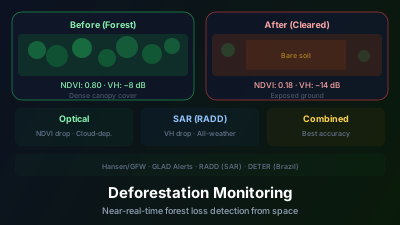
- NDVI drops from 0.7-0.9 (dense canopy) to 0.1-0.3 (bare soil or sparse regrowth)
- NIR reflectance decreases as leaf canopy is removed
- SWIR reflectance increases as soil is exposed (previously shaded by canopy)
- Red reflectance increases as chlorophyll absorption disappears
A single cloud-free image pair (before and after) is often sufficient to map clearance events. The spectral contrast between forest and cleared land is among the strongest change signals in remote sensing.
SAR Detection (Sentinel-1)
Forest clearance changes the radar scattering mechanism:
- Standing forest: Strong volume scattering from canopy → moderate-high backscatter in VH
- Cleared land: Surface scattering from soil → lower VH backscatter (typically 3-6 dB decrease)
- Coherence change: Forest always has low coherence at C-band; after clearance, bare soil maintains higher coherence
SAR detection works through clouds — critical in the tropics where persistent cloud cover can obscure optical views for weeks during the wet season, which is often when illegal deforestation accelerates (less chance of being spotted from aircraft).
Combined Optical + SAR
The most robust monitoring systems use both:
- SAR provides continuous monitoring regardless of weather
- Optical provides spectral confirmation when cloud-free imagery becomes available
- Combined detection reduces false alarms from either sensor alone
Global Monitoring Systems
Hansen Global Forest Change (University of Maryland)
The foundational dataset. Updated annually using Landsat imagery:
- Coverage: Global, 2000-present
- Resolution: 30 meters
- Definition: Tree cover loss — any reduction in canopy density from an initial state
- Accuracy: Best in tropical humid forests, where the forest-to-bare-soil contrast is strongest; weaker in dry and open woodlands. Published validation figures accompany each annual release, so check the version you are using rather than assuming a fixed number
The dataset maps both gain and loss, enabling net change calculations. It's freely available through Google Earth Engine and Global Forest Watch.
GLAD Alerts
Near-real-time deforestation alerts from the University of Maryland:
- Latency: ~1 week from satellite acquisition to alert publication
- Resolution: 30 meters (Landsat-based)
- Coverage: Pan-tropical
- Method: Time-series analysis detecting persistent NDVI drops below the historical forest range
RADD Alerts (Radar Alerts for Detecting Deforestation)
Developed by Wageningen University using Sentinel-1 SAR:
- Latency: 6-12 days
- Coverage: Tropical humid forests
- Key advantage: Works through clouds, providing detections when optical systems can't
- Method: Detects backscatter drops in forested areas exceeding historical variability
DETER (Brazil - INPE)
Brazil's national near-real-time system:
- Purpose: Operational law enforcement support
- Resolution: MODIS (250m) for rapid detection, Landsat/Sentinel for confirmation
- Latency: Days to 2 weeks
- Impact: Detection data triggers enforcement actions by environmental police
Challenges
Cloud Cover in the Tropics
The Amazon, Congo Basin, and Southeast Asian forests experience 60-80% cloud cover during wet seasons. Optical sensors like Landsat and Sentinel-2 may not acquire a usable image for 2-3 months. During this window, significant deforestation can occur undetected by optical systems alone.
This is why SAR has become indispensable for tropical deforestation monitoring. Sentinel-1's 6-12 day revisit through all weather conditions fills the gap.
Degradation vs. Clear-Cut
Complete forest removal (clear-cutting) is relatively easy to detect — the spectral change is dramatic. Selective logging and degradation — where individual trees are removed but the canopy partially remains — is much harder:
- NDVI may drop only 10-20% (within natural variability)
- SAR backscatter change is subtle
- The spectral signal recovers quickly as remaining canopy fills gaps
Detecting degradation requires:
- Higher resolution data (commercial satellites at 1-5m)
- Multi-temporal analysis tracking gradual decline
- Texture analysis (canopy gaps become visible at high resolution)
- LiDAR or SAR-derived canopy height data (detecting height loss)
False Positives
Not every forest change is deforestation:
- Seasonal deciduous forests lose leaves annually — this is natural, not deforestation
- Fire damage can kill trees without human agency
- Flooding temporarily reduces canopy reflectance
- Phenological variation causes year-to-year NDVI fluctuation
Robust systems use persistence criteria — the change must last through multiple satellite passes to be classified as deforestation rather than a temporary anomaly.
Definition Matters
"Forest" and "deforestation" have multiple definitions:
- FAO defines forest as >10% tree canopy cover, >0.5 hectares, >5 meters height
- Hansen dataset uses >50% canopy cover threshold by default
- National definitions vary widely
The same satellite data can show different deforestation rates depending on which definition is applied. When comparing deforestation statistics, always check which definition was used.
Choosing a Monitoring System by Region
Which alert system to lean on is mostly decided by cloud climatology and by the size and shape of the clearings you expect:
- Brazilian Amazon: well served by all three operational systems. DETER exists for enforcement, GLAD gives Landsat-resolution confirmation, and RADD covers the wet-season gap. Clearings tend to be large and geometric, which every sensor handles.
- Congo Basin: the hardest optical environment in the tropics — cloud can persist for most of the wet season. Treat SAR (RADD) as the primary stream and optical as confirmation when a clear scene appears.
- Insular Southeast Asia (Borneo, Sumatra): equatorial cloud is near-permanent, and much of the clearing is smallholder-scale, so a SAR-first approach with high-resolution follow-up is the practical combination.
- Dry forest and savanna (Cerrado, West Africa, Miombo): optical works well because clear scenes are common, but the "forest" definition matters more here than anywhere else — canopy cover is naturally below the thresholds used for humid forest.
The general rule: published accuracy for any alert system is season- and biome-dependent, and the seasonal spread is largest for optical systems. An optical alert stream that performs well in the dry season can go effectively blind for weeks in the wet season — which is precisely the period when clearing accelerates, and precisely why radar-based systems like RADD exist. Where an operational decision depends on the number, take it from the system's own published validation for your region and season rather than from a global average.
The Impact of Monitoring
Satellite deforestation monitoring has been credited with reducing forest loss where it is coupled to action:
Brazil's DETER system: Economic analyses of Brazil's monitoring-and-enforcement policy have credited near-real-time satellite alerts with a measurable deterrent effect — the mechanism being that alerts make enforcement action fast and geographically targeted, which raises the expected cost of clearing. The size of that effect is contested and depends heavily on how strongly enforcement follows the alert; detection alone changes nothing.
Norway's REDD+ programs: Satellite-verified deforestation data underpins billions of dollars in results-based payments for forest conservation. Countries receive payment for reducing deforestation below a satellite-verified baseline.
Supply chain monitoring: Companies committed to "zero-deforestation" supply chains use satellite data to verify that their commodity suppliers (palm oil, soy, beef, cocoa) aren't clearing forest for production.
The technology for detecting deforestation exists and works. The bottleneck is usually institutional — having the governance structures, enforcement capacity, and political will to act on what the satellites reveal. But without the monitoring data, there's nothing to act on. Satellite systems provide the transparency that makes forest protection possible at scale.
Start monitoring any forest area with the Monitoring Dashboard — track NDVI, RVI, and RFDI with automatic anomaly alerts that notify you when deforestation events occur.

Remote sensing specialist with 10+ years in satellite data processing and AI. Founder of Off-Nadir Lab. Ph.D. in Informatics (Yokohama National University, 2026). Master's in Earth System Science and Technology (Kyushu University). Co-author, Remote Sensing Encyclopedia. More about the author →