Geological Mapping from Space: Iron Oxide and Clay Mineral Detection with Sentinel-2
Quick Answer: Iron oxide minerals (hematite, goethite) absorb blue light and reflect red, creating a detectable spectral signature using red/blue band ratios. Clay minerals (kaolinite, montmorillonite) have absorption features in SWIR bands around 2.2μm, detectable with Sentinel-2 Band 12. These indices help identify alteration zones in mineral exploration, map laterite soils, and assess mine tailings. Best results come from arid/semi-arid regions with minimal vegetation cover.
Satellite Geology: Seeing Below the Surface
You can't see minerals from space — at least not directly. But mineral composition controls how surfaces reflect and absorb light across different wavelengths. By analyzing these spectral patterns, satellite sensors can detect mineral signatures that are invisible to the naked eye.
This capability has transformed geological exploration. Before satellite remote sensing, mineral surveys required extensive fieldwork. Now, Sentinel-2's multispectral bands can map mineral alteration zones across thousands of square kilometers in minutes.
Iron Oxide Detection
The Spectral Signature
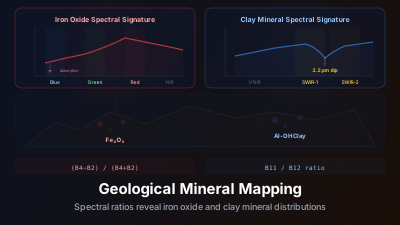
Iron oxide minerals (hematite, goethite, limonite) have a distinctive spectral behavior:
- Strong absorption in blue/violet (0.4-0.5 μm) — iron's crystal field absorption
- Moderate absorption in green (0.5-0.6 μm)
- High reflectance in red (0.6-0.7 μm)
This is why iron-rich rocks and soils appear red — they absorb blue light and reflect red light.
The Iron Oxide Index
The iron oxide index uses the normalized difference between red and blue reflectance:
Iron Oxide Index = (Red - Blue) / (Red + Blue)
For Sentinel-2: (B4 - B2) / (B4 + B2)
Positive values indicate iron oxide presence. The normalized difference reduces the effect of overall brightness variation, making results comparable across different illumination conditions.
| Surface | Iron Oxide Index |
|---|---|
| Iron-rich laterite | +0.25 to +0.45 |
| Oxidized rock | +0.15 to +0.25 |
| Normal soil | +0.05 to +0.15 |
| Vegetation | -0.05 to +0.05 |
| Water | -0.20 to +0.00 |
Where Iron Oxide Mapping Works Best
- Arid and semi-arid landscapes — Minimal vegetation reveals rock and soil surfaces
- Mining districts — Hydrothermal alteration zones associated with mineral deposits
- Laterite mapping — Iron-rich tropical soils important for nickel, bauxite exploration
- Environmental monitoring — Acid mine drainage produces iron oxide precipitates in waterways
Clay Mineral Detection
The Spectral Signature
Clay minerals have absorption features in the shortwave infrared (SWIR) region:
- ~1.4 μm — OH and water absorption (not accessible from space due to atmospheric water vapor)
- ~2.2 μm — Al-OH absorption in kaolinite, montmorillonite, muscovite
- ~2.3 μm — Mg-OH and Fe-OH absorption in chlorite, epidote
Sentinel-2's Band 12 (2.19 μm) captures the critical 2.2 μm clay absorption feature.
The Clay Mineral Ratio
Clay Ratio = SWIR1 / SWIR2
For Sentinel-2: B11 / B12
High values indicate clay mineral presence — SWIR1 (1.6 μm) reflectance is high while SWIR2 (2.2 μm) is reduced by clay absorption.
Ferrous Minerals
Ferrous iron (Fe²⁺) in minerals like olivine and pyroxene has absorption features that affect the ratio between SWIR bands. The ferrous silicate index uses:
Ferrous Index = SWIR2 / SWIR1
For Sentinel-2: B12 / B11
Practical Applications
Mineral Exploration
Hydrothermal alteration zones — where hot fluids have altered the original rock — often contain both iron oxides (from oxidized sulfides) and clay minerals (from altered feldspars). Satellite detection of these alteration minerals helps prioritize exploration targets.
The classic approach:
- Map iron oxide abundance (identifies gossans and oxidized zones)
- Map clay mineral abundance (identifies argillic and phyllic alteration)
- Overlay the two maps — areas with both signatures are high-priority targets
Soil Mapping
Iron oxide and clay content are fundamental soil properties:
- Iron oxide content correlates with soil age, drainage, and parent material
- Clay content affects water retention, nutrient availability, and engineering properties
Mine Site Monitoring
Active and abandoned mines produce mineral-rich waste that can be tracked with spectral indices:
- Tailings ponds — Iron oxide precipitates indicate acid drainage
- Waste rock piles — Clay mineral formation indicates weathering progression
- Dust deposition — Mineral-rich dust from mine operations affects surrounding areas
Geological Mapping
In poorly mapped or remote areas, spectral mineral indices provide a first-pass geological map. Different rock types (granites, basalts, limestones, shales) have different mineral compositions that produce distinct spectral signatures.
Limitations
Vegetation Cover
Vegetation dominates the spectral signal wherever it covers more than ~30% of the surface. In forested or heavily vegetated areas, mineral detection is essentially impossible with optical sensors.
Workaround: Focus analysis on exposed surfaces — road cuts, river banks, agricultural fields after harvest, and naturally bare areas. Or use the dry season when vegetation is minimal.
Atmospheric Effects
Water vapor absorbs strongly in SWIR wavelengths, potentially contaminating mineral absorption signals. This is less of a problem with Sentinel-2's atmospheric correction (Level-2A products), but humid tropical atmospheres can still reduce clay mineral detection accuracy.
Spectral Resolution
Sentinel-2 has only two SWIR bands. Dedicated geological sensors (like ASTER with 6 SWIR bands) provide much finer mineral discrimination. Sentinel-2 can detect the presence of clay minerals but can't distinguish between specific clay species (kaolinite vs montmorillonite) as reliably.
Mixed Pixels
At 20m resolution (Sentinel-2 SWIR bands), each pixel may contain multiple rock types and minerals. The measured signal is a mixture, making it difficult to identify minor mineral components.
Combining with Other Data
DEM Integration
Geological mapping benefits enormously from topographic context. Overlay mineral index maps with digital elevation models to correlate mineral patterns with geological structures (faults, folds, contacts).
SAR Texture
SAR imagery responds to surface roughness, which varies between rock types. Rough basalt flows, smooth limestone surfaces, and foliated schists each produce different SAR textures. Combining spectral mineral indices with SAR texture improves geological classification.
Try It in Off-Nadir Delta
Off-Nadir Delta includes iron oxide, clay mineral, and ferrous mineral indices for Sentinel-2 data:
- Search for imagery over an arid or semi-arid region with exposed rock
- Apply the iron oxide visualization to identify iron-rich surfaces
- Switch to clay mineral visualization to map alteration zones
- Compare with true-color and band combinations for geological context
- Try the SWIR composite (B12-B8A-B4) for a comprehensive geological overview

Remote sensing specialist with 10+ years in satellite data processing and AI. Founder of Off-Nadir Lab. Ph.D. in Informatics (Yokohama National University, 2026). Master's in Earth System Science and Technology (Kyushu University). Co-author, Remote Sensing Encyclopedia. More about the author →