Sentinel-2 Band Combinations: RGB Recipes with Examples
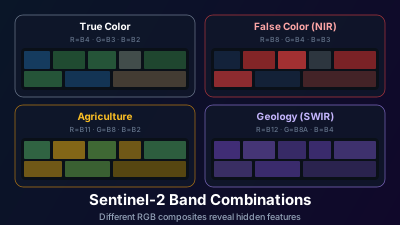
Quick Answer: True color (B4-B3-B2) is only one of many useful Sentinel-2 composites. False color infrared (B8-B4-B3) makes vegetation pop in red. SWIR composite (B12-B8A-B4) reveals soil moisture and burn scars. Agriculture composite (B11-B8-B2) separates crop types. Each combination highlights different surface properties by leveraging spectral bands beyond visible light.
Thirteen Bands, Infinite Combinations
Sentinel-2 carries a Multi-Spectral Instrument (MSI) with 13 spectral bands spanning visible light through short-wave infrared. Most users see the true color composite (red-green-blue) and stop there. That's like buying a 13-channel mixing board and only using the volume knob.
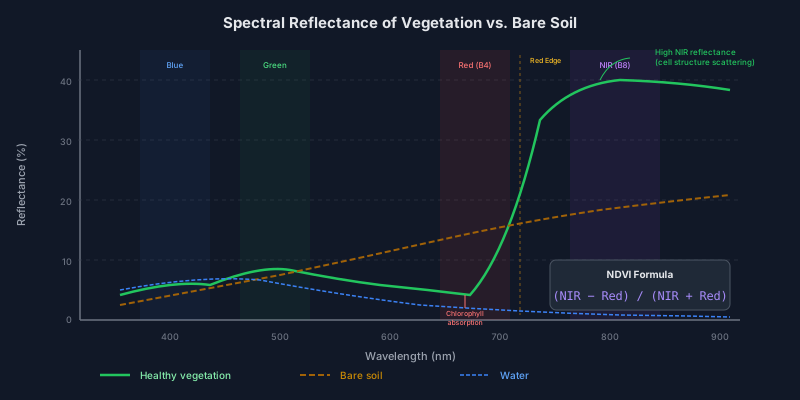
Each band measures reflectance at a specific wavelength range, and different surface materials have characteristic spectral signatures — patterns of high and low reflectance across wavelengths. Band combinations exploit these patterns to highlight features that are invisible or ambiguous in natural color.
Quick-Reference: Major Sentinel-2 Band Combinations
| Name | Bands (R-G-B) | Resolution | Best For | Key Color Cue |
|---|---|---|---|---|
| True Color | B4 – B3 – B2 | 10m | Orientation, cloud detection, public sharing | Natural landscape colors |
| False Color Infrared | B8 – B4 – B3 | 10m | Vegetation health, water delineation | Healthy vegetation = bright red |
| Agriculture Composite | B11 – B8 – B2 | 20m | Crop type mapping, harvest timing | Growing crops = bright green; ripening = yellow-orange |
| SWIR Composite | B12 – B8A – B4 | 20m | Burn scars, geology, soil moisture | Fresh burn = near-black; moist soil = dark |
| Atmospheric Penetration | B12 – B11 – B8A | 20m | Haze/dust penetration, desert terrain | All IR; disorienting but haze-free |
| Geology / Urban | B12 – B11 – B4 | 20m | Mineral mapping, built-up discrimination | Rock/mineral contrast; urban = bright |
| Vegetation Index (NDVI) | (B8−B4)/(B8+B4) | 10m | Quantitative vegetation; time series | Color-mapped from red (bare) to green (dense) |
| Moisture Index (NDMI) | (B8A−B11)/(B8A+B11) | 20m | Crop water stress, drought | Negative = dry; positive = moist |
| Normalized Burn Ratio | (B8A−B12)/(B8A+B12) | 20m | Fire severity, post-fire recovery | Negative = burned; higher = recovering |
The Essential Combinations
1. True Color (B4, B3, B2)
The baseline. This is what the scene would look like to human eyes (approximately). Useful for orientation and context, but limited by what our eyes can see.
- Best for: General landscape orientation, cloud identification, sharing with non-specialists
- Resolution: 10m
- Limitation: Vegetation appears uniformly green — you can't distinguish healthy from stressed crops
2. False Color Infrared (B8, B4, B3)
Probably the single most useful non-standard combination. Near-infrared (B8) is placed in the red channel, red (B4) in green, and green (B3) in blue.
Why it works: Healthy vegetation reflects strongly in NIR, so it appears bright red. Stressed or sparse vegetation appears pink or light red. Water absorbs NIR and appears dark blue/black. Urban areas appear cyan or gray.
- Best for: Vegetation health assessment, water body delineation, distinguishing vegetation types
- Resolution: 10m
- The "aha" moment: When you see a field that looks uniformly green in true color but shows clear red/pink variation in false color, revealing irrigation differences or crop stress
To see that contrast for an area you know, open it in the Sentinel-2 viewer and switch between true color and false color.
3. Agriculture Composite (B11, B8, B2)
Short-wave infrared (B11, 1610nm) in red, NIR (B8) in green, blue (B2) in blue.
Why it works: SWIR is sensitive to leaf water content, and combining it with NIR separates crop types effectively. Bare soil appears brown/tan. Actively growing crops are bright green. Mature or dry crops shift toward yellow/orange.
- Best for: Crop type identification, harvest monitoring, soil exposure mapping
- Resolution: 20m (SWIR bands are 20m native, upsampled when combined with 10m bands)
4. SWIR Composite (B12, B8A, B4)
Both SWIR bands with the red-edge NIR. This combination is particularly good for geological and moisture applications.
Why it works: Different rock and soil types have distinct SWIR reflectance patterns. Moist areas appear dark because water absorbs SWIR. Burn scars are clearly visible because charred vegetation has very different SWIR properties than green vegetation.
- Best for: Burn scar mapping, geology, mineral exploration, soil moisture (qualitative)
- Resolution: 20m
5. Natural Color Enhanced (B4, B3, B2 with contrast stretch)
Same bands as true color, but with the histogram stretched to use the full display range. This is sometimes underrated as a "combination" since it uses the same bands, but the visual improvement is significant.
The default rendering often leaves images looking hazy because atmospheric scattering compresses the useful data into a small portion of the dynamic range. A good contrast stretch can make a mediocre-looking scene quite informative.
Less Common Combinations Worth Knowing
Atmospheric Penetration (B12, B11, B8A)
All infrared bands, no visible. Useful for seeing through thin haze, but the complete loss of natural color context can be disorienting. It is most useful over desert terrain where visible wavelengths are dominated by atmospheric effects.
Vegetation Index (Color mapped NDVI)
Rather than a three-band composite, calculate NDVI as a single value and apply a color ramp. This is more quantitative than false color composites and works well for time-series comparison, but you lose the spatial detail that three-band composites provide.
Moisture Index (B8A, B11)
The Normalized Difference Moisture Index (NDMI) uses these two bands and is useful for drought monitoring and irrigation mapping. Like NDVI, it produces a single index value rather than a visual composite.
What Each Combination Actually Looks Like
Visual labels help, but here is more specific guidance for what you will actually see in different landscape contexts:
Active agricultural region in false color infrared (B8-B4-B3):
- Crops at peak growth appear bright red to magenta — striking against other surfaces
- Stressed or sparse crops shift to dull pink or light pink
- Harvested or fallow fields become cyan or blue-gray
- Water bodies are near-black (NIR absorbed)
- Bare roads appear pale gray or white
The "aha" moment for most users: a field that looks uniformly green in true color shows clear variation in false color — some patches vivid red, others pale — revealing irrigation differences or pathogen stress that is simply invisible to the human eye in natural color.
Same agricultural scene in agriculture composite (B11-B8-B2):
- Actively growing crops: vivid green to chartreuse
- Maturing or ripening crops (higher SWIR reflectance): yellow-orange — this is especially useful for estimating how close fields are to harvest
- Harvested stubble: tan to light brown
- Bare soil types separate in color depending on their moisture and iron oxide content
This is the most useful combination for distinguishing crop maturity stages and identifying which fields were harvested this week versus last month.
Burn scar in SWIR composite (B12-B8A-B4):
- Fresh char (days to weeks after fire): dark brown to near-black — the absence of both NIR and SWIR reflectance makes recently burned areas unmistakable
- Active fire frontiers in the scene: saturated bright orange-red
- Recovering post-fire vegetation (months later): vivid green against the still-dark scar background
- Adjacent unburned forest: dark green to teal
A common misinterpretation: burn scars can appear subtly reddish-brown in standard false color infrared, easily confused with bare agricultural soil. The SWIR composite makes them unambiguous because charred surfaces are dark in SWIR in a way that soil is not.
Practical Workflow
A practical sequence for looking at a new Sentinel-2 scene:
- True color first — orient yourself, assess cloud cover, get context
- False color infrared — immediately shows vegetation distribution and health
- Specific combination based on the question — agriculture composite for farmland, SWIR for burn scars or geology
The switch takes seconds and the additional information is substantial. There's no reason to limit yourself to one view.
A Note on Resolution
Sentinel-2's bands have three different native resolutions:
- 10m: B2 (Blue), B3 (Green), B4 (Red), B8 (NIR)
- 20m: B5-B7 (Red Edge), B8A (NIR narrow), B11-B12 (SWIR)
- 60m: B1 (Coastal), B9 (Water Vapor), B10 (Cirrus)
When you create a composite mixing 10m and 20m bands, the 20m bands are typically resampled to 10m. This doesn't add real detail — you're still limited by the coarser band — but it allows the combination to display at 10m pixel spacing.
For vegetation work, the 10m bands (especially B4 and B8 for NDVI) give you the finest spatial detail. For moisture and geological work, you're working at 20m resolution regardless.
On the Sentinel-2 viewer, you can switch between true color, false color infrared, and spectral indices like NDVI, EVI, NDMI, and NBR — each revealing different surface properties from the same scene. For custom three-band composites like the agriculture or SWIR combinations described above, desktop GIS software provides full flexibility.
Related reading
Choosing a band combination for one scene and choosing an index to track over months are different decisions — the second has to survive cloud gaps, seasonality, and the question of what counts as an unusual reading. Measuring a number versus watching for events covers picking an index for a continuous watch, and why an optical-only watch fails over persistently cloudy ground.

Remote sensing specialist with 10+ years in satellite data processing and AI. Founder of Off-Nadir Lab. Ph.D. in Informatics (Yokohama National University, 2026). Master's in Earth System Science and Technology (Kyushu University). Co-author, Remote Sensing Encyclopedia. More about the author →