SAR vs Optical Satellite Imagery: A Practical Guide to Choosing the Right Sensor
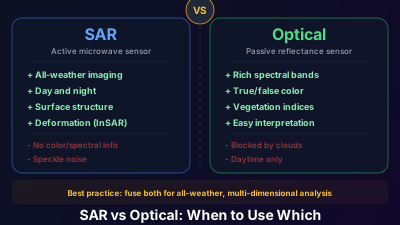
Quick Answer: Optical sensors capture reflected sunlight (like a camera) and produce intuitive color images, but fail under clouds and at night. SAR transmits its own microwave energy and measures backscatter, working 24/7 regardless of weather. For vegetation and water quality, use optical. For flood mapping, deformation, and all-weather monitoring, use SAR. For best results, combine both.
The Fundamental Difference
Optical and SAR satellites don't just use different technologies — they measure entirely different physical properties of the Earth's surface.
Optical sensors (like Sentinel-2) are passive. They detect sunlight reflected from the surface, much like a digital camera. What you see depends on the surface's spectral reflectance — how much light it reflects at different wavelengths.
SAR sensors (like Sentinel-1) are active. They transmit microwave pulses and measure the returned signal (backscatter). What you see depends on the surface's geometry, roughness, moisture content, and dielectric properties.
This isn't a subtle distinction. It means the same landscape can look completely different in optical versus SAR imagery.
What Each Sensor Actually Measures
| Property | Optical | SAR |
|---|---|---|
| Energy source | Sunlight (passive) | Own microwave pulses (active) |
| What it measures | Spectral reflectance | Backscatter intensity |
| Sensitive to | Chemistry, pigments, minerals | Geometry, roughness, moisture |
| Cloud penetration | No | Yes |
| Night operation | No | Yes |
| Spatial resolution | 10m (Sentinel-2) | 10m (Sentinel-1) |
| Color imagery | Yes (natural color possible) | No (single-band grayscale) |
When Optical Is the Better Choice
Vegetation Analysis
Optical imagery excels at vegetation monitoring because chlorophyll has a distinctive spectral signature. Indices like NDVI exploit the sharp contrast between red light absorption and near-infrared reflection by healthy plants. SAR can detect vegetation structure but cannot directly measure chlorophyll content. The Sentinel-2 viewer shows the same contrast in false color, where healthy vegetation stands out.
Water Quality
Turbidity, algal blooms, and sediment plumes are visible in optical bands. SAR sees only the water surface roughness, not what's in the water.
Land Cover Classification
The spectral diversity of optical data (13 bands on Sentinel-2) makes it far superior for distinguishing land cover types. Different crops, soil types, and mineral compositions have unique spectral fingerprints that band combinations can reveal.
Geology and Mineral Mapping
SWIR bands on optical sensors detect specific mineral absorption features — iron oxide, clay minerals, and carbonate deposits each have characteristic spectral signatures.
When SAR Is the Better Choice
Flood Mapping
Water surfaces appear dark in SAR because they reflect radar energy away from the sensor (specular reflection). This makes flood extent mapping straightforward — compare a pre-flood and post-flood image and look for areas that became dark.
All-Weather Monitoring
In tropical regions, cloud cover can block optical observations for weeks or months. SAR provides consistent data regardless of weather — critical for disaster response and continuous monitoring.
Ship Detection
Metal hulls produce extremely strong radar returns against the dark ocean background. SAR-based ship detection works at night and through clouds, making it essential for maritime surveillance.
Surface Deformation
SAR interferometry (InSAR) can detect millimeter-scale ground displacement — subsidence, volcanic inflation, earthquake deformation — something entirely impossible with optical sensors.
Urban Change Detection
Buildings create distinctive radar signatures (double-bounce reflection). New construction or building collapse produces dramatic changes in SAR backscatter.
The Power of Combining Both
The most effective monitoring strategies use both sensor types together:
-
SAR for timing, optical for detail — Use SAR's all-weather capability to detect when a change occurs, then use the next clear optical image to characterize what changed.
-
SAR for structure, optical for composition — SAR tells you about surface roughness and moisture; optical tells you about material composition. Together, they provide a more complete picture.
-
Gap-filling — When cloud cover blocks optical observations during a critical period (monsoon season, storm events), SAR fills the temporal gap.
Quick Decision Guide
| Your Application | Recommended Sensor | Why |
|---|---|---|
| Crop health monitoring | Optical (Sentinel-2) | NDVI, EVI require spectral bands |
| Flood extent mapping | SAR (Sentinel-1) | Works through storm clouds |
| Deforestation detection | Both | SAR for timing, optical for confirmation |
| Urban growth tracking | Both | SAR for structure, optical for land use |
| Ship monitoring | SAR (Sentinel-1) | 24/7 all-weather capability |
| Wildfire burn scars | Optical (Sentinel-2) | NBR index needs NIR and SWIR bands |
| Soil moisture estimation | SAR (Sentinel-1) | Backscatter correlates with moisture |
| Water quality | Optical (Sentinel-2) | Turbidity visible in optical bands |
A Practical Workflow: SAR First, Optical for Context
For land change monitoring in regions with seasonal cloud cover, starting with SAR and using optical as supplementary confirmation avoids the failure mode of waiting for a cloud-free optical scene that may not arrive for weeks. The workflow:
Step 1 — Monitor SAR continuously: Set up Sentinel-1 VV backscatter time series over your area. Scenes arrive approximately every 6 days, unaffected by clouds or monsoon season. The time series establishes a baseline and flags deviations automatically.
Step 2 — Identify SAR anomalies: A sudden backscatter change of ±3 dB or more over a single 6-day revisit signals that something happened. The SAR signal alone often can't tell you what changed — flooding, logging, construction, and extreme rainfall can all produce similar magnitude shifts.
Step 3 — Seek optical confirmation: Use the SAR anomaly date as the center of a targeted search window for cloud-free Sentinel-2 imagery (±30 days). Even in tropical regions, clear windows occur occasionally. Knowing when to look makes the search efficient rather than exhaustive.
Step 4 — Characterize with optical: Once you find a clear optical scene near the event date, spectral information identifies the change type: deforested areas appear as bare soil in the SWIR composite; flooded areas appear dark in false color infrared; construction shows as exposed bright soil.
The payoff: An optical-only workflow might miss a deforestation event that occurred during a 6-week cloud-covered monsoon period and partially revegetated before the next clear image. The SAR-first approach detects it within 6 days of occurrence, and you use optical later to confirm and characterize.
Try It Yourself
Off-Nadir Delta supports both SAR and optical data sources in the same interface:
- Load Sentinel-1 SAR imagery for radar analysis
- Load Sentinel-2 Optical imagery for spectral analysis
- Compare both over the same area using the layer manager
- Apply change detection across sensor types
The ability to switch between SAR and optical views of the same area — without leaving the browser — is one of the most practical advantages of a unified WebGIS platform.
Related reading
The choice also decides whether waiting is viable at all: an optical pass over cloud yields nothing, so over a persistently cloudy target the earliest usable observation is a SAR one even when the optical revisit figure looks better. When can a satellite next image this place covers turning that into a decision about waiting versus paying to task.

Remote sensing specialist with 10+ years in satellite data processing and AI. Founder of Off-Nadir Lab. Ph.D. in Informatics (Yokohama National University, 2026). Master's in Earth System Science and Technology (Kyushu University). Co-author, Remote Sensing Encyclopedia. More about the author →