Continuous Maritime Monitoring with SAR Ship Detection Time Series
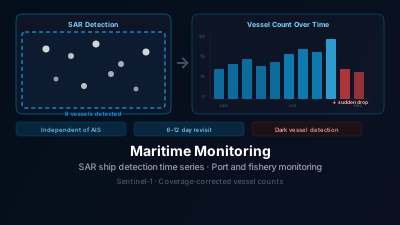
Quick Answer: Sentinel-1 SAR detects ships as bright point targets against the low-backscatter ocean background. By monitoring a defined sea area over time, you build a time series of vessel counts per satellite pass. This reveals port activity patterns, fishing intensity, traffic seasonality, and potential dark vessel activity (ships that have disabled their AIS transponders but still appear in SAR).
Why Monitor Maritime Areas with SAR?
The ocean covers 71% of Earth's surface and hosts a vast, largely invisible economy: shipping, fishing, energy, and resource extraction. Most of this activity is tracked through the Automatic Identification System (AIS) — transponders that vessels are required to carry and transmit. But AIS has critical limitations:
- Dark vessels — Ships can disable or spoof their AIS transponder, becoming invisible to tracking services
- Coverage gaps — AIS satellite relay has latency; some ocean areas have sparse coverage
- Small vessels — Fishing boats under certain tonnage are not required to carry AIS
- AIS data access — Commercial AIS data is expensive and proprietary
Sentinel-1 SAR provides independent, open-access vessel detection that does not depend on AIS at all. Ships appear as bright point targets against the low-backscatter ocean background, and they cannot hide from radar by turning off their transponder.
How SAR Detects Ships
SAR ship detection relies on a physical principle: a large metal vessel floating on calm water creates an extremely strong radar return. Several scattering mechanisms contribute at once:
- Corner reflection — The hull-deck junction acts as a corner reflector, two flat metal surfaces at right angles that bounce the radar pulse directly back toward the sensor with minimal loss
- Specular reflection — Large flat surfaces (decks, container walls) oriented perpendicular to the beam act as near-perfect mirrors
- Multiple-bounce effects — Complex structures (masts, antennas, container stacks) create multiple scattering paths that add to the return
Together these can make a single vessel return thousands of times stronger than the surrounding ocean.
The contrast between ship returns and the ocean background (which is typically much weaker) makes ships detectable using threshold or statistical approaches:
- Constant False Alarm Rate (CFAR) detection — For each pixel, the local ocean background level is estimated from surrounding pixels, a detection threshold is set from those background statistics, and pixels exceeding the threshold by a set margin are flagged. The "constant false alarm rate" name reflects that the threshold adapts to local conditions: it rises in rough, bright seas and falls in calm water, keeping the false-detection probability roughly constant regardless of sea state
- Deep learning detection — Convolutional neural networks trained on SAR ship images can handle challenging conditions (near-shore clutter, wave interference)
The result is a list of ship detections with positions, estimated sizes, and confidence scores for each satellite overpass.
Coverage Compensation: A Critical Factor
Unlike land monitoring where the entire polygon is typically covered by each satellite pass, maritime monitoring has an important complication: satellite swath coverage.
Sentinel-1 does not image the same ocean area every overpass. The swath width is 250 km, and orbits are not perfectly repeated — so on any given date, your monitoring polygon may be:
- Fully covered — The entire area was imaged
- Partially covered — Part of the area was covered, part was not
If a polygon with 100 ships is only 40% covered, the detector will find approximately 40 ships. Without accounting for coverage, this looks like a sudden drop in ship density — which could be mistaken for a real decrease in vessel activity.
Extrapolation Correction
One approach is to extrapolate the detected count based on coverage fraction:
Estimated ships = Detected ships / Coverage fraction
If 40 ships were detected at 40% coverage, the estimated total at 100% coverage would be ~100 ships. This assumes uniform spatial distribution of ships across the polygon, which is often reasonable for large open-ocean areas but less valid near ports where ship density is concentrated.
Exclusion Approach
The alternative is to exclude low-coverage scenes from the time series. Set a minimum coverage threshold (e.g., 70% or 90%) and only include scenes where sufficient area was imaged. This gives a cleaner time series but with more gaps.
The right approach depends on your use case:
- Activity trend analysis → Extrapolation gives more data points
- Event detection (sudden traffic stop) → Exclusion avoids false alarms from coverage artifacts
What Maritime Time Series Reveals
Port Activity Patterns
By drawing a polygon over a port approach area or anchorage, you can track vessel count over months and years. Common patterns include:
- Weekly cycles — Ports with scheduled arrivals show regular peaks
- Seasonal patterns — Fishing ports peak with fishing seasons; tourism ports with travel seasons
- Long-term growth — Increasing vessel density over years tracks port development
- Disruptions — Sudden drops from labor disputes, natural disasters, sanctions, or COVID-19 impacts
Fishing Effort Monitoring
Fishing vessel density in a fishery area is a proxy for fishing effort. SAR time series can track:
- Whether fishing effort in a marine protected area is changing
- Seasonal concentration patterns following fish migrations
- Comparison between declared exclusion zones and actual vessel presence
Dark Vessel Detection
Ships visible in SAR that are absent from AIS records are dark vessels — potentially engaged in unreported fishing, smuggling, or sanction evasion. By correlating SAR ship counts with AIS vessel counts over time, you can estimate the fraction of non-reporting vessels.
The gap can be very large. A global study by Global Fishing Watch, which applied machine learning to five years of satellite radar and optical imagery, found that about 75% of the world's industrial fishing vessels are not publicly tracked, with the untracked activity concentrated around Africa and South Asia. This kind of comparison is increasingly used by fisheries management authorities and NGOs monitoring illegal, unreported, and unregulated (IUU) fishing.
Infrastructure and Asset Monitoring
For offshore energy operations:
- Monitoring work vessel presence around oil platforms or wind farms
- Detecting unauthorized vessel activity in exclusion zones
- Tracking tanker loading/unloading activity at offshore terminals
Setting Up a Maritime Monitor
- Navigate to your target sea area — Port, fishing ground, shipping lane, or exclusive zone
- Draw your monitoring polygon over the area of interest
- For ports: draw over the anchorage and approach area
- For fisheries: draw the fishing ground or protected area boundary
- For shipping lanes: draw across the lane corridor
- Select Ship Detection from the Analysis options
- Set start date — A longer window (12+ months) gives better seasonal baseline
Understanding the Output
The time series graph shows vessel count on the y-axis and date on the x-axis. Each data point represents one Sentinel-1 overpass. The coverage fraction for each point is recorded — use the coverage controls to switch between raw counts, extrapolated counts, and filtered (coverage-threshold) views.
Limitations and Caveats
Spatial resolution: Sentinel-1 IW (Interferometric Wide) mode has a nominal resolution of 5×20 m. Very small vessels (under ~30 m) may not produce reliable detections.
False detections: Offshore infrastructure (oil platforms, aquaculture buoys, wind turbines) creates bright SAR returns similar to ships. These appear as permanent fixtures in the time series — consistently present at fixed locations — whereas ship traffic moves between passes.
Sea state effects: Very rough sea conditions create high ocean backscatter that can mask small ships or increase false alarm rates. High-sea-state scenes should be flagged as lower confidence. Detection probability depends jointly on vessel size and sea state — the table below shows approximate Sentinel-1 detection likelihood in open-ocean conditions:
| Vessel Length | Vessel Type | Calm Sea (Bft 1–2) | Moderate Sea (Bft 3–4) | Rough Sea (Bft 5+) |
|---|---|---|---|---|
| > 100 m | Large cargo / tanker | Near-certain | Near-certain | Reliable |
| 50–100 m | Medium cargo / trawler | Reliable | Reliable | Usually detected |
| 25–50 m | Steel fishing vessel | Usually detected | Usually detected | Marginal |
| 15–25 m | Small fishing vessel | Marginal | Often missed | Often missed |
| < 15 m | Small wooden boat | Often missed | Rarely detected | Not detectable |
This is a qualitative ranking, not a calibrated detection curve — the actual probability for your area depends on hull material, aspect, sea state, incidence angle, and the CFAR parameters used, and has to be established against local ground truth. The mechanism behind the ranking is contrast in radar cross-section: a large steel ship in calm seas sits far above the ocean background and clears any sensible threshold, while a small boat in a choppy sea sits only marginally above it. Two things follow. Wooden and fibreglass hulls return much less than steel of the same length, so vessel material matters as much as length. And near coastlines, land and infrastructure clutter drives false alarm rates up even for large vessels.
Temporal resolution: At ~6–12 day revisit, you cannot track individual vessel movements. This is fleet-level statistical monitoring, not real-time tracking.
Detection Performance and the Dark Fraction by Context
Both the detection rate and the size of the AIS gap vary systematically with the kind of water you are watching, and the two move in opposite directions. The contexts where SAR detects most reliably — deep-water shipping lanes, port anchorages, offshore energy zones — are also the contexts where AIS compliance is highest, so the dark fraction there is small. The contexts where the dark fraction is largest — artisanal coastal fisheries, remote fishing grounds, marine protected areas — are precisely where SAR detection is hardest, because the vessels are small, often non-metallic, and frequently close to shore where clutter is worst. Reading a low dark fraction in a difficult context is therefore ambiguous: it may mean compliance is good, or it may mean the detector is missing the vessels that are not reporting.
| Maritime Context | SAR Detection Difficulty | Expected AIS Gap | Key False Positive Source |
|---|---|---|---|
| Major commercial shipping lane | Easy — large steel hulls | Small; AIS is near-complete | Offshore platforms; wave clutter |
| Port anchorage (calm water) | Easiest — calm water, large vessels | Small; high AIS compliance | Fixed infrastructure |
| Offshore energy zone | Easy | Small to moderate; some service vessels | Oil platforms (permanent bright targets) |
| Open-ocean fishing ground | Moderate — sea state dependent | Large; many vessels are AIS-exempt | High sea state; small vessel misses |
| Marine protected area | Moderate to hard | Large; IUU activity concentrates here | Aquaculture, wave action |
| Coastal artisanal fishing zone | Hard — small, often wooden hulls near shore | Largest, and least reliably measured | Near-shore clutter; aquaculture floats |
| Arctic / high-latitude waters | Hard — ice clutter | Variable | Sea ice clutter; reduced revisit |
IUU fishing detection in practice: quantifying the dark fraction is the core analytical value of SAR-based maritime monitoring, and the global picture is stark. Global Fishing Watch's analysis of five years of satellite imagery found roughly 75% of the world's industrial fishing vessels absent from public tracking, with dark fishing vessels turning up inside many marine protected areas. Regional figures vary widely and should be measured for the specific EEZ or protected area in question rather than assumed from a global average.
Size detection limits: Sentinel-1 IW mode (5×20m nominal resolution) is dependable for steel vessels of roughly 30 m and above in moderate seas. Below that, detection becomes unreliable and degrades further as the sea state rises. For monitoring small-scale artisanal fisheries — small wooden boats with a weak radar return — Sentinel-1 is insufficient regardless of how the detector is tuned, and metre-class commercial SAR (for example ICEYE or Capella) is required, at substantially higher cost.
Integration with AIS Data
SAR ship detection is most powerful when combined with AIS data, not as a replacement for it:
- AIS tells you where ships are and their identities
- SAR tells you how many ships are there, including non-reporting vessels
The combination reveals the "dark fraction" — the proportion of activity invisible to AIS alone. This combined approach is the basis for the most advanced maritime domain awareness systems used by coast guards and fisheries enforcement agencies.
Summary
Continuous SAR ship detection monitoring builds a time series of vessel counts for any defined ocean area, independent of AIS transponder data. Sentinel-1's regular 6–12 day revisit cycle captures weekly and seasonal patterns in maritime activity, reveals dark vessels that do not appear in AIS records, and can detect sudden disruptions to normal traffic patterns. The key operational consideration is coverage compensation — always accounting for the fraction of your monitoring area actually imaged in each satellite pass before interpreting vessel count trends.
Set up automated maritime monitoring for any ocean area using the Monitoring Dashboard, or explore individual Sentinel-1 SAR scenes for ship detection with Ship Monitoring.

Remote sensing specialist with 10+ years in satellite data processing and AI. Founder of Off-Nadir Lab. Ph.D. in Informatics (Yokohama National University, 2026). Master's in Earth System Science and Technology (Kyushu University). Co-author, Remote Sensing Encyclopedia. More about the author →