Chlorophyll and Red Edge Bands: Sentinel-2's Secret Weapon for Crop Health
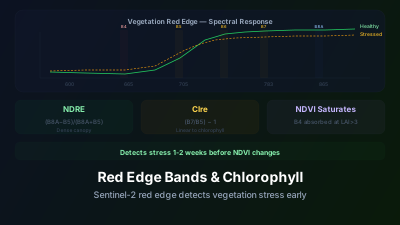
Quick Answer: Sentinel-2's red edge bands (B5: 705nm, B6: 740nm, B7: 783nm) sample the sharp reflectance transition between chlorophyll absorption and leaf structure reflection. This transition shifts with chlorophyll concentration — stressed plants with less chlorophyll show a blue-shifted red edge. Red edge indices like NDRE = (B8A - B5)/(B8A + B5) detect nitrogen deficiency and early stress before standard NDVI changes, because chlorophyll concentration falls before canopy density does. How much lead that buys depends on the crop, the severity, and how dense the canopy already is — the gap is largest in a closed canopy, where NDVI has saturated and effectively stopped responding at all. This makes red edge data essential for precision agriculture variable-rate applications.
Sentinel-2's red edge bands read chlorophyll content directly, so they register nitrogen deficiency and early stress while standard NDVI is still flat — and that head start is what makes an in-season correction possible at all. The reason is physical. Nitrogen is a building block of the chlorophyll molecule, so a nitrogen shortfall reduces chlorophyll concentration before it reduces canopy density or greenness. Broadband NDVI, which contrasts red against wide-band near-infrared, saturates in a dense canopy and can read as uniformly healthy while that decline is under way. A red edge index samples the steep reflectance transition that chlorophyll absorption itself controls, so the same deficiency appears as a measurable shift while it is still correctable in-season.
That's the practical value of spectral information most satellites simply don't have.
What Is the Red Edge?
The "red edge" isn't a single wavelength — it's a spectral region between approximately 680 and 780 nanometers where vegetation reflectance increases dramatically. On one side (red, ~680 nm), chlorophyll absorbs light for photosynthesis, producing low reflectance. On the other side (NIR, ~780 nm), the internal leaf structure (spongy mesophyll cells) scatters light, producing high reflectance.
This transition happens over a narrow ~100 nm window, and its exact position and steepness carry information about the plant's biochemistry:
- More chlorophyll → stronger red absorption → the transition stays anchored at longer wavelengths (red-shifted edge)
- Less chlorophyll (stress, nitrogen deficiency, senescence) → weaker red absorption → the transition moves to shorter wavelengths (blue-shifted edge)
- Steeper transition → healthier, denser canopy
- Shallower transition → reduced vigor, mixed pixels, or stressed vegetation
The shift is subtle — typically 5 to 20 nm — but Sentinel-2's three dedicated red edge bands are positioned precisely to capture it.
Which red edge bands does Sentinel-2 carry?
Sentinel-2 carries three red edge bands — B5 (705 nm), B6 (740 nm), and B7 (783 nm) — plus a narrow near-infrared band, B8A (865 nm), that serves as the reflectance reference. Each is 15–20 nm wide and sampled at 20-meter resolution, positioned to bracket the inflection point of the red edge so that small chlorophyll changes register as measurable shifts.
| Band | Central Wavelength | Bandwidth | What It Captures |
|---|---|---|---|
| B5 | 705 nm | 15 nm | Lower red edge — still influenced by chlorophyll absorption |
| B6 | 740 nm | 15 nm | Mid red edge — the inflection point region |
| B7 | 783 nm | 20 nm | Upper red edge — transitioning to NIR plateau |
| B8A | 865 nm | 20 nm | Narrow NIR — full NIR reflectance reference |
These bands are at 20-meter resolution, coarser than the 10-meter visible and broadband NIR (B8). For field-level precision agriculture, 20 meters is sufficient — most management zones are larger than individual pixels.
Red Edge Indices
NDRE (Normalized Difference Red Edge)
NDRE = (B8A − B5) / (B8A + B5)
This is the most widely used red edge index. It's structurally identical to NDVI but replaces the red band with the red edge band B5. Because B5 sits at the start of the red edge transition, it's sensitive to chlorophyll concentration changes that have already saturated the deeper red band used by NDVI.
Why NDRE outperforms NDVI for dense vegetation: In a mature crop canopy, the red band (665 nm) is almost completely absorbed regardless of whether chlorophyll is at 40 or 60 μg/cm². Red is "saturated" — it can't tell you anything more. But at 705 nm (B5), absorption is partial, meaning there's still dynamic range to detect chlorophyll differences.
NDRE values typically range from 0.1 to 0.6, with higher values indicating more chlorophyll/healthier vegetation.
CIre (Chlorophyll Index Red Edge)
CIre = (B7 / B5) − 1
A simpler ratio index that is close to linearly related to canopy chlorophyll content over a wide range, which is its main advantage over normalized-difference forms: it keeps responding where NDRE begins to compress. How tightly it tracks laboratory-measured chlorophyll depends on the crop, the growth stage, and the canopy density, so it should be calibrated locally rather than assumed.
MCARI (Modified Chlorophyll Absorption in Reflectance Index)
MCARI = ((B5 − B4) − 0.2 × (B5 − B3)) × (B5 / B4)
More complex but designed to minimize soil background effects while being sensitive to chlorophyll. Works well in sparse canopies where simple indices are contaminated by soil reflectance.
How does red edge map crop nitrogen?
Chlorophyll production requires nitrogen, so when nitrogen runs short chlorophyll concentration drops and the red edge shifts toward shorter wavelengths. Red edge indices like NDRE track that shift, which makes them effective proxies for crop nitrogen status and the basis for the variable-rate fertilizer maps used in precision agriculture.
A typical workflow for variable-rate nitrogen application:
- Acquire a mid-season Sentinel-2 image (when canopy is established but before flowering)
- Compute NDRE or CIre for each field
- Zone the field into management units based on index values (typically 3–5 zones)
- Calibrate zones against ground samples (leaf nitrogen measurements from a few representative points)
- Generate a variable-rate prescription map: less nitrogen where the crop is already healthy, more where it's deficient
The economic value comes from precision: instead of applying a uniform rate, the farmer applies nitrogen only where needed, reducing waste and environmental impact while maintaining yield.
Red Edge vs Standard NDVI: When Does It Matter?
The advantage of red edge indices is most pronounced when:
Vegetation is dense (LAI > 3): NDVI saturates; NDRE continues to show variation. This applies to mid-to-late season crops, dense grasslands, and forest canopies.
Stress is subtle: Mild nitrogen deficiency, early drought stress, beginning of disease impact — these reduce chlorophyll before they cause visible wilting or browning. Red edge detects the biochemical change; NDVI doesn't register it yet.
You need to differentiate nitrogen from water stress: Both reduce NDVI, but they affect the red edge differently. Nitrogen stress reduces chlorophyll (red edge shifts); water stress initially changes leaf water content (SWIR response) without immediately reducing chlorophyll. Combining red edge and SWIR indices helps separate these two stress types.
When is NDVI adequate? For low-to-moderate vegetation density, coarse monitoring (healthy vs. not healthy), and when 10-meter resolution matters more than spectral sensitivity. NDVI at 10m may outperform NDRE at 20m for small-plot agriculture.
Turning NDRE Values into a Nitrogen Decision
There is no universal NDRE threshold for "needs nitrogen." The absolute value depends on crop, variety, growth stage, row spacing, and even the atmospheric correction applied, so a number that means "deficient" in one field and season can mean "sufficient" in another. Published threshold tables are only starting points, and using one without local calibration is the most common way red edge prescriptions go wrong.
What travels between fields is the relative structure of the map. Within a single field on a single date, the ranking is reliable: the low-NDRE zones have less canopy chlorophyll than the high-NDRE zones, and that ordering is what a variable-rate prescription actually needs. The workflow is therefore to build zones from the relative values, anchor them with a handful of ground samples — leaf nitrogen or chlorophyll-meter readings from points spanning the observed range — and let those samples set the local thresholds. Repeat the anchoring each season rather than reusing last year's numbers.
How much earlier does red edge detect stress versus NDVI? Earlier, but by a margin that depends on the crop, the severity of the deficiency, and how dense the canopy already is. The mechanism sets the direction: chlorophyll concentration falls before canopy density does, and the red edge responds to chlorophyll while broadband NDVI mostly responds to density and saturates once the canopy closes. In a dense canopy the gap is largest, because NDVI has effectively stopped responding at all. With a 5-day Sentinel-2 revisit, even a modest lead can mean an extra overpass or two of warning — which for a fast-moving issue like nitrogen lockout or early disease onset is the difference between a targeted intervention and a yield loss.
How do red edge indices change through the season?
Through a typical temperate crop growing season, NDVI and NDRE rise together during early growth, then diverge once the canopy closes: NDVI saturates near 0.85–0.90 while NDRE keeps resolving chlorophyll differences, and at senescence NDRE often falls first as chlorophyll degrades before leaf structure. Tracking that whole curve is the point of vegetation index time series through a crop season. The pattern breaks down like this:
Early season (emergence): Both NDVI and NDRE are low. Soil still visible. SAVI may be more appropriate than either while exposed soil dominates the pixel.
Vegetative growth: NDVI and NDRE rise together. Differences between the two are minimal — neither is saturated yet.
Peak canopy: NDVI saturates at 0.85–0.90. NDRE continues to differentiate chlorophyll concentration. This is the critical window for red edge analysis.
Senescence: Both decline, but NDRE often drops first as chlorophyll degrades while leaf structure (NIR reflectance) initially persists.
The practical takeaway: if you're monitoring dense crops or forests and need to detect within-canopy variation in health, red edge indices are not optional — they're essential. Sentinel-2 is one of the few free satellite platforms that provides this capability, and it's one of the strongest reasons to prefer it over alternatives.

Remote sensing specialist with 10+ years in satellite data processing and AI. Founder of Off-Nadir Lab. Ph.D. in Informatics (Yokohama National University, 2026). Master's in Earth System Science and Technology (Kyushu University). Co-author, Remote Sensing Encyclopedia. More about the author →