
Wildfire Recovery Monitoring: From Burn Scar to Regrowth
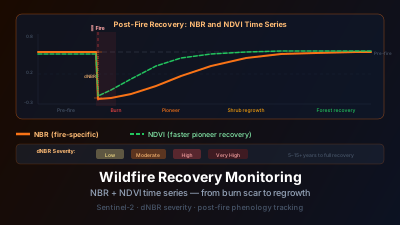
Quick Answer: NBR (Normalized Burn Ratio) is the most sensitive index for detecting fire damage and tracking post-fire recovery. A sharp NBR drop marks the fire event; the depth and duration of the drop indicate burn severity. NDVI begins recovering within weeks from pioneer species; NBR recovers more slowly as woody vegetation regrows. Areas where recovery plateaus well below pre-fire NBR levels may indicate soil damage, erosion, or repeat disturbance risk.
Fire as a Landscape Process
Wildfire is both a natural ecological process and an increasingly disruptive force as climate change expands fire weather conditions worldwide. Understanding post-fire recovery — its speed, spatial variability, and potential failure points — is essential for forest management, carbon accounting, and biodiversity conservation.
Satellite time series monitoring, particularly NBR from Sentinel-2, provides the most detailed and comprehensive tool available for tracking post-fire landscapes from the immediate aftermath through years of recovery.
The Key Indices for Fire Monitoring
NBR — Normalized Burn Ratio
Normalized Burn Ratio is the most fire-specific spectral index available from Sentinel-2:
NBR = (NIR − SWIR) / (NIR + SWIR)
The physical basis is straightforward: healthy vegetation has high NIR reflectance and low SWIR reflectance. After fire:
- Ash and charred material absorb NIR strongly and reflect SWIR
- Exposed bare soil reflects strongly in SWIR
- The NBR calculation amplifies this contrast
Pre-fire NBR for healthy vegetation: typically 0.3–0.8 (higher for denser forest) Post-fire NBR for severely burned areas: can drop to -0.3 to -0.5
dNBR — Differenced NBR
The burn severity is measured as the difference:
dNBR = NBR_pre − NBR_post
Higher dNBR means higher burn severity. Standard thresholds classify burn severity:
| dNBR Range | Burn Severity Class |
|---|---|
| < 0.1 | Unburned or enhanced greenness |
| 0.1 – 0.27 | Low severity |
| 0.27 – 0.44 | Moderate-low severity |
| 0.44 – 0.66 | Moderate-high severity |
| > 0.66 | High severity |
In a time series monitoring context, you watch NBR drop to its post-fire minimum and then track its recovery — an implicit dNBR computed continuously over the monitoring period.
NDVI — Recovery Tracking
While NBR is more sensitive to fire damage, NDVI is a better indicator of photosynthetic recovery because it directly measures green leaf area. The typical post-fire pattern:
- NDVI recovers faster than NBR — Pioneer grasses and forbs begin greening within weeks, pushing NDVI up even while char and bare soil still suppress NBR
- NDVI plateau at intermediate values — Dense grass or shrub recovery holds NDVI at 0.4–0.6 while NBR remains below pre-fire levels
- Both converge at pre-fire levels only when woody vegetation (trees and shrubs) has regrown sufficiently
Monitoring both NBR and NDVI simultaneously gives you:
- NDVI: How much green vegetation is present (any vegetation type)
- NBR: How similar the vegetation structure is to pre-fire conditions (weighted toward woody plants and dense canopy)
SAR Indices for Fire Monitoring
SAR provides several additional perspectives:
VH/RVI: Forest canopy loss reduces volume scattering → VH and RVI drop at fire. Recovery of these indices tracks woody canopy regrowth independently of optical measurements.
All-weather coverage: In the early post-fire period, smoke and ash may affect optical imagery quality. SAR continues to observe the landscape regardless.
The Recovery Trajectory
Post-fire recovery follows a predictable sequence, though the timeline varies enormously with vegetation type, climate, fire severity, and site conditions.
Phase 1: Immediate Aftermath (0–2 months)
- NBR at minimum (deep negative values in high-severity areas)
- NDVI near zero (no green vegetation)
- SAR VH low (no canopy)
- Nighttime lights unaffected unless fire damaged infrastructure
The imagery shows blackened ground, ash, and standing dead trees. This is the most visually striking phase but not necessarily the most informative ecologically.
Phase 2: Pioneer Colonization (2–6 months)
- NDVI begins rising rapidly (pioneer grasses, forbs, and resprouting perennial plants)
- NBR still low (new green cover is thin and cannot mask the underlying ash/char surface)
- This phase is the most dynamic and variable
The rate of pioneer colonization is the first indicator of site resilience:
- Fast green-up → Intact seed bank, favorable soil conditions, adequate precipitation
- Slow green-up → Possible severe soil damage, hydrophobic soils, erosion, or drought stress
Phase 3: Shrub and Early Tree Regrowth (6 months – 2 years)
- NDVI consolidates at moderate levels (0.4–0.6)
- NBR begins recovering as canopy biomass increases
- SAR RVI starts increasing as woody canopy develops
This phase is critical for determining the recovery trajectory — whether the site is heading back toward its original vegetation type or stabilizing at a lower-biomass alternative state.
Phase 4: Mature Recovery (2–10+ years)
- NDVI approaches pre-fire values as canopy closes
- NBR gradually approaches pre-fire levels — the slowest index to recover
- Full recovery to pre-fire NBR levels may take 5–15+ years for mature forest
Non-recovery indicators:
- NBR plateau well below pre-fire levels for years → Site may have shifted to a lower-biomass state (grassland replacing forest)
- Repeated small drops in NDVI and NBR after initial recovery → Repeat disturbance (recurring fire, grazing, insect outbreaks)
Monitoring Setup for Post-Fire Recovery
Immediate Post-Fire Setup
- Draw a polygon over the burned area (and some unburned buffer for comparison)
- Select NBR + NDVI from Sentinel-2 and VH + RVI from Sentinel-1
- Set start date to 3–6 months before the fire to capture pre-fire baseline
- The system automatically collects all historical and future scenes
Setting up monitoring immediately after a fire is reported maximizes the value — you capture the deepest dNBR and begin tracking recovery from day one.
Long-Term Recovery Study
For long-term recovery monitoring (2–5+ years):
- Include NBR, NDVI, SAVI, and SAR RVI/RFDI
- Compare recovery curves between areas of different burn severity
- Compare with unburned reference area for the same vegetation type
Multiple Burned Areas Comparison
Setting up monitoring polygons over different fire events (different years, locations, vegetation types, or management approaches) enables comparison of recovery rates — directly informing fire management and post-fire restoration decisions.
Case Study Patterns
Recovery Timeline by Vegetation Type
Different ecosystems recover at very different rates, reflecting their fire adaptation strategies:
| Vegetation Type | Relative recovery speed | Key Recovery Mechanism |
|---|---|---|
| Grassland / savanna | Fastest — greenness returns within a growing season | Belowground biomass intact; grasses regrow rapidly |
| Mediterranean shrubland (chaparral) | Fast green-up, slower structural recovery | Root resprouting; obligate seeder species |
| Tropical rainforest | Fast green-up, very slow return of old-growth structure | Fast pioneer canopy over a long structural recovery |
| Tropical dry forest | Moderate, and strongly rainfall-dependent | Pioneer trees, vine regrowth |
| Temperate mixed forest | Slow | Stump sprouts + seedling recruitment |
| Boreal forest (spruce/pine) | Slowest — recovery measured in decades | Seed-limited; short growing season in a harsh climate |
How to read this: the ordering is robust, the timelines are not. Actual recovery duration at a given site depends on burn severity, soil damage, post-fire rainfall, seed availability, grazing pressure and whether the site burns again — any of which can stretch recovery well beyond what the vegetation type alone would suggest. Rather than comparing your site to a published timeline, compare it to an unburned reference polygon in the same vegetation type and climate, monitored over the same period. That comparison is what tells you whether recovery is on track or stalled.
Mediterranean Shrubland (Chaparral/Maquis)
Adapted to fire, chaparral species resprout aggressively within weeks, so NDVI climbs back quickly. NBR lags well behind, because the dense woody structure it responds to takes years to reform. Repeat fires arriving before that structure has rebuilt can lock the system out of recovery and shift it toward annual grasses — a transition visible as an NDVI series that keeps recovering while NBR never does.
Boreal Forest
The slowest of the common fire-prone systems, reflecting a short growing season and seed-limited regeneration. NDVI recovers partway from feather moss and pioneer trees and then plateaus below pre-fire levels for a long time; NBR only returns as black spruce and lodgepole pine rebuild canopy structure, which is a multi-decade process.
Tropical Dry Forest
High post-fire resilience where rainfall is adequate — pioneer trees and vines push NDVI back toward pre-fire levels relatively quickly. Degraded sites with cattle grazing during recovery behave differently: NDVI stays suppressed and cycles with the seasonal grass/bare-ground alternation instead of trending upward, which is the signature to look for when distinguishing recovery from arrested recovery.
Reporting Burn Severity and Recovery
NBR time series provides data for:
- Insurance damage assessment — NBR depth and area-weighted burn severity
- Carbon loss estimation — Pre-fire biomass (NDVI proxy) minus post-fire biomass
- Recovery monitoring for management — 6-month, 12-month, 24-month recovery milestones
- Reforestation success verification — NBR reaching pre-fire levels confirms successful restoration
Summary
Post-fire recovery monitoring with NBR and NDVI time series provides the most detailed and accessible picture of how landscapes heal after fire. NBR captures the full cycle from fire damage through gradual canopy reconstruction; NDVI tracks the faster-recovering green vegetation component. Sites where NBR recovery stalls below pre-fire values after 3–5 years may have shifted to an alternative vegetation state, warranting management intervention. SAR RVI fills cloud gaps and provides independent confirmation of woody canopy recovery. The combination of optical and SAR monitoring, set up immediately after a fire with a pre-fire baseline, gives fire managers and ecologists the continuous documentation needed to understand fire impacts and guide recovery.

Remote sensing specialist with 10+ years in satellite data processing and AI. Founder of Off-Nadir Lab. Ph.D. in Informatics (Yokohama National University, 2026). Master's in Earth System Science and Technology (Kyushu University). Co-author, Remote Sensing Encyclopedia. More about the author →