
NASA FIRMS Explained: VIIRS vs MODIS, FRP & Confidence
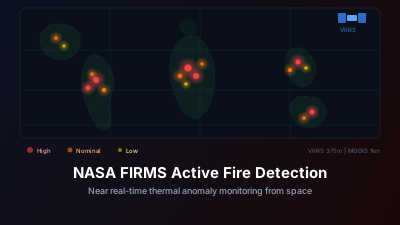
Quick Answer: NASA FIRMS detects active fires using thermal sensors on VIIRS (375m resolution) and MODIS (1km). NASA makes global near real-time detections available within 3 hours of satellite observation, and some US and Canada detections in real time. Off-Nadir Delta displays FIRMS data as a map overlay via NASA GIBS WMS — no API key needed. Users can view fire hotspots by date, compare with satellite imagery, and track fire progression over time.
What Is NASA FIRMS?
NASA FIRMS (Fire Information for Resource Management System) is a global service that distributes near real-time active fire data detected by satellite-borne thermal sensors. Operated by NASA's Land, Atmosphere Near real-time Capability for EOS (LANCE), FIRMS processes data from multiple instruments and delivers fire detections within hours of satellite overpass.
FIRMS data is used worldwide by:
- Fire agencies for early detection and resource allocation
- Environmental researchers tracking deforestation fires
- Insurance companies assessing fire risk exposure
- Disaster response teams coordinating evacuation and containment
How Satellites Detect Fire
Thermal anomaly detection relies on a simple physical principle: fire is significantly hotter than its surroundings. Satellite sensors measure infrared radiation at wavelengths where fire emits strongly (around 3.7 µm and 11 µm), and algorithms flag pixels that are statistically hotter than neighboring pixels.
VIIRS — High-Resolution Detection
The Visible Infrared Imaging Radiometer Suite (VIIRS) flies on three satellites:
| Satellite | Launch | Overpass Times (local) |
|---|---|---|
| Suomi NPP (S-NPP) | 2011 | ~01:30 / ~13:30 |
| NOAA-20 | 2017 | ~01:30 / ~13:30 |
| NOAA-21 | 2022 | ~01:30 / ~13:30 |
NOAA has announced that distribution of all Suomi NPP science products, including VIIRS, ends on November 1, 2026 (NOAA NESDIS). Off-Nadir Delta uses NOAA-20 as the default VIIRS satellite; NOAA-21 is also selectable, and S-NPP remains selectable for dates up to October 31, 2026.
Key specs:
- 375m resolution (I-band) — detects smaller fires than MODIS
- Data latency: global near real-time within 3 hours of observation (NASA FIRMS)
- Swath width: 3,000 km — near-global daily coverage
MODIS — Long-Term Record
The Moderate Resolution Imaging Spectroradiometer (MODIS) provides the longest continuous fire record:
| Satellite | Launch | Status |
|---|---|---|
| Terra | 1999 | Active (25+ years) |
| Aqua | 2002 | Active (23+ years) |
Key specs:
- 1km resolution — detects larger fires
- Data latency: same 3-hour near real-time pipeline as VIIRS — NASA does not publish a separate per-sensor figure
- Archive: Continuous record since 2000
What the Data Shows
Each fire detection represents a pixel where thermal anomaly algorithms confirmed elevated temperatures. The data includes:
- Geographic location (latitude/longitude of the pixel center)
- Confidence level — High, Nominal, or Low
- Fire Radiative Power (FRP) — energy output in megawatts
- Observation time — satellite overpass timestamp
On the map, fire detections typically appear as colored dots:
- Red — High confidence detections
- Orange — Nominal confidence
- Yellow — Low confidence
Every one of these detections is plotted on the live NASA FIRMS fire map, where you can switch between VIIRS and MODIS and step through dates.
VIIRS vs MODIS: Which to Choose?
| Factor | VIIRS | MODIS |
|---|---|---|
| Resolution | 375m | 1km |
| Small fire detection | Better | Limited |
| Data latency | Global NRT within 3 hours | Global NRT within 3 hours |
| Historical record | 2012-present | 2000-present |
| Best for | Current monitoring | Long-term trends |
Recommendation: For near real-time monitoring, use VIIRS — NOAA-20, or All VIIRS to see every VIIRS satellite for the date. Use MODIS when you need historical context going back to 2000.
Using Active Fires in Off-Nadir Delta
Off-Nadir Delta displays FIRMS data directly on the map using NASA GIBS (Global Imagery Browse Services) WMS. No API key or account registration is required for this data.
Quick Start
- Open the Data Layers panel (database icon in the sidebar)
- Select the Active Fires tab
- Choose a sensor — NOAA-20 is the default VIIRS satellite; All VIIRS shows every VIIRS satellite
- Pick an observation date (defaults to yesterday)
- Click Show on Map
Fire hotspots appear as an overlay that you can combine with any satellite imagery layer.
Date Range Mode
For tracking fire progression over multiple days:
- Switch to Date Range mode
- Set start and end dates (up to 31 days)
- Each day is added as a separate layer — toggle individual days on/off in the Layer Manager
Combining with Satellite Imagery
The real power of fire monitoring comes from combining FIRMS hotspots with other data:
- Sentinel-2 optical — See burn scars and smoke plumes in true/false color
- Sentinel-2 NBR — Quantify burn severity using the Normalized Burn Ratio
- Sentinel-1 SAR — Detect burned areas through smoke and cloud cover
- Reference layers — Overlay infrastructure, pipelines, and populated areas to assess risk
Tips
- MODIS data has a ~2-day processing delay. If you select yesterday's date with a MODIS sensor, data may not be available yet. A warning will appear in the UI.
- All VIIRS draws each VIIRS satellite as its own layer, so one satellite's missing day does not blank the others.
- Fire data is available globally — zoom to any region of interest.
- Use the Layer Manager to adjust opacity and compare fire layers with underlying imagery.
Fire Radiative Power (FRP): Interpreting Fire Intensity
Each FIRMS detection includes a Fire Radiative Power value — the rate of radiative energy release from the fire within that pixel, in megawatts. FRP is not just a quality flag; it is a physical measure of how hard the fire is burning at that moment, and it scales with the rate at which fuel is being consumed. That makes it far more informative than a simple hotspot count.
How to use it in practice:
- Relative, not absolute. FRP is most useful for comparison — this fire against that one, today against yesterday, this season against the climatology — rather than as a standalone number with a fixed meaning. A given FRP value corresponds to different things in grassland, savanna, closed-canopy forest, and peat.
- Low values are ambiguous. Small detections are frequently agricultural or land-clearing burns of limited consequence, and are also where false positives concentrate (industrial heat sources, flares). Check the confidence flag and the context before treating one as a wildfire.
- Persistence matters more than a single peak. A cluster of high-FRP pixels that keeps reappearing over successive overpasses indicates sustained large-scale burning; an isolated single-pixel detection usually does not.
- Very high FRP marks extreme fire behaviour. The most intense crown-fire episodes — the kind associated with pyroconvective plumes that can loft smoke to great altitude — sit orders of magnitude above routine detections, so they stand out clearly even without a fixed threshold.
Whatever the FRP values, confirm the result: overlay Sentinel-2 NBR imagery after the fire to map the burned area and check that the detections correspond to real burn scars.
Limitations to Keep In Mind
- Cloud cover can block thermal detection (VIIRS/MODIS are optical sensors)
- Small or low-intensity fires may fall below the detection threshold
- Urban heat islands and industrial sources can cause false detections
- Temporal gaps occur between satellite overpasses (~6-12 hours between passes)
- Pixel size means a single detection covers a 375m × 375m area (VIIRS) — the actual fire may be much smaller
Summary
NASA FIRMS provides one of the most accessible and widely-used fire monitoring datasets available. By integrating it directly into Off-Nadir Delta's map interface, users can overlay fire hotspots on satellite imagery without managing API keys or downloading files. Whether you are tracking an active wildfire, assessing post-fire damage with NBR, or researching fire patterns over time, the combination of FIRMS thermal detections and multispectral satellite imagery provides a comprehensive view of fire activity from space.
Detections at refineries, power plants and gas fields are often routine heat rather than incidents; What Is a Thermal Anomaly? explains how to tell an unusual heat source from a steady one.
For a quick-reference overview of FIRMS sensors and how to use them in Off-Nadir Delta, see the Active Fire Map page. For burn severity analysis, check out Mapping Burn Severity After Wildfires with NBR.

Remote sensing specialist with 10+ years in satellite data processing and AI. Founder of Off-Nadir Lab. Ph.D. in Informatics (Yokohama National University, 2026). Master's in Earth System Science and Technology (Kyushu University). Co-author, Remote Sensing Encyclopedia. More about the author →
Related Articles
What Is a Thermal Anomaly? Telling an Unusual Heat Source from a Routine Flare in Satellite Data
Oct 6, 2026
A Field Guide to Free Satellite Data Sources: Sentinel-1, Sentinel-2, VIIRS, and NASA FIRMS
Jun 19, 2026
Was There a Fire, and When? Confirming and Dating a Reported Fire with Satellite Data
Oct 4, 2026