
Post-Disaster Recovery Monitoring with Satellite Time Series
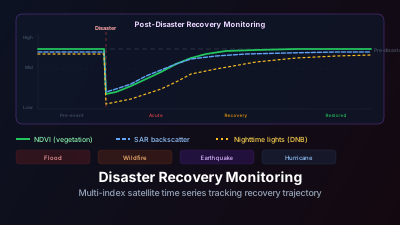
Quick Answer: Post-disaster recovery monitoring uses multiple satellite indices over time to track the return to pre-disaster conditions. Vegetation recovery (NDVI, NBR) tracks ecological restoration; SAR backscatter tracks structural rebuilding; nighttime lights (DNB) track return of population and economic activity. Recovery is rarely linear — setbacks from secondary events, seasonal effects, and resource constraints create complex trajectories that only time series monitoring can fully capture.
Recovery is a Process, Not an Event
When a disaster strikes — a flood, earthquake, wildfire, or cyclone — the immediate humanitarian focus is on the acute emergency phase. But recovery can take months or years, and its spatial distribution is highly uneven. Some areas recover quickly; others remain damaged long after the event.
Satellite time series monitoring provides objective, area-wide tracking of recovery progress without requiring ground access. It reveals which communities are recovering fastest, where reconstruction is lagging, and whether declared recovery milestones match observable change on the ground.
Different Disasters, Different Recovery Signatures
Each type of disaster has a characteristic time series signature that differs in the type of change, the indices that detect it, and the expected recovery trajectory.
Flood Recovery
Phase 1 — Inundation (days to weeks):
- NDWI/MNDWI: Strong increase as floodwaters cover land
- SAR VV: Sharp decrease (specular reflection off water)
- Nighttime lights: Drop if power infrastructure flooded
Phase 2 — Water recession (days to weeks):
- NDWI/MNDWI: Return toward baseline as water recedes
- SAR VV: Recovery toward pre-flood levels
Phase 3 — Agricultural/ecological recovery (weeks to months):
- NDVI: Initially low (waterlogged or damaged crops), gradual recovery as vegetation regrows
- NDMI: Remains elevated for weeks even after surface water recedes (waterlogged soil)
Indicators of incomplete recovery:
- NDVI remaining below seasonal baseline indicates crop/vegetation damage
- NDWI elevated at wet-season baseline indicates drainage infrastructure not yet repaired
- Nighttime lights not returning to pre-flood levels indicates displaced population has not returned
Wildfire Recovery
Phase 1 — Active fire and immediate aftermath:
- NBR: Sharp negative spike (NBR = NIR − SWIR; burned areas have low NIR, high SWIR)
- NDVI: Collapse toward near-zero
- SAR VH/RVI: Decrease as canopy is destroyed
Phase 2 — Initial regrowth (months):
- NDVI begins recovering as grasses and pioneer species emerge
- NBR recovery is slow in heavily burned areas
Phase 3 — Forest regrowth (years to decades):
- Shrub and early successional tree regrowth gradually pushes NDVI toward pre-fire levels
- SAR RVI recovers as canopy volume is rebuilt
Monitoring value: The rate of NDVI and NBR recovery indicates ecological resilience. Areas with slow recovery may face soil degradation, erosion, or repeat disturbance risk.
Earthquake Recovery
Earthquakes themselves are not directly visible in optical or SAR imagery — they happen in seconds. What is visible is the structural damage aftermath and subsequent reconstruction.
Damage assessment (post-quake):
- SAR coherence loss (change detection using SAR phase information) identifies collapsed buildings and land subsidence
- SAR VV/VH changes in urban areas indicate structural change
- Nighttime lights: Drop in severely damaged areas (power disruption, evacuation)
Reconstruction monitoring (months to years):
- SAR VV backscatter in urban areas: Initially low (rubble scatters differently than intact buildings), then gradually increasing as reconstruction occurs
- Nighttime lights: Gradual return toward pre-quake levels tracking population return and grid restoration
Cyclone/Hurricane Recovery
Vegetation damage:
- NDVI: Sharp drop from defoliation and mechanical damage to forests and crops
- Recovery rate depends on storm intensity and vegetation type
- Slow NDVI recovery in repeated-storm pathways indicates accumulated stress
Infrastructure:
- SAR VV: Changes in coastal and urban areas from storm surge damage
- Nighttime lights: Recovery trajectory tracks power restoration progress
A recurring pattern worth watching for: after a major tropical cyclone, vegetation indices over the affected area can stay below their pre-storm seasonal baseline well beyond the initial defoliation, and in some cases the shortfall is compounded by secondary deforestation — communities cutting timber and making charcoal during a period when normal fuel and income sources are disrupted. Where that happens, NDVI does not simply recover along a smooth curve; parts of the area step down to a lower baseline and stay there. This is exactly the kind of second-order effect that only time series monitoring surfaces, and it is worth checking for explicitly rather than assuming recovery is monotonic.
Setting Up Multi-Index Recovery Monitoring
For comprehensive post-disaster recovery monitoring, set up monitoring with all relevant indices for the affected area:
- Navigate to the disaster-affected area and draw a polygon
- Select indices appropriate to the disaster type:
- Flood: NDWI + MNDWI + NDVI + SAR VV + VIIRS DNB
- Fire: NBR + NDVI + SAR VV + SAR VH + SAR RVI
- Earthquake: SAR VV + SAR VH + VIIRS DNB
- All disasters: Include DNB for infrastructure/population tracking
- Set start date to at least 6 months before the disaster to establish a pre-event baseline
- Let the monitoring system collect historical data and continue updating as new scenes arrive
Reading Recovery Progress
The Recovery Curve
A healthy recovery curve shows:
- Pre-disaster baseline
- Sudden anomaly at disaster date
- Stabilization at post-disaster level
- Gradual rise back toward baseline
- Return to pre-disaster level (full recovery)
In practice, recovery curves are rarely this clean. Common complicating patterns include:
Secondary events: A drought following a flood, or a new storm during hurricane season, can interrupt recovery and create a second dip in the time series.
Seasonal effects: Agricultural areas show seasonal NDVI cycles regardless of disaster status — a recovery that looks good in summer may still be below pre-disaster summer baseline compared to the same season in prior years.
Incomplete recovery at new equilibrium: Some areas permanently change after a disaster. A flooded neighborhood converted to a park will have different NDVI baseline than the former residential development. Recovery to a new normal is still recovery.
Spatial Variation in Recovery
A single polygon covering an entire affected region will average diverse recovery trajectories. For spatial detail, use multiple smaller polygons covering:
- Different administrative zones (district-by-district comparison)
- Different land use types (agricultural vs. urban vs. forest)
- Areas of known aid intervention vs. control areas
This granular approach reveals spatial inequity in recovery — a concern for humanitarian planners and governments.
Recovery Timescales: What to Expect from Each Index
Recovery durations vary enormously by event, region, and the resources available for reconstruction, so there is no table of standard timelines to look a number up in. What is transferable is the relative ordering of the indices — which signal comes back first, and what its return actually means:
Water indices recover first, and fastest. Flood water recedes over days to weeks, and SAR VV over open land returns to its pre-flood level as soon as the surface is no longer specular. This is the cleanest recovery signal in the whole set, and also the least meaningful: water leaving does not mean damage is repaired.
Vegetation recovers on a seasonal-to-multi-year scale, depending on what burned or drowned. Grass and annual crops re-establish within a growing season or two. Forest canopy after a high-severity burn is a multi-year to multi-decade process, and NBR recovery tracks canopy closure rather than ecosystem recovery — a stand can look green again long before it is structurally or ecologically restored. The standard dNBR severity classes (dNBR above roughly 0.66 indicating high severity) are the right starting point for setting expectations, since severity is the strongest predictor of how long recovery will take.
Structural signals recover slowest and least legibly. Urban SAR backscatter after an earthquake changes character as rubble is cleared and buildings are replaced, but the trajectory is dominated by reconstruction funding and policy, not by any physical process with a characteristic timescale. Expect years, and expect wide variation between neighbourhoods within the same city.
Nighttime lights track people and power, and are the most socially informative. Grid restoration can be quick or can take many months; the recovery curve reflects the state of the utility and the scale of investment more than the severity of the initial damage.
The one robust cross-event pattern: nighttime lights typically recover faster in wealthy, well-insured areas and slower in poor or conflict-affected regions — making the recovery gap a satellite-observable proxy for inequality in disaster response. Because it is a relative comparison within a single event, it is far more defensible than any absolute recovery-duration figure.
Comparing Recovery Across Events
Long-term monitoring enables comparison of recovery rates across different events:
- Does a wealthier district recover faster than a poorer one after the same disaster?
- Do forests in protected areas recover faster than unprotected forests after fires?
- Does improved drainage infrastructure in one area result in faster NDWI recovery after floods?
These comparative analyses are the foundation of evidence-based disaster risk reduction policy.
Reporting Recovery Progress
Satellite time series provides objective, reproducible data for recovery reporting:
- Monthly updates on NDVI recovery percentage
- Nighttime lights as % of pre-disaster level
- Number of weeks to return to pre-disaster baseline for different indices
This data can supplement and validate ground-level assessments, provide independent verification of recovery claims, and identify areas that may need additional support.
Summary
Post-disaster recovery monitoring uses satellite time series across multiple indices to objectively track the trajectory from disaster impact to restoration. Vegetation recovery appears in NDVI and NBR; structural rebuilding in SAR backscatter; population and economic return in nighttime lights. The key is establishing a pre-disaster baseline against which recovery progress can be measured, monitoring continuously over weeks and months, and comparing recovery rates across different areas and sectors to guide resource allocation. Recovery is complex and non-linear — only time series monitoring captures its full dynamics.

Remote sensing specialist with 10+ years in satellite data processing and AI. Founder of Off-Nadir Lab. Ph.D. in Informatics (Yokohama National University, 2026). Master's in Earth System Science and Technology (Kyushu University). Co-author, Remote Sensing Encyclopedia. More about the author →