
Monitoring Economic Activity and Infrastructure with VIIRS Nighttime Light Time Series
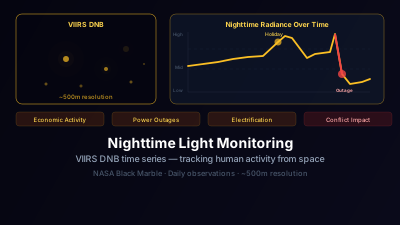
Quick Answer: VIIRS Day/Night Band (DNB) measures nighttime radiance at ~500m resolution, updated daily. Time series monitoring of DNB tracks economic activity through patterns of artificial light: cities brighten as they grow, drop during power outages, and slowly recover after disasters. Seasonal patterns include Ramadan lights in Middle Eastern cities, agricultural burning in South Asia, and fishing fleet activity in coastal waters. The DNB needs no external illumination — it measures the light a place emits at night rather than reflected sunlight — but clouds still block the view, so usable observations are limited to cloud-free nights and the effective temporal resolution depends on local cloud cover.
Why Nighttime Lights Reveal What Daytime Imagery Misses
Satellite imagery in daylight shows the physical landscape — what is there. Nighttime imagery shows which parts of that landscape are actively powered and occupied at night — which is often a better proxy for economic activity, population distribution, and infrastructure status.
The VIIRS Day/Night Band (DNB) sensor aboard the Suomi NPP, NOAA-20, and NOAA-21 satellites measures low-level light emissions at night with remarkable sensitivity — capable of detecting single fishing vessels at sea or the lights of a small village in a remote region.
NASA Black Marble (VNP46A2 from Suomi NPP, VJ146A2 from NOAA-20) is the science-quality processed product derived from VIIRS DNB data. It applies corrections for moonlight, atmospheric scattering, cloud screening, and snow cover to provide measurements of actual anthropogenic (human-caused) light emission — not just raw brightness.
In Off-Nadir Delta, the daily series comes from VJ146A2 (NOAA-20) for dates from 2019-08-28, and from the Suomi NPP archive product VNP46A2 for earlier dates. NOAA has announced that Suomi NPP data distribution ends on November 1, 2026 (NOAA NESDIS); the Black Marble User Guide treats both products as the same algorithm, but NASA publishes no cross-sensor calibration figure. A monitor that ran on Suomi NPP continues on NOAA-20 after its last Suomi NPP point, so a step at the switch is not by itself a change on the ground.
What DNB Monitors
Urban Economic Activity
City brightness correlates with economic activity: more commerce, industry, and transportation means more light. Over years, you can observe:
- Urban growth — New residential and commercial development produces new light sources
- Economic recession or recovery — Downtown brightness follows business cycles
- Industrial activity — Manufacturing zones vary with production levels
The correlation is not perfect — energy-efficient LED conversion can reduce measured brightness even as economic activity grows — but within a consistent technology era, DNB trends are informative.
Power Infrastructure
Electricity access is fundamental to development. DNB time series tracks:
- Rural electrification — Gradual brightening as grid access expands
- Power outage events — Sudden drops during grid failure (storms, conflicts, infrastructure damage)
- Recovery progress — The rate at which brightness returns to pre-event levels after a disaster
Following Hurricane Maria in Puerto Rico (2017), NASA used Black Marble nighttime lights to track the recovery of electricity service across the island, revealing which communities recovered fastest and where restoration lagged. NASA reports that in the six months after the storm Puerto Ricans lost an estimated 3.9 billion hours of access to electric power, with rural areas accounting for 61% of that loss and some residents in the mountainous interior going without power for more than 120 days.
Conflict and Displacement
Armed conflict has a dramatic impact on nighttime lights:
- Active conflict zones — Cities being contested or bombed show sudden sharp drops
- Mass displacement — Population evacuation empties formerly lit areas
- Conflict cessation — Recovery of normal light levels signals return of displaced population and resumption of economic activity
Researchers have used Syrian city nighttime lights to estimate conflict intensity and correlate with humanitarian data on displacement — the best-known example being the Wuhan University analysis showing that 83% of Syria's visible night-time lights had gone out in the four years after the conflict began in March 2011.
Agricultural and Fishing Activity
DNB also captures natural and human seasonal activity:
Agricultural burning — Large-scale crop residue burning at harvest time creates strong nighttime signals in agricultural regions of South Asia, Sub-Saharan Africa, and Southeast Asia. These signals are seasonal and predictable, creating clear annual patterns.
Fishing fleet activity — Many fishing fleets use powerful lights to attract squid and small fish at night. The squid fishing fleets of the East China Sea, Argentine coast, and South Atlantic are clearly visible from space as bright concentrations moving seasonally.
Ramadan patterns — In Muslim-majority regions, nighttime lighting increases during Ramadan evenings (later peak activity hours) and drops during Eid holidays.
How DNB Monitoring Works
VIIRS DNB provides near-daily observations at approximately 500-meter resolution. However, clouds still block the view (unlike SAR), so the effective temporal resolution depends on local cloud cover.
Monthly Composites vs. Daily Data
NASA Black Marble provides both daily observations and monthly composites:
- Daily data: Higher temporal resolution but many cloud gaps
- Monthly composites: Cloud-free mosaic using the clearest observations of the month
For long-term trend monitoring, monthly composites provide more reliable baselines. For event response (detecting a sudden power outage), daily data is needed.
Setting Up a DNB Monitor
- Navigate to your area of interest — city, region, industrial zone, or rural electrification area
- Draw a polygon over the area
- Select VIIRS (Nighttime) → DNB - Nighttime Radiance
- Set a start date appropriate to your question:
- Long-term economic trends: 2–5 years back
- Post-disaster recovery: start 3 months before the event
- Electrification tracking: start when the project began
Reading the DNB Time Series Graph
The y-axis shows nighttime radiance in nW/cm²/sr (nanowatts per centimeter squared per steradian). Higher values = more light.
Expected patterns:
- Smooth annual cycles with seasonal variations
- Holidays and special events create short-term spikes
- Urban pixels: stable high values; rural pixels: low values with occasional spikes from burning or events
Anomaly indicators:
- A sudden drop to near-zero in a normally bright urban area → power outage
- A step increase that does not reverse → new development or electrification
- A step decrease that does not recover → depopulation or economic collapse
Interpreting Seasonal Patterns Correctly
DNB time series has strong seasonal patterns that are expected and should not be confused with real economic changes:
Winter patterns: At high latitudes, longer nights mean more hours of artificial lighting are captured. DNB values are often higher in winter simply due to the longer dark period.
Agricultural fire seasons: South Asia and Sub-Saharan Africa show annual spikes during crop residue burning seasons. These are expected, not anomalies.
Holiday effects: Christmas, Diwali, Chinese New Year, and other regional holidays produce visible short-term spikes.
Cloud effects on daily data: Even with quality filtering, cloud-affected observations can suppress apparent brightness. Check cloud cover for any suspicious dips.
Combining DNB with Daytime Data
DNB monitoring is most powerful when combined with other data sources:
- Sentinel-2 NDVI for the same area — compare economic activity (lights) with vegetation condition
- SAR backscatter — construction visible in SAR corresponds with new light sources in DNB
- Population estimates — brightness per capita changes track electrification equity
- GDP data — at national/regional scale, DNB changes correlate with economic growth estimates
Applications by Sector
Humanitarian: Power restoration progress after earthquakes, hurricanes, or conflict. Monthly DNB maps of affected regions can guide recovery priorities.
Finance and markets: Industrial activity in manufacturing zones, port and logistics hub activity levels.
Energy sector: Grid expansion planning, identifying high-demand unelectrified areas, estimating energy demand.
Research: Long-term urbanization mapping, nighttime light as a proxy for economic development in regions without reliable statistics.
Reading DNB Radiance Values
DNB radiance spans several orders of magnitude, and what matters for monitoring is where a place sits on that scale and how it moves — not an absolute number. Ranked from brightest to faintest, the scene types you will encounter are:
| Scene / Context | Where it sits on the DNB scale | Notes |
|---|---|---|
| Dense urban core (Tokyo, New York) | Brightest land signal | Can saturate at extremely bright point sources |
| Suburban commercial area | High | Stable with mild seasonal variation |
| Small rural town | Moderate | Clearly visible from space; useful electrification baseline |
| Isolated village / partial electrification | Low, near the detection threshold | Still trackable over time if the baseline is stable |
| Active squid fishing fleet | Isolated bright points over dark ocean | Bright relative to their surroundings; migrate seasonally |
| Agricultural burning | Short, sharp spike | Brief duration; strong seasonal pattern in South Asia and Africa |
| Dark forest / open ocean | Sensor noise floor | Effectively zero anthropogenic light |
| Power outage in an urban area | Sudden collapse toward the noise floor | Magnitude of the drop scales with how much of the grid is down |
Interpreting recovery: the useful measurement after a disaster is not the raw radiance but the ratio to a same-season pre-event baseline for the same polygon, tracked week by week. Satellite-observed recovery routinely lags headline restoration announcements, because a re-energised feeder does not mean every household on it is lit — this was the central finding of the Black Marble work on Puerto Rico described above. The same ratio-to-baseline method applies to conflict (the Syrian case), to grid failures, and to demand shocks such as pandemic lockdowns, where the residential increase partly offsets the commercial and transport decrease and the net change in city-scale brightness is smaller than intuition suggests.
Limitations
Blooming effect: Bright sources spread into adjacent dark pixels in the DNB data, making point sources appear larger than they are. Large city centers can appear to cover surrounding suburban areas.
Resolution constraints: At ~500m resolution, individual buildings are not distinguishable. This is neighborhood-level or region-level monitoring, not building-level.
Seasonal and atmospheric corrections: While Black Marble products apply corrections, residual seasonal effects remain. Always interpret changes relative to the same-season historical baseline.
Over-saturation: Extremely bright sources (oil flares, large cities) may saturate the sensor, limiting sensitivity to changes at already-bright locations.
Summary
VIIRS DNB time series monitoring tracks nighttime light as a proxy for economic activity, electrification, conflict impact, and post-disaster recovery. Monitoring any area over months to years reveals whether it is growing, declining, disrupted, or recovering — information that is often unavailable from any other open data source. The key to correct interpretation is understanding expected seasonal patterns (longer winter nights, agricultural burning, fishing seasons) so that genuine anomalies — power outages, new development, displacement — stand out clearly.

Remote sensing specialist with 10+ years in satellite data processing and AI. Founder of Off-Nadir Lab. Ph.D. in Informatics (Yokohama National University, 2026). Master's in Earth System Science and Technology (Kyushu University). Co-author, Remote Sensing Encyclopedia. More about the author →