
Estimating Soil Moisture with SAR: Why Radar Sees What Optical Can't
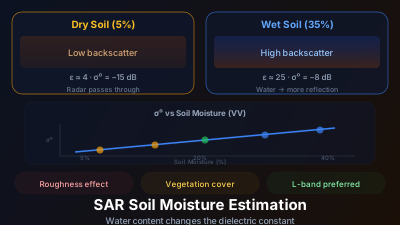
Quick Answer: Radar backscatter is sensitive to soil moisture because water dramatically changes soil's dielectric constant. Dry soil (dielectric ~3-5) reflects little radar energy; wet soil (dielectric ~15-30) reflects significantly more, appearing 3-8 dB brighter in SAR images. Sentinel-1 C-band can detect soil moisture changes in bare or sparsely vegetated fields, but dense vegetation canopy obscures the soil signal. The relationship is strongest for VV polarization on bare soil. Operational soil moisture products (like SMAP and Sentinel-1-based retrievals) combine radar with models to provide global estimates.
SAR images of the same area can look completely different before and after rain. Fields that were medium gray turn almost white. Roads barely change. Water bodies stay black. That pattern is one of radar's most useful properties — its sensitivity to soil moisture — and it follows directly from the physics of how microwaves interact with water in the ground.
The Physics: Dielectric Constant
The connection between radar and soil moisture runs through a material property called the dielectric constant (ε). The dielectric constant describes how a material interacts with electromagnetic waves — specifically, how much it polarizes in response to an electric field.
Water has a very high dielectric constant (~80 at microwave frequencies). Dry soil minerals have a low dielectric constant (~3-5). When you add water to soil, the mixture's dielectric constant increases dramatically:
| Volumetric Soil Moisture | Dielectric Constant (approx.) | SAR Response |
|---|---|---|
| 5% (very dry) | ~4 | Low backscatter |
| 15% (moderate) | ~10 | Medium backscatter |
| 25% (moist) | ~18 | High backscatter |
| 35% (wet) | ~25 | Very high backscatter |
| 40%+ (saturated) | ~30+ | Maximum backscatter |
This relationship is roughly linear in the 5-35% moisture range, which conveniently covers the range most relevant to agriculture. A 10% increase in volumetric soil moisture typically produces a 2-4 dB increase in C-band backscatter — easily detectable by Sentinel-1.
Why VV Polarization Works Best for Soil Moisture
Sentinel-1 transmits and receives in two polarizations: VV (vertical transmit, vertical receive) and VH (vertical transmit, horizontal receive).
For bare soil moisture estimation, VV polarization is preferred because:
- VV backscatter from bare soil is dominated by surface scattering, which is directly related to dielectric constant (moisture) and surface roughness
- VH backscatter involves depolarization, which is more influenced by volume scattering (vegetation canopy) and less directly tied to soil moisture
The practical consequence: on bare, smooth soil the VV response to volumetric moisture is a fraction of a decibel per percentage point. Set against Sentinel-1's radiometric accuracy — on the order of 1 dB — that means only moisture changes of several percentage points stand clearly above the measurement floor. Small changes are real but not separable from noise in a single pair of scenes; they emerge only from a time series.
The Surface Roughness Problem
Here's the complication that keeps soil moisture retrieval from being simple. Backscatter depends on two factors simultaneously: moisture and surface roughness.
A rough, dry field can produce the same backscatter as a smooth, wet field. Without knowing the roughness, you can't isolate the moisture signal.
Approaches to handle this:
Multi-temporal change detection: If surface roughness doesn't change between two dates (no plowing, no erosion), the backscatter difference is attributable to moisture change. This works well for monitoring moisture changes over time but can't give absolute moisture values.
Polarization ratio: The VV/VH ratio (a co-pol to cross-pol ratio) is less sensitive to roughness than either channel alone, providing a more robust — if less sensitive — moisture indicator.
Model inversion: Physical backscatter models (like the Integral Equation Model or Oh model) relate backscatter to both roughness and moisture. With multi-polarization or multi-angle data, both parameters can be estimated simultaneously.
The Vegetation Problem
Vegetation above the soil attenuates the soil-surface signal and adds its own volume scattering contribution. As crop canopy develops through the growing season:
- Early season (bare soil or seedlings): SAR sees the soil directly. Moisture estimation works well.
- Mid-season (partial canopy): Vegetation partially obscures the soil. Estimation accuracy degrades.
- Full canopy (closed crop): Vegetation dominates the signal. Soil moisture estimation becomes unreliable at C-band.
The transition point depends on crop type and radar wavelength. For C-band over wheat, the soil signal becomes negligible once the crop height exceeds about 30-40 cm (roughly NDVI > 0.6). For corn, the canopy effect is even stronger due to the larger plant structure.
L-band radar (~24 cm wavelength, like NISAR) penetrates deeper into vegetation canopy, maintaining soil moisture sensitivity at higher biomass levels. This is one of the key motivations for L-band missions.
Operational Soil Moisture Products
Several global soil moisture products are available:
Sentinel-1 Based Retrievals
ESA and various research groups produce soil moisture maps from Sentinel-1 at approximately 1 km resolution. The Copernicus Global Land Service provides a Surface Soil Moisture (SSM) product updated every 1-3 days (depending on Sentinel-1 overpasses).
The approach typically uses change detection relative to dry and wet reference conditions, normalized to produce a relative moisture index (0-100%) rather than absolute volumetric moisture.
SMAP
NASA's Soil Moisture Active Passive mission (launched 2015) provides global soil moisture at ~36 km resolution using an L-band radiometer. While the active radar component failed shortly after launch, the passive radiometer continues to provide the most reliable global soil moisture dataset.
SMAP's coarse resolution limits its utility for field-scale agriculture, but it excels at regional drought monitoring and climate applications.
Combined Products
The most promising approaches combine C-band SAR (high resolution, moisture + roughness sensitivity) with L-band radiometry (coarser resolution but more direct moisture measurement) and physical models. Downscaling SMAP data using Sentinel-1 spatial patterns can produce field-scale moisture estimates with regional-scale accuracy.
Practical Tips
Timing matters: Acquire SAR data early morning (ascending passes in some orbit configurations) when soil moisture reflects recent precipitation rather than afternoon evaporative losses.
Frozen soil looks dry: Frozen water doesn't contribute to the dielectric constant the same way liquid water does. Winter SAR data over frozen ground shows low backscatter regardless of actual water content.
After heavy rain: Very wet soil surfaces can become smooth (rainfall breaks up soil aggregates), reducing roughness-related backscatter while increasing moisture-related backscatter. These opposing effects can partially cancel, making post-rain moisture retrieval less straightforward than expected.
Irrigation detection: The 6-12 day Sentinel-1 revisit can detect irrigation events as sudden backscatter increases in agricultural fields. This has practical value for water resource management — tracking which fields are being irrigated and how frequently.
Detecting Irrigation Events: What to Expect
Identifying irrigation events in a Sentinel-1 time series means recognising patterns rather than reading absolute values. The direction and rough scale of the signal follow from the physics described above:
| Scenario | Expected VV response | How detectable |
|---|---|---|
| Flood irrigation on bare soil | Largest response of any scenario — but the sign depends on whether water ponds. Wetting the soil raises backscatter; standing water on the surface reflects the pulse away and lowers it sharply | Strong signal, but interpret the direction before assuming a wetting event |
| Sprinkler irrigation on bare soil | Clear increase as soil dielectric rises, without ponding | Usually detectable |
| Drip irrigation on bare soil | Small increase — only a fraction of the surface is wetted | Often within scene-to-scene noise |
| Irrigation on mature canopy (NDVI > 0.6) | Little to none — the soil signal is obscured by the canopy | Not usable at C-band |
| Natural rain event on bare soil | Increase of similar character to sprinkler irrigation | Detectable, but indistinguishable from irrigation on the SAR signal alone |
The ambiguity between irrigation and rainfall is the central challenge. Cross-referencing SAR backscatter anomalies against local precipitation records (ERA5 reanalysis or station data) helps separate the two. A VV change on a day with no recorded rainfall in a dry region points to irrigation. Note the sign is not always positive: as the table above shows, wetting bare soil raises backscatter, but water ponding on the surface reflects the pulse away and lowers it, so a flood-irrigated field can read as a drop rather than a spike. A change coinciding with 15 mm of rain is ambiguous either way.
The timing signature: Irrigation events in a given field tend to recur at regular intervals (every 7, 10, or 14 days depending on crop and system type), while rainfall events are irregular. Building a time series of VV anomalies over a full growing season and looking for periodicity is more reliable than interpreting any single event.
What This Means for Agriculture
Soil moisture is arguably the most important variable in crop management that can't be easily measured at scale from the ground. Tensiometers and capacitance probes measure individual points; satellite SAR covers entire regions simultaneously.
The current state of the technology: SAR-based soil moisture provides useful relative information (this field is wetter than that field; this week is drier than last week) rather than precise absolute measurements. For agricultural decision-making — when to irrigate, where drought stress is developing, which fields received recent rainfall — relative information is often sufficient.
L-band missions are now contributing: NISAR data is publicly distributed through the Alaska Satellite Facility. As data fusion techniques improve, the accuracy and coverage of satellite soil moisture should continue to advance. The physics is well-understood; the engineering challenge is in separating the moisture signal from the many other factors that influence radar backscatter.

Remote sensing specialist with 10+ years in satellite data processing and AI. Founder of Off-Nadir Lab. Ph.D. in Informatics (Yokohama National University, 2026). Master's in Earth System Science and Technology (Kyushu University). Co-author, Remote Sensing Encyclopedia. More about the author →