Synthetic Aperture Radar (SAR): The Complete Guide
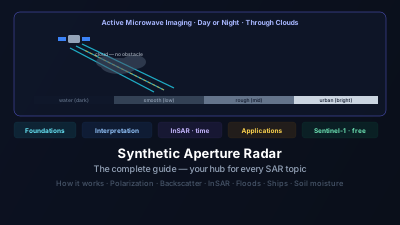
Quick Answer: Synthetic Aperture Radar (SAR) is an active microwave sensing technology that images Earth's surface day or night, through clouds, rain, and smoke. Unlike optical sensors that measure reflected sunlight, SAR transmits its own radar pulses and measures the backscattered signal, which depends on surface roughness, geometry, and moisture. This guide is a structured hub: start with how SAR works and why it penetrates clouds, then move through interpretation (polarization, backscatter, speckle), advanced techniques (InSAR, coherence change detection), and applications (flooding, ships, oil spills, soil moisture, agriculture). Sentinel-1 provides free C-band SAR with a 6-12 day revisit, making operational SAR monitoring accessible to everyone.
What Is SAR, and Why Is It Different?
Most satellite imagery you've seen is optical — it measures sunlight reflected off the Earth, just like a camera. That approach has two hard limits: it needs daylight, and it's blocked by clouds. In many of the places and moments that matter most — a flood under a storm, a tropical forest under perpetual cloud, a ship at night — optical sensors simply can't see.
Synthetic Aperture Radar (SAR) removes both limits. SAR is an active sensor: it transmits its own microwave radar pulses toward the ground and measures the signal that scatters back. Because it provides its own illumination and uses microwave wavelengths that pass through clouds, SAR images the surface day or night, in any weather.
This guide is a structured hub for everything SAR. Each section links to a deep-dive article — read top to bottom for a full education, or jump to the topic you need.
Part 1 — Foundations
Start here if SAR is new to you. These articles build the mental model you need before interpreting any radar image.
- Getting Started with Sentinel-1 SAR — your first hands-on introduction to the world's most accessible SAR satellite.
- Why SAR Sees Through Clouds — the physics of microwave wavelengths and atmospheric penetration.
- How to Read a SAR Image — why radar images look so different from photos, and how to interpret bright and dark areas.
- Ascending vs Descending Orbits — how viewing geometry changes what you see and when.
Part 2 — Interpreting the Signal
SAR brightness is not color — it's physics. These articles explain what the numbers actually mean.
- SAR Polarization Demystified (VV/VH) — how the orientation of the radar wave reveals surface type and structure.
- The SAR Backscatter Coefficient — turning raw radar returns into calibrated, comparable measurements (sigma-nought).
- SAR Speckle Noise and Filtering — why SAR looks grainy and how to clean it without destroying detail.
- Sentinel-1 GRD vs RTC — choosing the right processing level for terrain-corrected analysis.
- Multi-Temporal SAR Color Composites — visualizing change by stacking dates into RGB.
Part 3 — Advanced Techniques
Once you can read a single image, these methods extract change and deformation over time.
- InSAR Explained — using the radar phase to measure millimeter-scale ground movement.
- Coherence Change Detection — detecting disturbance by how consistent the radar signal stays between passes.
- SAR Backscatter Time Series — monitoring a location continuously with all-weather radar.
- SAR-Optical Data Fusion — combining radar and optical for results neither achieves alone.
Part 4 — Applications
This is where SAR's all-weather, all-hours capability pays off. Each links to a practical workflow.
| Application | What SAR contributes | Deep dive |
|---|---|---|
| Flood mapping | Smooth water appears dark; works under storm clouds | Flood Mapping with SAR |
| Maritime / ship detection | Metal ships are bright against dark sea, day or night | Ship Detection with SAR |
| Oil spill detection | Oil dampens waves, appearing as dark slicks | Oil Spill Detection with SAR |
| Soil moisture | Backscatter rises with surface water content | SAR Soil Moisture Estimation |
| Ground deformation | InSAR measures subsidence and uplift | Ground Subsidence InSAR |
| Forest monitoring | Penetrates canopy; longer wavelengths reach biomass | Forest Biomass Estimation |
How to Choose: SAR or Optical?
SAR is powerful but not always the answer. The decision usually comes down to clouds, timing, and what physical property you're measuring:
- Use SAR when you need all-weather, day-or-night coverage, are tracking water/moisture/structure, or measuring ground movement.
- Use optical when you need color, vegetation health (NDVI), or human-interpretable imagery in clear conditions.
- Use both when you can — fusion gives the most reliable time series.
The full decision framework is in SAR vs Optical: Choosing the Right Sensor.
Getting Started with SAR Yourself
The barrier to using SAR has collapsed. Sentinel-1 provides free C-band SAR with a systematic global acquisition plan and a 6-12 day revisit, and analysis-ready products remove most of the heavy preprocessing. In Off-Nadir Delta you can load Sentinel-1 imagery for any area, build a backscatter time series, and set up continuous area monitoring without installing any desktop software.
Key Takeaways
- SAR is active microwave imaging — it provides its own illumination and sees through clouds, day or night.
- Brightness reflects physics, not color: surface roughness, geometry, and moisture drive backscatter.
- Polarization, backscatter calibration, and speckle filtering are the core interpretation skills.
- InSAR and coherence unlock change and millimeter-scale deformation over time.
- Applications span flooding, maritime, oil spills, soil moisture, deformation, and forestry.
- Sentinel-1 makes SAR free and operational — the perfect place to start.
Sentinel-1 SAR data is part of the EU Copernicus programme, operated by ESA, and distributed free and open.

Remote sensing specialist with 10+ years in satellite data processing and AI. Founder of Off-Nadir Lab. Master's in Earth System Science and Technology (Kyushu University). Co-author, Remote Sensing Encyclopedia. More about the author →