
Sentinel-2 vs. Landsat 9: A Practical Comparison for Earth Observation
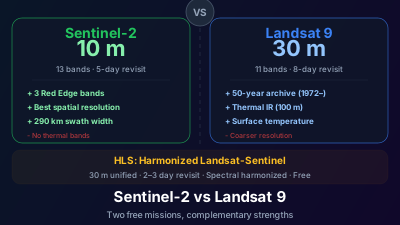
Quick Answer: Sentinel-2 offers higher spatial resolution (10m vs. 30m), more frequent revisit (5 days vs. 16 days), and additional red-edge bands valuable for vegetation analysis. Landsat 9 offers a 50-year archive (back to 1972 with earlier Landsat missions), thermal infrared bands (absent on Sentinel-2), and proven long-term calibration stability. For new projects: Sentinel-2 is generally preferred for its resolution and revisit. For time series extending before 2015: Landsat is the only option. For thermal applications (evapotranspiration, urban heat): Landsat is required. The Harmonized Landsat-Sentinel (HLS) dataset combines both into a consistent, analysis-ready product at 30m resolution with 2-3 day effective revisit — the best of both worlds for many applications.
"Should I use Sentinel-2 or Landsat?" is probably the most frequently asked question in optical remote sensing. The answer depends on what you're doing — and increasingly, the best answer is "both."
Spectral Comparison
Sentinel-2 MSI (13 bands)
| Band | Wavelength (nm) | Resolution | Primary Use |
|---|---|---|---|
| B1 | 443 (Coastal aerosol) | 60m | Atmospheric correction |
| B2 | 490 (Blue) | 10m | Water, atmospheric |
| B3 | 560 (Green) | 10m | Vegetation, water |
| B4 | 665 (Red) | 10m | Vegetation (chlorophyll absorption) |
| B5 | 705 (Red-edge 1) | 20m | Vegetation stress, chlorophyll |
| B6 | 740 (Red-edge 2) | 20m | Canopy structure |
| B7 | 783 (Red-edge 3) | 20m | LAI, chlorophyll |
| B8 | 842 (NIR broad) | 10m | Vegetation, biomass |
| B8A | 865 (NIR narrow) | 20m | Vegetation, water vapor |
| B9 | 945 (Water vapor) | 60m | Atmospheric correction |
| B10 | 1375 (Cirrus) | 60m | Cirrus cloud detection |
| B11 | 1610 (SWIR 1) | 20m | Vegetation moisture, snow, soil |
| B12 | 2190 (SWIR 2) | 20m | Vegetation moisture, geology |
Key advantage: Three red-edge bands (B5, B6, B7) in the 700-790nm region where chlorophyll and canopy properties create steep spectral gradients. No other free satellite provides this spectral detail in the red-edge.
Landsat 9 OLI-2 / TIRS-2 (11 bands)
| Band | Wavelength (nm) | Resolution | Primary Use |
|---|---|---|---|
| B1 | 443 (Coastal aerosol) | 30m | Atmospheric, coastal |
| B2 | 482 (Blue) | 30m | Water, atmospheric |
| B3 | 562 (Green) | 30m | Vegetation, water |
| B4 | 655 (Red) | 30m | Vegetation |
| B5 | 865 (NIR) | 30m | Vegetation, biomass |
| B6 | 1609 (SWIR 1) | 30m | Vegetation moisture |
| B7 | 2201 (SWIR 2) | 30m | Geology, minerals |
| B8 | 590 (Pan) | 15m | Pan-sharpening |
| B9 | 1373 (Cirrus) | 30m | Cloud detection |
| B10 | 10900 (TIR 1) | 100m | Surface temperature |
| B11 | 12000 (TIR 2) | 100m | Surface temperature |
Key advantage: Thermal infrared bands measure land surface temperature — essential for evapotranspiration, urban heat island studies, volcanic monitoring, and fire characterization. Sentinel-2 has no thermal capability.
Resolution Comparison
Spatial Resolution
| Sensor | VNIR | SWIR | Thermal |
|---|---|---|---|
| Sentinel-2 | 10m | 20m | N/A |
| Landsat 9 | 30m | 30m | 100m |
| Advantage | Sentinel-2 (3×) | Sentinel-2 (1.5×) | Landsat (only option) |
Sentinel-2's 10m resolution resolves features 3× smaller than Landsat's 30m — a significant difference for applications like urban mapping, small-field agriculture, and narrow linear features (rivers, roads).
Temporal Resolution
| Configuration | Revisit |
|---|---|
| Sentinel-2A alone | 10 days |
| Sentinel-2A + 2B | 5 days |
| Landsat 9 alone | 16 days |
| Landsat 8 + 9 | 8 days |
| Sentinel-2 + Landsat 8/9 | ~2-3 days |
Sentinel-2's 5-day revisit provides approximately 3× more observation opportunities than Landsat's 16-day cycle. After accounting for cloud cover, this translates to substantially more usable images per growing season.
Archive Depth
This is Landsat's strongest advantage:
| Satellite | Operational Period | Archive Depth |
|---|---|---|
| Landsat 1-3 (MSS) | 1972-1983 | ~80m, 4 bands |
| Landsat 4-5 (TM) | 1982-2013 | 30m, 7 bands |
| Landsat 7 (ETM+) | 1999-2024 | 30m, 8 bands (SLC-off after 2003) |
| Landsat 8 | 2013-present | 30m, 11 bands |
| Landsat 9 | 2021-present | 30m, 11 bands |
| Sentinel-2A | 2015-present | 10-20m, 13 bands |
| Sentinel-2B | 2017-present | 10-20m, 13 bands |
(Landsat 7 ended its official mission in 2024 and was decommissioned on 4 June 2025; its archive remains available.)
For any analysis requiring data before 2015, Landsat is the only free option. The 50-year Landsat archive is irreplaceable for:
- Long-term deforestation monitoring
- Urban expansion over decades
- Glacier retreat since the 1970s
- Historical crop yield analysis
- Coastal change detection
When to Choose Sentinel-2
- Spatial detail needed: 10m resolution resolves more features than 30m
- Frequent monitoring: 5-day revisit critical for rapid change detection, phenology tracking
- Red-edge analysis: Vegetation stress, chlorophyll mapping, forest type classification
- Recent time period: Analysis within 2015-present timeframe
- Cloud-prone areas: More frequent observations increase chance of cloud-free data
When to Choose Landsat
- Historical analysis: Any time period before 2015
- Thermal applications: Surface temperature, evapotranspiration, urban heat islands
- Long-term consistency: 50-year calibrated archive with consistent spectral bands
- Legacy workflows: Established algorithms calibrated for Landsat band positions
- Pan-sharpening: 15m panchromatic band enables visual enhancement
When to Use Both: HLS
The Harmonized Landsat-Sentinel (HLS) dataset combines Sentinel-2 and Landsat 8/9 into a unified product:
What HLS provides:
- Consistent 30m resolution (Sentinel-2 resampled to match Landsat grid)
- Harmonized spectral bands (adjusted for cross-sensor differences)
- Combined temporal coverage (~2-3 day effective revisit)
- Common data format and access through NASA LP DAAC
How harmonization works:
- Spectral adjustment: Sentinel-2 reflectance adjusted to match Landsat spectral response using empirical band-pass adjustment coefficients
- Spatial registration: Both sensors aligned to a common 30m grid
- BRDF correction: Bidirectional reflectance differences from different viewing angles normalized
- Atmospheric correction: Both processed to surface reflectance with consistent algorithms
When HLS is ideal:
- Dense time series analysis requiring maximum observation frequency
- Applications where 30m resolution is sufficient
- Studies spanning both Sentinel-2 and Landsat data periods
- Operational monitoring systems that need temporal robustness against clouds
Cross-Sensor Differences to Be Aware Of
Even after harmonization, residual differences exist:
Spectral response functions: Sentinel-2 and Landsat bands are similar but not identical. The "red" band on each sensor covers slightly different wavelength ranges, producing slightly different reflectance values for the same surface.
Viewing geometry: Sentinel-2 has a wider swath (290km vs. 185km) with more off-nadir viewing, producing different BRDF effects.
Overpass time: Both cross the equator around 10:30 AM local time, but exact times differ slightly, affecting sun angle and shadow patterns.
Atmospheric correction differences: Sen2Cor (Sentinel-2) and LaSRC (Landsat) use different algorithms, producing slightly different surface reflectance even for the same target. HLS addresses this through harmonization.
For most applications, these differences are small enough to ignore when using HLS products. For high-precision radiometric analysis, they may matter and should be characterized.
The practical reality for most users today: start with Sentinel-2 for its resolution and revisit advantages. Add Landsat when you need historical depth, thermal data, or temporal gap-filling. Use HLS when you want the combined strengths without managing the cross-sensor differences yourself. The era of choosing one sensor over the other is giving way to an era of using both together — which is ultimately better for everyone.

Remote sensing specialist with 10+ years in satellite data processing and AI. Founder of Off-Nadir Lab. Ph.D. in Informatics (Yokohama National University, 2026). Master's in Earth System Science and Technology (Kyushu University). Co-author, Remote Sensing Encyclopedia. More about the author →