
Satellite Image Compositing and Mosaicking: Creating Cloud-Free Views from Multiple Scenes
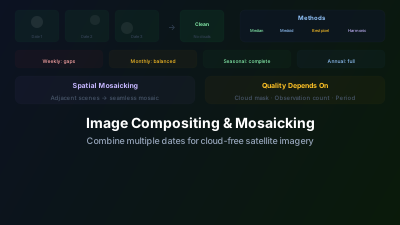
Quick Answer: Individual satellite scenes contain clouds, shadows, haze, and sensor artifacts. Compositing combines multiple observations of the same area over a time window to produce a clean, cloud-free result. The median composite (pixel-wise median across dates) is the most common approach — it removes clouds and outliers automatically. Alternatives include medoid (selects the actual observation closest to the median, preserving spectral consistency), best-pixel (selects the least-cloudy observation per pixel), and harmonic fitting (models seasonal variation to predict cloud-free values). Compositing period affects the result: shorter periods (weekly) capture rapid changes but may retain clouds; longer periods (seasonal) are cloud-free but blur temporal dynamics. Mosaicking extends compositing spatially, stitching adjacent scenes into seamless large-area coverages.
No single satellite image is perfect. NASA reports that "one study based on nearly a decade of satellite data estimated that about 67 percent of Earth's surface is typically covered by clouds". Cloud shadows darken the ground beneath. Thin cirrus introduces haze. Sensor anomalies create stripe artifacts. The probability that any particular pixel is cloud-free on any particular date is often less than 50% in tropical and maritime regions.
Compositing solves this problem by combining multiple observations over time, selecting or calculating the best representation of the surface for each pixel. It's the technique that makes "cloud-free" satellite maps possible — from basemaps to annual land cover classifications.
Why Is Compositing Necessary?
Because no single acquisition is reliably clean. Optical satellites can't see through clouds, cloud shadows contaminate pixels that look clear at first glance, and snow, haze, and sensor artifacts add further gaps. Compositing turns a stack of imperfect observations into one usable image — for many regions it's the only way to get complete coverage at all.
The Cloud Problem
For Sentinel-2 at 5-day revisit:
- Tropical humid regions: Only 10-30% of observations are cloud-free. A pixel may get 10-20 usable observations per year.
- Mediterranean/arid: 60-80% clear. 50-70 usable observations per year.
- Mid-latitude temperate: 30-50% clear during growing season. 15-30 usable observations.
Without compositing, any single-date map has gaps wherever clouds were present — which for many regions means more gaps than data.
Other Contamination
Beyond clouds:
- Cloud shadows: Dark areas on the ground beneath clouds. Often misclassified as water or dark vegetation.
- Cirrus and thin clouds: Semi-transparent clouds that reduce contrast and shift spectral values.
- Snow/ice: Seasonal coverage that obscures the land surface.
- Sensor artifacts: Occasional bad pixels, striping, or radiometric anomalies.
- Sun glint: Specular reflection from water surfaces at certain sun-sensor geometries.
Compositing Methods
Pixel-Wise Median
The most widely used approach:
For each pixel location, collect all observations within the compositing window (e.g., one month, one season), mask out clouds and shadows using quality flags, and compute the median value across the remaining observations — independently for each spectral band.
Why median works: The median is resistant to outliers. A cloud (very bright, spectrally different) or shadow (very dark) will be an outlier relative to the cloud-free observations and will be excluded by the median operation.
Limitation: The median computes each band independently, so the resulting composite pixel may combine the red value from one date with the green value from another date. This creates a "synthetic" observation that never actually occurred — potentially producing unrealistic band combinations.
Medoid Composite
Addresses the median's spectral inconsistency problem:
- Compute the median across all bands (as above)
- For each pixel, find the actual observation (date) that is closest to the median in multi-dimensional spectral space
- Use all bands from that single observation
The result: every pixel in the composite is an actual observation, preserving spectral consistency across bands. That property is why the medoid is increasingly preferred over the plain median for analysis applications — particularly index calculation, where mixing bands from different dates corrupts the ratio. It appears in large-area Landsat-based compositing workflows; check the documentation of any composite you consume to see which method it actually used, since this is rarely obvious from the product itself (see the Landsat program guide for what the standard products include).
Best Available Pixel (BAP)
Selects the single "best" observation per pixel based on a scoring function:
Scoring criteria (weighted combination):
- Cloud/shadow distance (farther from detected clouds = higher score)
- Day-of-year proximity to target date (closer = higher score)
- Sensor quality (clear observation = high; haze = medium; cloud edge = low)
- Sun/view angle (nadir-like geometry preferred)
Result: Each pixel comes from one actual observation, scored as the best available. Temporal consistency within the composite is not guaranteed (adjacent pixels may come from different dates).
Harmonic Fitting
Models the seasonal reflectance cycle:
- Fit a harmonic function (Fourier series) to the time series of cloud-free observations
- Predict the reflectance at any desired date from the fitted model
- The prediction is inherently cloud-free (the model ignores cloudy observations)
Advantage: Produces composites for any target date, including dates with no cloud-free observation. Captures seasonal dynamics smoothly — the same property that makes it useful for vegetation index time series.
Limitation: Assumes the seasonal pattern is predictable from the harmonic model. Sudden changes (harvest, fire, flood) that don't fit the harmonic pattern are smoothed out.
Maximum NDVI Composite (MVC)
A classic method used since the AVHRR era, and still associated with coarse-resolution daily sensors — NASA notes that "Terra MODIS and Aqua MODIS are viewing the entire Earth's surface every 1 to 2 days", which is exactly the observation frequency that made daily MVC products practical (more on that heritage in the MODIS data guide):
For each pixel, select the observation with the maximum NDVI value within the compositing window. The rationale: clouds and atmospheric contamination reduce NDVI, so the maximum NDVI is most likely to represent the clearest observation.
Limitation: Biased toward overestimating vegetation greenness. Does not work well for non-vegetated surfaces. Largely superseded by quality-flag-based methods.
Compositing Methods Comparison
| Method | Spectral Consistency | Handles Abrupt Changes | Cloud Removal | Computational Cost | Best For |
|---|---|---|---|---|---|
| Pixel-wise median | Moderate (bands computed independently) | Yes — outliers excluded | Excellent | Low | Monthly basemaps, global cloud-free products |
| Medoid | Excellent (all bands from same observation) | Yes | Excellent | Medium | Spectral analysis, index calculation, research |
| Best Available Pixel (BAP) | Good (single observation per pixel) | Good (scoring biases toward target date) | Good | Medium | Phenologically-aware seasonal composites |
| Harmonic fitting | Excellent (smooth seasonal model) | Poor — sudden changes smoothed | Excellent | High | Phenology modeling, predicting any target date |
| Maximum NDVI (MVC) | Poor (bands may mix dates) | Poor — biased toward peak greenness | Good for vegetated areas | Very low | Legacy coarse-resolution products (AVHRR era) |
Cloud observation count vs. composite quality: In tropical humid regions (Sentinel-2, ~70 overpasses/year), only 10–30% may be cloud-free — meaning 7–21 usable observations per year. The median approach needs at least ~5 cloud-free observations to be reliable; with fewer, even a single hazy scene can shift the median substantially. For regions with <5 clean observations per period, harmonic fitting or BAP with a relaxed temporal window performs better.
How Long Should the Compositing Period Be?
As short as your cloud climate allows. Weekly composites capture rapid change but often stay incomplete in cloudy regions; monthly windows balance completeness against temporal detail; seasonal-to-annual windows are nearly gap-free but blur everything that happened within them. The choice is always a trade-off:
Short Period (Weekly to Biweekly)
- Advantage: Captures rapid changes (crop growth, flooding, fire)
- Disadvantage: May not have enough cloud-free observations to produce a complete composite, especially in cloudy regions
- Use case: Operational monitoring, near-real-time applications
Medium Period (Monthly)
- Advantage: Good balance between temporal resolution and completeness
- Disadvantage: May blur events shorter than one month
- Use case: Monthly vegetation monitoring, water extent mapping
Long Period (Seasonal to Annual)
- Advantage: Nearly complete spatial coverage (enough observations to fill gaps)
- Disadvantage: Temporal variation within the period is lost. A "summer" composite doesn't distinguish June from August.
- Use case: Annual land cover maps, basemap generation
How Does Mosaicking Differ From Compositing?
Compositing operates in the temporal dimension (multiple dates for one area). Mosaicking operates in the spatial dimension (adjacent areas combined into one seamless product). In practice the two are chained: composite each location over time first, then stitch the composites together — that order minimizes the visible seams described below.
Challenge: Seam Lines
Adjacent satellite scenes acquired on different dates have different:
- Atmospheric conditions (brightness, haze)
- Sun angles (shadow direction, illumination)
- Phenological state (vegetation growth stage)
Simple edge-to-edge mosaicking creates visible seam lines at scene boundaries.
Solutions
Radiometric normalization: Adjust brightness and contrast of overlapping scenes to match in the overlap zone.
Feathering/blending: Gradually transition between scenes in the overlap area (weighted average that transitions from 100% scene A to 100% scene B across the overlap).
Temporal compositing first: If you temporally composite each scene location first (producing cloud-free composites), then mosaic the composites, seam lines are reduced because each composite represents a similar time period's average condition.
Global composites: Products like the Sentinel-2 Global Mosaics distributed through the Copernicus Data Space Ecosystem and Google Earth Engine mosaics apply these techniques at planetary scale to produce seamless global imagery.
Quality Metrics
Good composites include quality information:
Observation count: Number of cloud-free observations used per pixel. Low counts indicate less reliable composite values.
Date of observation: For best-pixel and medoid composites, which date was selected for each pixel. Important for phenological interpretation.
Quality flags: Per-pixel indicators of potential issues (residual cloud, snow, shadow, atmospheric correction quality).
Temporal range: The spread of dates contributing to each pixel. A pixel composed from observations spanning 3 months has different temporal meaning than one from observations spanning 1 week.
Practical Considerations
Cloud masking quality: Compositing quality depends entirely on how well clouds and shadows are masked — and cloud masks aren't as reliable as beginners assume. Aggressive masking (removing anything suspicious) produces cleaner composites but fewer observations. Conservative masking retains more observations but may include residual contamination.
Terrain shadow: In mountainous areas, topographic shadows are persistent (same time of day, same geometry). These are not clouds but may be mishandled by compositing algorithms that expect shadow to be transient.
Water surfaces: Water reflectance varies naturally with wind, turbidity, and sun angle. Compositing water pixels requires different approaches than land pixels — median compositing may produce unrealistic water reflectance.
Urban areas: Built surfaces are relatively stable spectrally, making compositing straightforward. But construction changes within the compositing window will be smoothed out.
Compositing is one of those techniques that seems simple (just take the median!) but involves numerous subtleties that affect the quality and interpretability of the result. Understanding what your composite actually represents — temporally, spectrally, and in terms of quality — is essential for using it correctly in subsequent analysis.

Remote sensing specialist with 10+ years in satellite data processing and AI. Founder of Off-Nadir Lab. Ph.D. in Informatics (Yokohama National University, 2026). Master's in Earth System Science and Technology (Kyushu University). Co-author, Remote Sensing Encyclopedia. More about the author →