
Dealing with Clouds in Sentinel-2 Data: Masking Techniques That Work
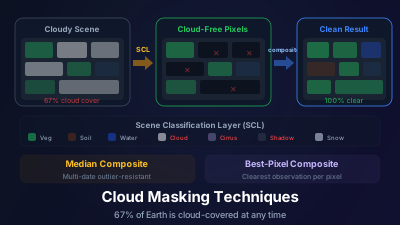
Quick Answer: Clouds are the biggest practical limitation of optical satellite data. Sentinel-2 Level-2A includes a Scene Classification Map (SCL) that classifies each pixel as cloud, cloud shadow, vegetation, water, etc. Mask pixels with SCL values 3, 8, 9, 10 to remove clouds and shadows. For persistent cloud cover, build temporal composites using the median or best-pixel approach across multiple dates. NASA's MODIS analysis found about 67 percent of Earth's surface is typically cloud-covered, and equatorial regions sit well above that average during their wet seasons — so in the humid tropics plan for composite windows of 3-6 months, or fall back on SAR when optical never clears.
In the humid tropics, it is entirely ordinary for every Sentinel-2 acquisition over a site across a multi-month window to be too cloudy to use. Cloud cover, not revisit frequency, is what limits optical remote sensing in these regions.
Clouds are not a minor inconvenience in optical satellite work — they're the primary limiting factor. NASA's analysis of nearly a decade of MODIS observations found that about 67 percent of Earth's surface is typically covered by clouds, with "less than 10 percent of the sky" completely clear over the oceans at any one time against 30 percent over land. Equatorial regions sit well above the global average during their wet seasons.
The SCL Approach
Sentinel-2 Level-2A products include the Scene Classification Map (SCL), generated by the Sen2Cor atmospheric correction processor. It classifies every pixel into one of 12 categories:
| SCL Value | Class | Action |
|---|---|---|
| 0 | No data | Exclude |
| 1 | Saturated/defective | Exclude |
| 2 | Dark area pixels | Keep (with caution) |
| 3 | Cloud shadows | Mask |
| 4 | Vegetation | Keep |
| 5 | Bare soils | Keep |
| 6 | Water | Keep |
| 7 | Cloud low probability | Keep or mask |
| 8 | Cloud medium probability | Mask |
| 9 | Cloud high probability | Mask |
| 10 | Thin cirrus | Mask |
| 11 | Snow/ice | Context-dependent |
The conservative approach: mask everything with SCL values 0, 1, 3, 8, 9, and 10. This removes definite clouds, cloud shadows, thin cirrus, and defective pixels.
The aggressive approach: also mask SCL 7 (cloud low probability) and 2 (dark area pixels, which sometimes indicate undetected cloud shadow). This removes more potential contamination but also throws away more valid data.
SCL Limitations
The SCL isn't perfect. Several issues recur:
Commission errors over bright surfaces: White sand beaches, salt flats, and limestone exposures are sometimes classified as clouds. If your study area includes bright surfaces, verify the SCL against the actual imagery.
Missed thin cirrus: Thin, semi-transparent cirrus clouds can pass through the SCL filter, especially at the "low probability" threshold. These contaminate reflectance values without being obvious in the classification.
Cloud shadow misplacement: Shadow detection depends on estimating cloud height and solar geometry. The shadow mask can be displaced by several hundred meters, missing the actual shadow while masking valid pixels nearby.
Snow/cloud confusion: In mountainous areas during winter, distinguishing fresh snow from clouds is genuinely difficult. The SWIR-based discrimination helps (snow absorbs SWIR; clouds don't), but it's not foolproof.
Building Cloud-Free Composites
When single acquisitions are too cloudy, compositing aggregates multiple dates to fill gaps.
Median Composite
Take all valid (non-clouded) pixels from a time window and compute the median value for each pixel. The median is preferred over the mean because it's resistant to outliers — a partially unmasked cloud or shadow won't corrupt the result as badly.
Window selection matters: Too short and you don't have enough clear observations. Too long and genuine surface changes (crop growth, seasonal vegetation shifts) contaminate the composite. Rules of thumb:
- Temperate regions, summer: 1-month window usually sufficient
- Temperate regions, winter: 2-3 months (more clouds, less frequent clear sky)
- Tropical regions: 3-6 months for dry season composite; may not be possible during wet season
- Arid regions: 2-week window often sufficient
Best-Pixel Composite
Instead of the median, select the single "best" observation for each pixel — usually the one with the highest NDVI (for vegetation) or the lowest blue-band reflectance (as a proxy for least atmospheric contamination).
Best-pixel composites preserve more spectral fidelity than median composites because they use actual observations rather than statistical summaries. The downside is that adjacent pixels may come from different dates, creating spatial inconsistencies in rapidly changing landscapes.
Harmonic Fitting
For annual monitoring, fitting a harmonic function (sine/cosine curves) to the time series of valid observations provides a modeled estimate for any date. This handles irregular observation gaps elegantly and produces smooth, continuous time series. It's more complex to implement but produces cleaner results for phenology tracking.
Practical Workflow
A workflow that covers most cases:
- Download Level-2A data for your area and time window
- Apply SCL mask: Remove pixels with SCL values 0, 1, 3, 8, 9, 10
- Check coverage: Calculate the percentage of valid pixels per scene. Discard scenes with less than 20% valid coverage — they contribute noise without useful data
- Composite: If single-date coverage is insufficient, build a median composite from remaining valid observations
- Visual QC: Always inspect the result. Zoom to areas where you suspect residual cloud contamination. Compare against the input scenes.
The Cloud Cover Metadata Trap
Sentinel-2 metadata includes a scene-level cloud cover percentage. It's tempting to use this to filter — "give me all scenes with less than 20% clouds." But this number represents the entire scene, not your specific area of interest.
A scene might have 15% overall cloud cover, but if those clouds sit directly over your study area, the image is useless for your purpose. Conversely, a 60% cloud cover scene might be perfectly clear over your region.
Always check cloud cover spatially, not just numerically.
How Many Clear Scenes Can You Expect? Regional Reference
Planning a cloud masking strategy starts with knowing roughly how many valid scenes you're likely to have. Do not take that number from a table — it is specific enough to your site that you should measure it. The reliable way is to run a scene-count query for your own area of interest over a full past year and count how many acquisitions cleared your cloud threshold over the AOI, not scene-wide (see the metadata trap above). What a table can usefully give you is the ordering, and the composite window that ordering implies:
| Region / Climate Type | Relative clear-scene availability | Composite Window Needed |
|---|---|---|
| Western Sahara / Arabian Peninsula | Highest — most acquisitions usable | 2–4 weeks |
| Mediterranean coast (summer) | High | 1–2 months |
| Temperate continental (summer) | Moderate–high | 1–2 months |
| Temperate maritime (UK, NW France) | Moderate | 2–3 months |
| Temperate continental (winter) | Low | 3–6 months |
| Subtropical monsoon (dry season) | Moderate | 2–3 months |
| Subtropical monsoon (wet season) | Very low | May not be possible |
| Tropical equatorial (year-round) | Low | 3–6 months |
| Coastal rainforest (equatorial) | Lowest | 4–6 months |
Note that Sentinel-2 has a 5-day revisit with both satellites, so the ceiling is roughly 70 potential acquisitions per year. In the Sahara you can use most of them; in equatorial rainforest only a small fraction of that ceiling turns into genuinely usable scenes, which is why the composite window has to stretch to months.
Planning rule of thumb: a median composite needs several valid observations per pixel before the median means anything — with only two or three, one unmasked cloud edge still drives the result. If your own scene count over the AOI comes back thin, extend the composite window or reduce your expectations about the data's temporal specificity.
When Clouds Win
Sometimes there's no optical solution. Monsoon-season data in Southeast Asia, wet-season data in Central Africa, persistent stratus over coastal deserts — these situations defeat any amount of temporal compositing.
That's when SAR data becomes essential. Sentinel-1's C-band radar penetrates clouds completely. You lose the spectral information of Sentinel-2, but you gain reliable, all-weather observations. Many operational monitoring systems — flood mapping, deforestation detection in the tropics — rely on SAR precisely because clouds make optical monitoring unreliable.
The most robust monitoring systems fuse both: optical data when available (for its spectral richness) and SAR data when clouds prevent optical observations (for its all-weather reliability). This complementary approach acknowledges what no amount of cloud masking can fix — sometimes the sky simply isn't cooperating.
Related reading
Masking cloud in a single scene is one problem; cloud removing entire acquisitions from a time series is another. Measuring a number versus watching for events covers what that does to a continuous watch — the effective optical cadence is always lower than the nominal revisit — and satellite pass prediction covers planning around it.

Remote sensing specialist with 10+ years in satellite data processing and AI. Founder of Off-Nadir Lab. Ph.D. in Informatics (Yokohama National University, 2026). Master's in Earth System Science and Technology (Kyushu University). Co-author, Remote Sensing Encyclopedia. More about the author →