Early Detection of Crop Stress from Satellite Imagery: Before the Damage Is Done
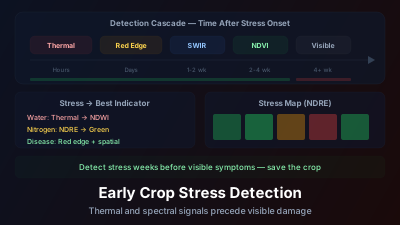
Quick Answer: Crop stress produces spectral changes detectable by satellites before visible symptoms appear. Chlorophyll reduction shifts the red edge (detectable by Sentinel-2 NDRE) before broadband NDVI drops. Water stress increases canopy temperature (Landsat thermal) before wilting occurs. The key approach is anomaly detection — comparing each field against its own historical performance or neighboring fields. SAR adds cloud-independent monitoring of structural changes. How much warning you get varies by stress type — longest for nitrogen and water stress, where the plant signals the problem well before yield is lost, and near-zero for defoliation, where the first satellite signal is already the damage — so the value depends on whether irrigation, fertilizer, or spraying can actually be applied in time.
Satellites flag crop stress days to weeks before it is visible to the eye: thermal sensors catch rising canopy temperature within hours of water stress, and red edge indices register chlorophyll loss while broadband NDVI is still flat. But "earlier" has limits worth understanding. Visual crop scouting depends on symptoms that appear late in that sequence: yellowing in a corner of a field marks the end of a physiological process, not its beginning. That is the fundamental problem with visual scouting: by the time stress is visible to the eye, significant physiological damage has already occurred.
Satellites can detect stress earlier than human observation, but "earlier" has limits. Understanding what satellites actually detect, and how much lead time they provide, determines whether the information arrives in time to act.
How does crop stress progress through detectable stages?
Crop stress progresses through a physiological cascade that satellites pick up in order: canopy temperature rises first (thermal), then chlorophyll drops and the red edge shifts (NDRE), then leaf water content falls (SWIR), and only later does the canopy visibly wilt and NDVI drop. Each stage exposes a different spectral signal, and the earliest ones are invisible to the eye.
Stage 1 (Hours to days): Stomata close to conserve water. Transpiration decreases. Canopy temperature rises. Photosynthesis slows. No visible change. Thermal sensors detect the temperature increase.
Stage 2 (Days to 1 week): Chlorophyll production slows. Existing chlorophyll begins to degrade. The red edge position shifts. Still no visible change. Red edge indices (NDRE) detect the chlorophyll change.
Stage 3 (1-2 weeks): Leaf water content decreases. SWIR reflectance increases. Subtle color change may be visible to trained observers at close range. SWIR-based indices detect moisture loss.
Stage 4 (2-4 weeks): Canopy structure changes — leaves wilt, curl, or drop. NIR reflectance decreases. Clearly visible stress. Standard NDVI finally shows a significant drop.
Stage 5 (4+ weeks): Irreversible damage — leaf death, canopy collapse, yield loss locked in. NDVI drops dramatically.
The window between Stage 1 and Stage 5 is the intervention opportunity. For many stress types, that window is 2-4 weeks — enough time to apply supplemental irrigation, emergency fertilizer, or targeted pest control if the stress is identified and localized quickly enough.
Spectral Indicators by Stress Type
Water Stress
Earliest indicator: Canopy temperature increase (Landsat thermal, ECOSTRESS). Stomatal closure reduces transpiration cooling within hours of soil moisture depletion.
Secondary indicator: SWIR reflectance increase as leaf water content drops. The Normalized Difference Water Index (NDWI) using NIR and SWIR bands responds within days.
Later indicator: NDVI decrease as prolonged water stress causes chlorophyll degradation and leaf wilting.
Nitrogen Deficiency
Earliest indicator: Red edge shift detected by NDRE. Nitrogen is directly required for chlorophyll synthesis; deficiency reduces chlorophyll before visible yellowing.
Secondary indicator: Green band reflectance increase (chlorophyll absorbs less green light when depleted).
Later indicator: NDVI decrease as chlorophyll loss becomes severe enough to affect the red band.
NDRE therefore leads NDVI for nitrogen stress, by a margin that widens as the canopy closes and NDVI saturates. This is the "secret weapon" of Sentinel-2's red edge bands for agriculture.
Pest and Disease
Variable indicators: Depends entirely on the pest/disease mechanism:
- Foliar diseases (rusts, mildews) reduce chlorophyll → red edge shift first
- Root diseases reduce water uptake → thermal stress signal first
- Defoliating insects reduce leaf area → NDVI drops directly
- Stem borers weaken structure → SAR backscatter changes (canopy structure)
Spatial pattern is diagnostic: Disease typically starts at a point and spreads radially. Pest infestation may follow wind patterns or field edges. Nutrient deficiency follows soil variability patterns. These spatial signatures help distinguish stress types even when the spectral response is similar.
Frost/Cold Damage
Immediate indicator: NDVI drops within days of a frost event as damaged cells lose chlorophyll. The spatial extent of frost damage correlates with topographic cold pools — low-lying areas where cold air accumulates.
Anomaly Detection Approaches
Because no fixed threshold defines "stressed," stress detection relies on anomaly detection — comparing a field against a reference and flagging significant departures. Three references are common.
Within-Field Comparison
Compare each pixel's current NDVI/NDRE against the field mean. Pixels significantly below the field average (more than 1-2 standard deviations) indicate localized stress. This works even without historical data — you're using the healthy portion of the same field as the reference.
Advantages: No historical data needed. Detects localized stress patterns. Limitations: Misses field-wide stress (entire field is affected equally).
Temporal Anomaly
Compare the current NDVI against the expected value based on the field's own history or a crop growth model:
Anomaly = Observed NDVI − Expected NDVI
Expected NDVI can be derived from:
- Multi-year average for this field at this date
- Crop growth model prediction based on weather inputs
- Neighboring fields of the same crop type
A negative anomaly exceeding the historical variability threshold triggers an alert.
Advantages: Detects both localized and field-wide stress. Limitations: Requires 3+ years of historical data for reliable baselines.
Neighbor Comparison
Compare each field against neighboring fields of the same crop type. If one field's NDVI is declining while neighbors are stable, something field-specific is happening (management issue, localized pest, drainage problem).
If all fields in a region are declining simultaneously, it's likely a weather-driven event (drought, heat wave) rather than a field-specific management problem.
What does SAR add to crop stress detection?
SAR adds stress detection that optical sensors can't provide: it senses canopy structure and works through cloud. Radar backscatter changes when leaves droop, when crops lodge (fall over), and it keeps observing during the cloudy stretches when optical data goes dark — exactly when a fast-moving stress event could otherwise slip through undetected.
Structural changes: As crops wilt, the canopy structure changes — drooping leaves alter the scattering geometry. VH backscatter from Sentinel-1 can detect wilting before NDVI responds.
Lodging detection: When crops fall over (from wind, rain, or disease-weakened stems), the dramatic change in canopy structure produces a clear SAR backscatter change. Optical sensors may not detect lodging because the canopy is still green — just horizontal instead of vertical.
Cloud independence: In regions where clouds frequently prevent optical observation during the growing season, SAR provides the only reliable monitoring. A 2-week optical data gap during rapid stress development means the early detection window is lost.
From Detection to Action
Detecting stress is only valuable if it leads to intervention:
| Stress Type | Detection Method | Lead Time | Possible Intervention |
|---|---|---|---|
| Water stress | Thermal + NDWI | 1-3 weeks | Supplemental irrigation |
| N deficiency | NDRE anomaly | 2-3 weeks | Side-dress fertilizer |
| Foliar disease | Red edge + spatial pattern | 1-2 weeks | Fungicide application |
| Insect pest | NDVI + SAR texture | 1-2 weeks | Targeted pesticide |
| Waterlogging | SAR + NDVI pattern | Days | Drainage improvement |
The detection-to-action pipeline requires:
- Timely satellite data (processing delay < 48 hours)
- Automated anomaly detection (human review of every field is impractical)
- Alert delivery to the farmer or agronomist
- Diagnostic support (what type of stress? automated or expert interpretation)
- Equipment availability (sprayer, irrigator, fertilizer applicator)
Stress Detection Performance: What Each Signal Can Realistically Do
Different stresses become visible to different sensors at different points in the cascade, and each has a characteristic minimum size before it registers at 10–30 m resolution. Ranking them this way is more useful than a single "detection accuracy" number, because reliability in practice is dominated by whether the right sensor happened to see the field on the right day:
| Stress Type | Earliest Satellite Signal | Relative Lead Time | Detection Reliability | Minimum Practical Patch Size |
|---|---|---|---|---|
| Severe water stress | Thermal (ECOSTRESS/Landsat) | Longest — thermal is first in the cascade | Good, when thermal data is available at all | A few hectares |
| Mild water stress | NDWI (Sentinel-2 SWIR) | Moderate | Fair; easily confused with normal diurnal and irrigation cycles | Larger — needs a clear patch |
| Nitrogen deficiency | NDRE (Sentinel-2 red edge) | Long — chlorophyll falls early | Good, given a within-field reference | A few hectares |
| Foliar fungal disease | NDRE anomaly + spatial spread | Moderate | Fair; the spreading spatial pattern is more diagnostic than the index value | Larger — needs a coherent patch |
| Root disease | Thermal + NDVI pattern | Long in principle, but the canopy only responds after root damage | Poor to fair | Larger |
| Insect pest (locust/caterpillar) | NDVI rapid drop | Short — defoliation is already damage | Good for large infestations | A hectare or so |
| Crop lodging | SAR backscatter (VH drop) | Near-immediate | Good; the structural change is unambiguous | Small patches detectable |
| Frost/cold damage | NDVI rapid drop | Near-immediate | Good, and the topographic pattern corroborates it | Follows cold-pool topography |
Why early detection is worth paying for: the value is not that satellites see stress that scouting cannot, but that they see it earlier and everywhere at once. The intervention curve is steep — supplemental irrigation applied while stomata are still closing preserves far more yield than the same water applied after visible wilting, because by then some of the loss is physiological and irreversible. The same logic applies to nitrogen: a side-dress during the vegetative phase can still be taken up, one applied after visible yellowing at grain fill largely cannot. The realisable value therefore depends on whether you can actually act on the alert — irrigation infrastructure, sprayer availability, and labour — which is why the return is largest in irrigated, high-value systems and smallest in rainfed extensive ones.
The revisit constraint: Sentinel-2 offers a 5-day revisit globally, but cloud reduces the usable cadence substantially in temperate growing seasons — often to a fraction of the nominal rate. Stress that begins and does its damage inside a couple of weeks, such as a fast-moving fungal outbreak or a locust swarm, may simply fall between usable observations no matter how sensitive the detection algorithm is. This temporal limitation is why daily commercial constellations have found a market in high-value specialty crops, and why operational systems pair optical data with SAR, which is unaffected by cloud.
What are the limits of satellite crop stress detection?
Satellite stress detection is powerful but not magic: it flags symptoms, not causes, so ground verification is still needed to diagnose why a field is stressed. It works at field scale rather than plant scale, temporal gaps from cloud can erase the early-warning advantage, and false positives from cloud shadow and mask leakage do occur.
It detects symptoms, not causes. A stressed field detected from satellite could be suffering from any of a dozen problems. Ground verification is usually needed to diagnose the specific cause and prescribe the right intervention.
It works at the field scale, not the plant scale. A disease affecting 5% of plants in a field won't produce a detectable signal at 10-meter resolution. By the time the satellite detects it, the affected area is at least several hundred square meters.
Temporal gaps are the enemy. If clouds prevent observation for 2 weeks during a critical period, the early detection advantage is lost. This is why operational systems combine optical and SAR data.
False positives occur. Shadows from clouds, partial cloud contamination that passed the masking algorithm, irrigation timing mismatches — all can produce anomalies that aren't real stress. Persistent anomalies across multiple dates are more reliable than single-date detections.
Despite these limitations, satellite-based crop stress detection has moved from research into operational agriculture. The economics are compelling: the cost of a missed stress event — lost yield, degraded quality — far exceeds the cost of monitoring. Even imperfect early warning is valuable at scale, because the alternative is not perfect scouting but no systematic look at most fields at all.

Remote sensing specialist with 10+ years in satellite data processing and AI. Founder of Off-Nadir Lab. Ph.D. in Informatics (Yokohama National University, 2026). Master's in Earth System Science and Technology (Kyushu University). Co-author, Remote Sensing Encyclopedia. More about the author →