
Coral Reef Monitoring from Space: Mapping Underwater Ecosystems with Satellites
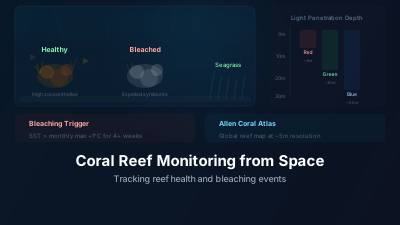
Quick Answer: Satellites can map coral reefs in shallow, clear water (typically <15m depth) by correcting for water column attenuation. Blue and green bands penetrate water best; red and NIR are absorbed within the first few meters. Coral bleaching — where stressed corals expel symbiotic algae and turn white — increases bottom reflectance, detectable as brightness anomalies in blue-green bands. Sentinel-2's 10m resolution maps reef features at ecologically meaningful scales. The Allen Coral Atlas provides the first global high-resolution coral reef map using Planet and Sentinel-2 data. Limitations include depth, turbidity, cloud cover, and sun glint.
Flying over the Great Barrier Reef, you can see individual reef structures from the airplane window — the dark patches of healthy coral, the turquoise of sandy lagoons, the white of bleached areas. Satellites see the same thing, at remarkably similar resolution, across every reef system on Earth simultaneously.
Coral reef monitoring from space sounds improbable — how can a sensor 700 km above the surface see something underwater? The answer lies in the optical properties of clear tropical water.
How can satellites see coral through water?
In clear tropical water, blue and green light penetrate 10–30 m, reflect off the shallow seabed, and travel back up to the sensor. Red and near-infrared are absorbed within the first few meters, so reef mapping leans on the blue-green bands. Water absorbs light unevenly across wavelengths:
| Wavelength | Penetration Depth (clear water) | Sentinel-2 Band |
|---|---|---|
| Blue (490 nm) | ~20-30 m | B2 |
| Green (560 nm) | ~10-20 m | B3 |
| Red (665 nm) | ~3-5 m | B4 |
| NIR (842 nm) | <1 m | B8 |
Blue light penetrates deepest, which is why deep, clear ocean appears blue — blue is the last color to be absorbed. In shallow water over coral reefs (typically 1-15 m deep), enough light reaches the bottom and reflects back to be detectable by the satellite sensor after passing through the water column twice (down and up).
The signal the satellite receives from a shallow reef pixel is: Total signal = Atmospheric contribution + Water surface reflection + Water column scattering + Bottom reflection (attenuated by water)
Extracting the bottom reflectance requires correcting for the first three components — a process called water column correction.
Water Column Correction
The most widely used approach is the Lyzenga method, which exploits the fact that different wavelengths attenuate at different rates in water:
- Identify deep water pixels where no bottom signal exists — these represent pure water column + atmosphere
- Subtract deep water reflectance from all pixels to isolate the bottom-influenced signal
- Compute depth-invariant indices by combining bands that attenuate at different rates — the ratio of two bands with different attenuation coefficients removes the depth effect
The result is a bottom reflectance estimate that's independent of depth (within the penetration limits), enabling mapping of benthic habitat types: coral, sand, seagrass, algae, rubble. The same optically complex shallow water challenges inland water quality retrieval and ocean color sensing, where multiple constituents muddy the signal.
What does coral bleaching look like from space?
Bleached coral shows up as a sudden brightening in the blue-green bands. Bleaching occurs when thermal stress causes corals to expel their symbiotic zooxanthellae — the algae that give healthy corals their brown/green color and provide most of their nutrition. Without zooxanthellae the coral tissue becomes transparent, revealing the white calcium carbonate skeleton, which reflects far more light than healthy tissue.
This color change is detectable from satellites:
Healthy coral: Moderate reflectance with brown/green tones (chlorophyll absorption by zooxanthellae) Bleached coral: High reflectance across visible bands — the white skeleton reflects much more light than healthy tissue
The spectral signature of bleaching:
- Blue and green reflectance both rise substantially, because the exposed carbonate skeleton is far brighter than pigmented tissue
- The spectral shape flattens (it loses the chlorophyll absorption features contributed by the zooxanthellae)
- The magnitude at the sensor is heavily attenuated by depth and water clarity, so the same bleaching event looks stronger on a shallow reef flat than on a deeper slope
Bleaching Detection Methods
Anomaly approach: Compare current bottom reflectance against a healthy baseline. Pixels showing significant brightness increases (particularly in blue-green bands) are flagged as potentially bleached — the same satellite anomaly detection logic used to flag change on land.
NOAA Coral Reef Watch: Uses sea surface temperature (SST) from satellite thermal data to predict bleaching risk. When SST exceeds the normal summer maximum by 1°C for 4+ weeks (measured as Degree Heating Weeks), mass bleaching becomes likely. This thermal monitoring provides early warning before bleaching occurs.
Direct optical detection: After bleaching begins, optical satellites confirm its extent and severity. Sentinel-2's 10m resolution can map bleaching at individual reef patch scale.
The Allen Coral Atlas
The Allen Coral Atlas completed the first comprehensive global habitat maps of the world's shallow tropical coral reefs in September 2021:
- Coverage: All tropical shallow water coral reefs worldwide
- Resolution: ~5m (derived from Planet imagery, supplemented by Sentinel-2)
- Classes: Coral, algae, seagrass, sand, rock, rubble
- Bleaching monitoring: Near-real-time detection using Sentinel-2 and Planet
- Access: Free and open (allencoralatlas.org)
The atlas represents a milestone — previously, most coral reef mapping was limited to individual reefs or small regions. Having a globally consistent baseline enables tracking change across all reef systems simultaneously.
Bleaching Severity: Quantifying What Satellites Observe
Coral bleaching occurs on a spectrum from mild stress to total mortality. Here's how satellite observables map to ecological status:
| Bleaching Category | DHW (Degree Heating Weeks) | Expected Optical Signature | Outcome |
|---|---|---|---|
| Watch | 1–2 DHW | No detectable change | Monitoring advised |
| Warning | 2–4 DHW | Slight brightening at most, often below the noise floor | Bleaching likely |
| Alert Level 1 | 4–8 DHW | Clear brightness anomaly in the blue-green bands | Severe bleaching expected |
| Alert Level 2 | > 8 DHW | Strong brightness anomaly over broad areas | Mortality likely |
| Post-bleaching mortality | N/A (aftermath) | Mixed signal: darkening as algae overgrow the skeleton | Algae colonizes dead skeleton |
DHW = Degree Heating Weeks from NOAA Coral Reef Watch. As NOAA defines it, one DHW accumulates when sea surface temperature stays 1°C above the maximum monthly mean for one week, and the program flags 4 DHW as the significant-bleaching threshold and 8 DHW for widespread mortality. The DHW thresholds are NOAA's; the optical column is the expected direction of the response, not a calibrated conversion — how much brightening actually reaches the sensor depends on depth, water clarity, and what fraction of the pixel is live coral in the first place.
The optical detection lag: thermal stress accumulates before the white skeleton becomes visible, because expelling the zooxanthellae takes time. This is why thermal accumulation is the better early-warning signal and optical data is better as after-the-fact confirmation of where bleaching actually occurred — the two are sequential, not interchangeable.
Practical Limitations
Depth
Below ~15 m in clear water (less in turbid water), insufficient light reaches the bottom for satellite detection. Most reef mapping is limited to the upper 5-10 m, where the signal-to-noise ratio is adequate. Deep reef slopes and mesophotic reefs (30-150 m) are invisible to optical satellites.
Turbidity
Coastal reefs near river mouths or in areas with high sediment loading may be invisible even in shallow water. Turbidity scatters and absorbs light, reducing water column penetration. After storms or during wet seasons, temporarily elevated turbidity can prevent reef monitoring.
Sun Glint
When the sun angle relative to the sensor creates specular reflection off the water surface, the sun glint signal overwhelms the weak bottom reflection. Glint correction algorithms exist but work best when glint contamination is moderate. Severe glint makes pixels unusable.
Spatial Resolution
At 10m (Sentinel-2), individual coral colonies aren't distinguishable — the mapping is at habitat patch level. Distinguishing between "healthy reef" and "reef with 30% bleaching" requires higher resolution (1-3m commercial satellites) or additional spectral information.
Temporal Resolution
Coral bleaching events develop over weeks and can recover (if stress subsides) or progress to mortality. The 5-day Sentinel-2 revisit is adequate for tracking bleaching progression, but cloud cover in tropical reef areas frequently creates multi-week observation gaps.
Global Reef Status: What Satellites Have Documented
Satellites have not merely confirmed that reefs are declining — they changed what "documented" means. Before global thermal monitoring, a bleaching event was known through whichever reefs happened to have researchers on them; the global picture was assembled after the fact from scattered surveys. NOAA Coral Reef Watch's thermal products now flag heat stress everywhere, continuously, including on reefs nobody visits, and optical satellites then confirm the extent where the water is shallow and clear enough to see the bottom.
The clearest recent demonstration is the fourth global bleaching event. NOAA confirmed it in April 2024 — the fourth on record and the second within ten years — with bleaching-level heat stress documented across all three reef-bearing ocean basins. On the Great Barrier Reef, aerial surveys flown by the Reef Authority, AIMS and CSIRO over more than a thousand reefs found bleaching on 73% of surveyed reefs inside the Marine Park. That combination — a satellite-derived thermal alert, followed by systematic survey confirmation — is the modern workflow, and neither half works on its own.
What thermal alerts can and cannot tell you: the DHW thresholds are a well-established indicator of risk, not a measurement of outcome. High accumulated heat stress makes bleaching likely, but whether a given reef bleaches, and whether bleaching becomes mortality, depends on local factors the thermal product does not see — water depth, flow and mixing, turbidity and shading, cloud cover during the stress period, and the thermal history and species composition of the corals themselves. Reefs sometimes escape at high DHW and sometimes bleach below the nominal threshold. This is why an alert should trigger a survey rather than substitute for one, and why the field surveys that follow an alert remain the ground truth for how much coral was actually affected.
Applications Beyond Bleaching
Reef Extent Mapping
Establishing accurate boundaries of reef ecosystems for marine protected area planning. Satellite-derived reef maps reveal reef structures that weren't previously documented, particularly in remote Pacific atolls and deep lagoon systems.
Seagrass and Algae Mapping
The same water column correction techniques apply to seagrass beds and macroalgal communities, and extend to the mangroves and shorelines that surround many reefs. Tracking the balance between coral, algae, and seagrass indicates reef ecosystem health — a shift from coral-dominated to algae-dominated bottom is a sign of degradation.
Coastal Development Impact
Before-and-after change detection assesses the impact of coastal construction, dredging, and land reclamation on nearby reef systems. Increased turbidity plumes from construction can be tracked to their impact on downstream reef health, and standing area monitoring turns those one-off comparisons into a continuous watch.
Climate Change Monitoring
Multi-decadal satellite records (Landsat since 1984) enable long-term assessment of reef change. Combining thermal stress records (SST anomalies) with optical reef condition data builds the evidence base for climate change impacts on coral ecosystems.
Coral reefs occupy less than 1% of the ocean floor but support 25% of marine species. Monitoring them from space provides the global coverage and temporal continuity that no fleet of research vessels could match. The satellite data doesn't tell reef ecologists everything they need to know — but it tells them where to focus their limited resources, and it provides an undeniable record of how these ecosystems are changing.

Remote sensing specialist with 10+ years in satellite data processing and AI. Founder of Off-Nadir Lab. Ph.D. in Informatics (Yokohama National University, 2026). Master's in Earth System Science and Technology (Kyushu University). Co-author, Remote Sensing Encyclopedia. More about the author →