
VV, VH, HH, HV Polarization in SAR, Explained
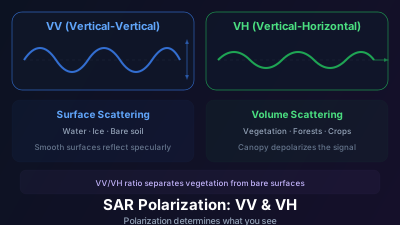
Quick Answer: SAR polarization refers to the orientation of the transmitted and received electromagnetic wave. VV emphasizes surface scattering (good for water, ice, and soil), while VH captures volume scattering from complex structures like vegetation. Sentinel-1 typically provides both VV and VH in its standard IW mode. Choosing the right polarization is often more impactful than choosing the right algorithm.
What Polarization Actually Means
Electromagnetic waves oscillate in a specific plane. When we say a SAR system transmits in "V" (vertical) polarization, we mean the electric field oscillates perpendicular to the ground. "H" (horizontal) means it oscillates parallel to the ground.
The naming convention uses two letters: transmit first, receive second.
- VV: Transmit vertical, receive vertical
- VH: Transmit vertical, receive horizontal
- HH: Transmit horizontal, receive horizontal
- HV: Transmit horizontal, receive vertical
VV and HH are called "co-polarized" (same polarization transmitted and received). VH and HV are "cross-polarized" (the received polarization differs from transmitted).
Why does this matter? Because different surface types interact differently with each polarization, and the choice directly affects what information you can extract.
The Scattering Mechanisms
Three primary scattering mechanisms dominate SAR imagery, and each has a characteristic polarimetric signature:
Surface Scattering
Occurs at relatively smooth surfaces — bare soil, water, roads. The radar bounces off the surface in a predictable way, with most energy remaining in the co-polarized channel.
Dominant in: VV or HH Examples: Calm water, bare soil, paved surfaces
Volume Scattering
Occurs within complex, three-dimensional structures where the radar signal bounces multiple times between elements — tree branches, leaves, crop canopies. Each bounce can change the polarization, so significant energy appears in the cross-polarized channel.
Dominant in: VH or HV Examples: Forest canopy, dense crops, snow pack
Double-Bounce Scattering
The radar signal bounces off a horizontal surface, hits a vertical surface (or vice versa), and returns to the satellite. This creates a phase shift that produces a very strong co-polarized return.
Dominant in: HH (primarily) Examples: Buildings next to roads, tree trunks standing in water (flooded forest)
Sentinel-1: VV + VH
Sentinel-1 operates in C-band (5.405 GHz) and its standard Interferometric Wide (IW) swath mode provides dual-polarization data: VV and VH simultaneously.
This is a practical compromise. Fully polarimetric systems (transmitting and receiving all four combinations) provide richer information but require twice the data rate and more complex processing. Sentinel-1's VV+VH dual-pol covers the most useful polarimetric space for its primary applications.
The Sentinel-1 SAR viewer displays either channel, so you can look at the same scene in VV and in VH.
When to use VV
Water and flood mapping: Calm water produces almost no backscatter in any polarization, but the contrast between water and land is generally highest in VV — which makes it the sensible default when delineating a flood boundary.
Sea ice classification: The distinction between different ice types (first-year, multi-year, thin ice) is often clearest in VV due to surface scattering differences.
Soil moisture estimation: Surface scattering from bare or sparsely vegetated soil is better characterized by VV.
When to use VH
Forest monitoring: VH is more sensitive to canopy structure because volume scattering from branches and leaves produces cross-polarized returns. For biomass estimation or deforestation detection, VH typically outperforms VV.
Crop classification: Different crop types at different growth stages produce distinct VH signatures. Rice paddies, for instance, show a characteristic VH increase as the crop develops from standing water through tillering to heading.
Separating agriculture from forest: In VV, both forests and mature crops can appear similar. In VH, forests generally show higher backscatter due to their more complex three-dimensional structure.
When to use the VH/VV ratio
The cross-pol ratio (VH/VV, often expressed in dB) is itself a useful indicator. It's sensitive to vegetation characteristics while being partially normalized against some systematic effects like incidence angle variation.
A high VH/VV ratio suggests dominant volume scattering (dense vegetation). A low ratio suggests surface scattering (bare ground, water).
Typical VV vs. VH Values by Surface Type
Having reference numbers helps you quickly assess whether a polarization choice is giving you useful signal. These are typical Sentinel-1 IW GRD values at moderate incidence angles (~35–40°):
| Surface Type | VV (dB) | VH (dB) | VH/VV ratio | Best Channel |
|---|---|---|---|---|
| Calm open water | −20 to −25 | −25 to −30 | Low (−5 to −10 dB) | VV (sharper contrast) |
| Wet bare soil | −10 to −15 | −18 to −23 | Low | VV |
| Dry grassland | −8 to −12 | −15 to −20 | Low-medium | VV or VH |
| Mature crop (wheat/maize) | −6 to −10 | −12 to −16 | Medium | VH (biomass sensitivity) |
| Dense forest | −5 to −8 | −8 to −12 | High (−2 to −5 dB) | VH (volume scattering) |
| Urban fabric | −2 to +3 | −8 to −12 | Low | VV (double-bounce) |
| Ship / metal structure | +5 to +15 | +3 to +12 | Near 1 | Either |
Reading the ratio column: A high VH/VV ratio (small negative number, like −2 dB) indicates dominant volume scattering — complex structure that depolarizes the signal. A low ratio (large negative, like −10 dB) indicates surface scattering — smooth or specularly reflecting surfaces that preserve polarization.
In practice, creating a false-color composite with VV in the red channel and VH in the green channel immediately separates surface scatterers (red) from volume scatterers (green). Urban areas appear orange to red; dense forest appears green; bare soil appears darker red; water appears near-black. This composite is one of the most information-dense single-image views available from Sentinel-1 and takes about 30 seconds to set up.
L-Band: A Different Game
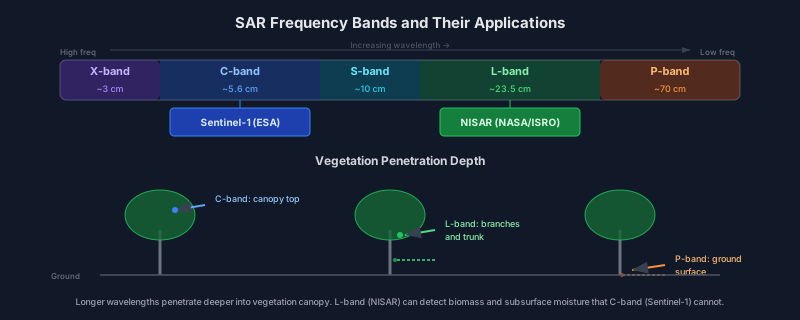
NISAR now provides L-band data publicly, and the polarimetric picture changes significantly. L-band's longer wavelength (24 cm vs. 5.55 cm for C-band) penetrates deeper into vegetation canopy, interacting with larger structural elements — branches and trunks rather than leaves.
This means L-band HH is particularly sensitive to double-bounce from trunk-ground interactions, making it excellent for:
- Detecting flooded forest (the trunk-water double bounce is very strong in HH)
- Estimating above-ground biomass (trunk size correlates with biomass)
- Mapping wetland inundation under canopy
NISAR carries both L-band and S-band radars and supports several polarimetric modes, with the mode selected per acquisition according to the science target — opening up analysis possibilities that C-band VV+VH alone cannot address. Check the mission's product documentation for which polarizations are actually acquired over your area of interest before planning around a specific channel combination.
Practical Recommendations
For most users starting with Sentinel-1:
- Begin with VV for general-purpose visualization — it provides the most intuitive contrast between land and water
- Switch to VH when working with vegetated areas — forest, agriculture, wetlands
- Try creating an RGB composite with VV (red), VH (green), and VV/VH (blue) for a false-color image that separates scattering mechanisms visually
- Don't default to one polarization for everything — the 30 seconds it takes to check both can save hours of misinterpretation
Load both VV and VH data for the same scene and toggle between them. The differences tell you about the surface properties that each polarization is sensitive to.
Frequently asked questions
What does SAR polarization actually mean?
Polarization refers to the orientation of the transmitted and received electromagnetic wave, either vertical (V) or horizontal (H). A label like VH means the radar transmitted a vertical wave and received the horizontal component of what scattered back.
What is the difference between VV and VH?
VV emphasizes surface scattering and is well suited to water, ice, and soil, while VH captures volume scattering from complex three-dimensional structures such as vegetation canopy. Choosing the right polarization is often more impactful than choosing the right algorithm.
Which polarizations does Sentinel-1 provide?
In its standard Interferometric Wide (IW) mode, Sentinel-1 typically provides dual polarization: both VV and VH. Having the two together lets you combine surface and volume information from the same acquisition.
What is the VH/VV ratio useful for?
The VH/VV ratio highlights surfaces dominated by volume scattering, so it is a strong discriminator for vegetation against smoother surfaces like water or bare soil. It is commonly used for crop and land-cover mapping.
What are the main radar scattering mechanisms?
Three dominate: surface scattering from relatively smooth surfaces, volume scattering from vegetation and other complex structures, and double-bounce scattering from corner-reflector geometries such as buildings. Polarization choice determines which mechanism a scene emphasizes.

Remote sensing specialist with 10+ years in satellite data processing and AI. Founder of Off-Nadir Lab. Ph.D. in Informatics (Yokohama National University, 2026). Master's in Earth System Science and Technology (Kyushu University). Co-author, Remote Sensing Encyclopedia. More about the author →