
Hyperspectral Remote Sensing: What 200+ Bands Reveal That Multispectral Can't
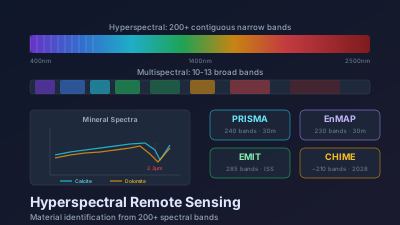
Quick Answer: Hyperspectral sensors capture 200+ contiguous narrow spectral bands (typically 5-10 nm wide) compared to multispectral sensors' 10-13 broad bands (60-180 nm wide). This continuous spectrum enables identification of specific materials — particular minerals, crop species, water pollutants — by matching observed spectra to laboratory reference libraries. Key missions include Italy's PRISMA (30m, 240 bands, 2019-present) and Germany's EnMAP (30m, 228 bands, 2022-present). The trade-off: hyperspectral data requires more complex processing (atmospheric correction is critical), larger storage, and specialized analysis techniques like spectral unmixing and matched filtering. Applications where hyperspectral excels over multispectral include geological mineral mapping, detecting specific crop diseases, identifying plastic pollution in water, and distinguishing materials with similar broadband reflectance but different absorption features.
Geological mapping shows the gap most clearly. Multispectral Sentinel-2 data separates broad lithological classes — "bright rock" from "dark rock", carbonates from basalts. Hyperspectral data from a sensor like PRISMA can go a step further and discriminate specific carbonate minerals: calcite, dolomite and magnesite each produce a diagnostic absorption feature near 2.3 μm, but centred at slightly different wavelengths. Those shifts are averaged away inside Sentinel-2's broad SWIR bands, and clearly resolved by PRISMA's 10 nm channels.
That level of specificity is what makes hyperspectral remote sensing fundamentally different from multispectral. It's the difference between seeing colors and identifying chemical compositions.
What's the difference between multispectral and hyperspectral?
The difference is sampling density: multispectral sensors take a handful of wide samples of the spectrum, while hyperspectral sensors record a nearly continuous curve. Multispectral sensors (Sentinel-2, Landsat) capture 10-13 bands, each spanning 60-180 nm of the electromagnetic spectrum. They sample the spectrum at discrete, widely spaced intervals. This is like hearing a symphony through a wall — you get the general melody but lose the fine detail.
Hyperspectral sensors capture 200+ contiguous bands, each only 5-10 nm wide, producing a nearly continuous spectrum for every pixel. This is like sitting in the concert hall — every instrument is distinguishable.
| Feature | Sentinel-2 (Multispectral) | PRISMA (Hyperspectral) |
|---|---|---|
| Bands | 13 | 240 |
| Band width | 15-180 nm | ~10 nm |
| Spectral range | 443-2190 nm | 400-2500 nm |
| Spatial resolution | 10-60m | 30m |
| Swath width | 290 km | 30 km |
| Data per scene | ~800 MB | ~5 GB |
The narrow swath and large data volume are the practical trade-offs. Hyperspectral sensors sacrifice spatial coverage for spectral detail.
Current Hyperspectral Satellite Missions
PRISMA (Italy, ASI, 2019-present)
The PRecursore IperSpettrale della Missione Applicativa has been a game-changer for the research community:
- 240 bands from 400-2500 nm at ~10 nm spectral resolution
- 30m spatial resolution
- 30 km swath width
- Data freely available for registered users
EnMAP (Germany, DLR, 2022-present)
The Environmental Mapping and Analysis Program:
- 228 bands from 430-2450 nm
- 30m spatial resolution
- 30 km swath width
- Improved signal-to-noise ratio compared to earlier missions
EMIT (NASA, ISS, 2022-present)
NASA describes EMIT as "the first instrument to use NASA-invented imaging spectroscopy technology to comprehensively measure the different wavelengths of light emitted by minerals on the surface of deserts and other dust sources to determine their composition." Originally designed for that mineral dust mission, EMIT has become a powerful methane and CO₂ point-source detector:
- 285 bands from 380-2500 nm
- 60m spatial resolution
- 75 km swath width
- Mounted on the International Space Station
Upcoming: CHIME (ESA/Copernicus)
The Copernicus Hyperspectral Imaging Mission for the Environment, planned for 2028-2029, will be the first operational hyperspectral satellite:
- ~210 bands from 400-2500 nm at 10 nm resolution
- 30m spatial resolution
- ~130 km swath width — dramatically wider than current missions
- Systematic global coverage with ~11 day revisit
CHIME will transform hyperspectral from a research tool to an operational monitoring capability.
What can hyperspectral do that multispectral cannot?
Four things stand out: identifying specific mineral species rather than mineral groups, detecting crop stress with disease-specific spectral signatures, retrieving individual water quality constituents, and reliably unmixing what's inside a mixed pixel. Everything else — broad land cover, general vegetation health — multispectral already does well.
Mineral Identification
This is the classic hyperspectral application. Minerals have diagnostic absorption features at specific wavelengths:
- Iron oxides: Absorption near 900 nm (goethite vs. hematite distinguished by exact position)
- Carbonates: Absorption near 2340 nm (calcite) vs. 2320 nm (dolomite)
- Clay minerals: Absorption doublet near 2200 nm (kaolinite vs. montmorillonite vs. illite)
- Sulfates: Absorption near 1750 nm and 2200 nm
Sentinel-2 can detect the presence of iron oxides (its SWIR band spans the absorption region) but cannot distinguish between goethite and hematite. Hyperspectral sensors can, because they resolve the exact absorption wavelength. What multispectral band ratios can achieve in geology is covered in iron oxide and clay mineral mapping.
Crop Species and Stress Detection
Different crop species have subtly different spectral signatures, especially in the red-edge region (680-750 nm). Multispectral sensors have 1-3 bands here; hyperspectral sensors have 10-15.
More importantly, specific stresses produce diagnostic spectral changes:
- Nitrogen deficiency: Shifts the red-edge position toward shorter wavelengths
- Water stress: Deepens the 1450 nm and 1940 nm water absorption features
- Disease-specific signatures: Some fungal infections produce unique spectral patterns before visible symptoms appear
Water Quality Parameters
Hyperspectral data enables retrieval of specific water constituents:
- Chlorophyll-a concentration from the shape of the reflectance peak near 700 nm
- Cyanobacteria detection using the phycocyanin absorption feature near 620 nm
- Dissolved organic matter from the spectral slope in visible wavelengths
- Suspended sediment type (organic vs. mineral) from the spectral shape in red-NIR
Spectral Unmixing
In a 30m pixel, you might have a mixture of vegetation, soil, and shadow. Spectral unmixing decomposes this mixed spectrum into its constituent endmembers and their fractional abundances.
With multispectral data, unmixing is heavily under-determined (more endmembers than bands). With 200+ hyperspectral bands, the problem becomes over-determined, enabling reliable unmixing of complex scenes into 5-10 endmember materials.
Why is hyperspectral data harder to process?
Three compounding reasons: atmospheric correction must be far more precise, high dimensionality degrades naive classifiers, and data volumes are roughly an order of magnitude larger per scene. None of these is a blocker, but together they explain why hyperspectral workflows demand more expertise than an NDVI analysis.
Atmospheric Correction Is Critical
For multispectral analysis, approximate atmospheric correction is often sufficient — NDVI is relatively robust to atmospheric effects because it's a ratio. For hyperspectral analysis, atmospheric correction must be precise because you're comparing the exact shape of absorption features, and atmospheric water vapor and aerosols produce absorption features in the same spectral regions as your target materials.
Tools: ATCOR, FLAASH, and the newer ISOFIT provide hyperspectral-specific atmospheric correction.
The Hughes Phenomenon (Curse of Dimensionality)
With 200+ bands, many machine learning classifiers perform worse, not better, than with a well-chosen subset of 10-20 bands. This is because:
- Adjacent bands are highly correlated (adding redundant features)
- Training sample requirements increase exponentially with dimensionality
- Noise in individual bands accumulates
Solutions: Dimensionality reduction (PCA, MNF transform), band selection, or algorithms designed for high-dimensional data (SVM with RBF kernel, random forest).
Storage and Processing
A single PRISMA scene is ~5 GB. A regional study might involve dozens of scenes. Processing 200+ bands through atmospheric correction, geometric correction, and classification requires significantly more compute than equivalent multispectral workflows.
Multispectral vs. Hyperspectral: What Can Actually Be Detected?
The practical question: for which applications does the extra complexity of hyperspectral data yield results that multispectral cannot achieve?
| Application / Target | Sentinel-2 (13 bands) | PRISMA/EnMAP (200+ bands) | Hyperspectral Advantage |
|---|---|---|---|
| Broad land cover (forest/crop/water) | Excellent | Excellent | None — multispectral sufficient |
| Iron oxide presence | Good | Excellent | Minimal (SWIR1/SWIR2 sufficient) |
| Iron oxide species (goethite vs. hematite) | Poor (bands too broad) | Excellent (~900 nm feature) | Critical |
| Clay mineral type (kaolinite vs. illite) | Poor | Excellent (2200 nm doublet) | Critical |
| Carbonate type (calcite vs. dolomite) | Poor | Good (2340 vs. 2320 nm) | Critical |
| General vegetation health (NDVI) | Excellent | Excellent | None |
| Crop nitrogen status | Moderate (NDRE) | Good | Moderate improvement |
| Specific crop disease detection | Poor (pre-symptom) | Moderate (disease-specific features) | Significant |
| Cyanobacteria in water (phycocyanin) | Poor (620 nm feature missed) | Good | Critical |
| Chlorophyll-a in complex waters | Moderate | Good–Excellent | Significant in coastal waters |
| Plastic detection in ocean | Poor | Moderate (1.3, 1.7 μm features) | Significant |
| Methane point source detection | No | Good (EMIT: 2.3 μm CH₄ band) | Critical |
The realistic expectation: For most environmental monitoring tasks involving vegetation, land cover, and coarse water quality, Sentinel-2 is adequate and hyperspectral adds marginal value. The domains where hyperspectral delivers transformative capability are: geological mineral mapping (species-level discrimination), specific water quality parameters (cyanobacteria, dissolved organics), and chemical/gas detection (methane, CO₂ with EMIT). For these applications, Sentinel-2 simply cannot substitute — the spectral information is not there.
Getting Started with Hyperspectral Data
- Register for PRISMA data access at ASI's portal (prisma.asi.it) — free for research
- Register for EnMAP data at DLR's portal — also free
- Start with EnMAP-Box — DLR's free QGIS plugin specifically designed for hyperspectral analysis
- Use spectral libraries — USGS Spectral Library and ECOSTRESS Spectral Library provide reference spectra for minerals, vegetation, and man-made materials
- Begin with a focused question — "Can I distinguish mineral X from mineral Y?" is answerable; "Map everything" is not
The field is at an inflection point. For decades, hyperspectral remote sensing was limited to expensive airborne campaigns and a handful of research satellites with narrow coverage. CHIME will change that, providing systematic global hyperspectral coverage for the first time. The analysis techniques developed on PRISMA and EnMAP data today will scale to global applications within a few years.

Remote sensing specialist with 10+ years in satellite data processing and AI. Founder of Off-Nadir Lab. Ph.D. in Informatics (Yokohama National University, 2026). Master's in Earth System Science and Technology (Kyushu University). Co-author, Remote Sensing Encyclopedia. More about the author →