
Mapping Soil Properties from Satellite Imagery: What's Possible and What's Not
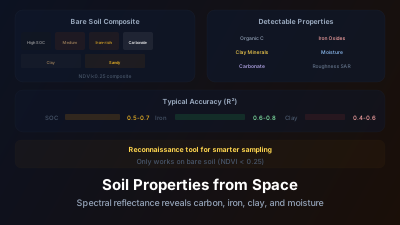
Quick Answer: Satellites can map soil properties only when soil is exposed (bare, no vegetation). Soil organic carbon correlates with visible/NIR darkness; iron oxides show distinctive red/SWIR signatures; clay minerals have SWIR absorption features; soil moisture affects all bands through dielectric changes. Sentinel-2 SWIR bands enable basic mineral discrimination. Accuracy is moderate and site-specific: the fit for organic carbon is best in homogeneous landscapes and degrades where moisture or parent material also control soil brightness, while properties with a more direct spectral link — such as iron content — map more reliably. Bare-soil composites (combining cloud-free, vegetation-free observations) maximize mapping potential. Satellite soil mapping complements but doesn't replace field sampling.
Soil remote sensing is constrained by a blunt physical fact: where a canopy is present, the reflected signal comes from leaves, not from the ground beneath them. The fundamental limitation of optical soil mapping from satellites is that you can only see the soil when nothing is covering it.
But when soil is exposed — after harvest, before planting, in fallow periods, in arid regions — satellite data reveals more about soil composition than most people expect.
What Soil Properties Are Visible from Space
Soil Organic Carbon (SOC)
Organic matter darkens soil. High-SOC soils absorb more light across visible and near-infrared wavelengths, appearing darker in satellite imagery. The relationship is strongest in the visible range (400-700 nm).
The approach: On bare soil images, darker pixels generally indicate higher organic carbon. Regression models using visible and NIR reflectance can estimate SOC at regional scales, but the strength of the fit varies substantially between studies and landscapes — it is best where parent material and moisture are relatively uniform, and it degrades wherever something other than organic matter is also controlling soil brightness.
Limitations: The relationship breaks down when other factors also darken the soil — moisture (wet soil is darker regardless of SOC), iron oxides (dark minerals), and surface roughness all confound the SOC signal.
Iron Oxides
Iron minerals (hematite, goethite, ferrihydrite) produce diagnostic spectral features:
- Hematite: Strong absorption in blue (450 nm), giving soil a red color
- Goethite: Absorption in blue-green (480 nm), producing yellow-brown color
- General iron: Broad absorption feature around 900 nm (NIR)
Sentinel-2's blue and red bands, combined with NIR, enable basic iron oxide mapping. The ratio B4/B2 (Red/Blue) is a simple iron oxide index — high values indicate iron-rich soils.
Clay Minerals
Clay minerals (kaolinite, illite, montmorillonite) have absorption features in the SWIR region, particularly around 2200 nm. Sentinel-2's B12 (2190 nm) captures the edge of this absorption.
The clay index B11/B12 provides a coarse indicator of clay content, though the spectral resolution of Sentinel-2 is too broad for reliable clay mineral identification. Hyperspectral sensors (like EnMAP or PRISMA) with numerous narrow SWIR bands perform much better for clay mineralogy.
Soil Moisture
As discussed in the SAR soil moisture article, water dramatically changes soil's spectral and dielectric properties. In optical imagery, wet soil appears darker than dry soil across all bands. In SAR, wet soil returns stronger backscatter.
Calcium Carbonate
Carbonate-rich soils (calcareous soils) are typically light-colored with high reflectance across the visible spectrum. They show subtle absorption features around 2340 nm, just beyond Sentinel-2's spectral range but detectable by hyperspectral sensors.
Surface Texture (Roughness)
While not a compositional property, soil surface roughness affects how light is scattered and can be inferred from SAR backscatter. Freshly plowed soil is rough; crusted soil is smooth. This matters for erosion risk assessment and seedbed quality evaluation.
Bare Soil Composites
The key to soil mapping from satellites is obtaining cloud-free, vegetation-free imagery. The Bare Soil Composite approach:
- Collect all available Sentinel-2 images over several years (3-5 years)
- Apply cloud masking (SCL-based)
- Apply vegetation masking: Exclude pixels with NDVI > 0.25 (vegetation present)
- Composite the bare soil observations: For each pixel, select the observation(s) with the lowest NDVI (most bare soil)
The result is a synthetic "bare soil image" where every pixel shows the soil surface, even if it's only bare for a few weeks per year. This composite maximizes spatial coverage and provides the cleanest soil spectral signal.
This technique works particularly well in agricultural landscapes where fields are periodically bare between crops. In permanently vegetated areas (forests, permanent grassland), bare soil composites can't help.
Digital Soil Mapping with Satellite Data
Modern digital soil mapping integrates satellite-derived soil indices with:
- Terrain variables: Elevation, slope, curvature, wetness index (from DEMs)
- Climate data: Temperature, precipitation, evapotranspiration
- Geological maps: Parent material information
- Existing soil samples: Sparse field measurements as calibration/validation
Machine learning models (Random Forest, gradient boosting) trained on these combined datasets produce continuous soil property maps at 10-30 m resolution. The satellite data provides the spatial detail that sparse soil samples alone cannot.
Accuracy Expectations
Be realistic about what satellite-based soil mapping can achieve. Published R² values for these retrievals range widely — the same property can fit well in one catchment and poorly in the next, because the fit is a property of the calibration dataset as much as of the sensor. What is stable is the ordering, which follows directly from how direct the spectral link to the property is:
| Property | Satellite Approach | Relative strength | Notes |
|---|---|---|---|
| Iron oxide content | Red/Blue ratio | Strongest | Diagnostic colour; direct spectral feature |
| Organic carbon | Visible/NIR darkness | Good | Best in homogeneous landscapes; confounded by moisture |
| Soil moisture | SAR backscatter | Good | Bare soil only at C-band |
| Clay content | SWIR ratios | Moderate | Sentinel-2 too broad; hyperspectral better |
| Texture class | Combined indices | Weak | Very approximate |
| pH | Indirect (via SOC, carbonate) | Weakest | No direct spectral signal; inferred through correlates |
Retrievals at this level are sufficient for:
- Identifying spatial patterns and variability zones
- Guiding targeted soil sampling (sample where the satellite indicates variability)
- Monitoring temporal changes (SOC trends, erosion)
They're insufficient for:
- Replacing soil laboratory analysis
- Meeting regulatory requirements for soil classification
- Making precise fertilizer recommendations based on nutrient content
Sensor Suitability by Soil Property
Not all satellites are equally suited for soil mapping. Choosing the right sensor depends on which property you're targeting:
| Soil Property | Sentinel-2 (10–20 m) | Hyperspectral (EnMAP, PRISMA) | SAR (Sentinel-1) | Thermal (Landsat TIRS) |
|---|---|---|---|---|
| Organic carbon | Moderate | Good | Poor | Poor |
| Iron oxide content | Good | Excellent | Poor | Poor |
| Clay mineralogy | Weak (too broad SWIR) | Excellent (2200 nm features) | Poor | Poor |
| Surface moisture | Moderate (darkness proxy) | Moderate | Good (0–2 cm depth) | Indirect (evaporative cooling) |
| Soil texture class | Poor–Moderate | Moderate | Poor | Poor |
| Surface roughness | Poor | Poor | Good (backscatter) | Poor |
| Carbonate content | Poor | Moderate (2340 nm) | Poor | Poor |
Key takeaway: Sentinel-2 is the practical starting point for most soil mapping projects due to free access and 10 m resolution, but its broad SWIR bands (B11 at 1610 nm, B12 at 2190 nm) lack the spectral resolution for clay mineral discrimination. If your primary target is clay or carbonate mineralogy, hyperspectral data (EnMAP at 30 m resolution, launched 2022) offers substantially better performance for those specific properties.
For soil moisture specifically, combining Sentinel-2 (optical soil darkness) with Sentinel-1 (SAR backscatter) gives complementary information: Sentinel-2 captures the visible darkening of wet topsoil, while Sentinel-1 C-band sees the dielectric change in the top 1–2 cm regardless of cloudiness.
Practical Applications
Erosion Risk Mapping
Combining bare soil composite brightness (indicating SOC/texture) with terrain slope identifies erosion-prone areas. Light-colored soil on steep slopes is at highest risk — likely low organic matter, poor structure, and gravitational stress.
Carbon Stock Estimation
Climate change mitigation requires large-scale SOC monitoring. Satellite-derived SOC maps, calibrated with field measurements, provide estimates of soil carbon stocks across agricultural regions. Temporal monitoring (comparing bare soil composites from different years) can track SOC changes, though detecting small changes requires many years of data.
Precision Soil Sampling
Instead of sampling on a regular grid, use satellite soil variability maps to place samples strategically — more samples where the satellite shows high variability, fewer where conditions appear uniform.
Geological/Mineral Exploration
In arid regions where soil is permanently exposed, satellite spectral analysis aids mineral exploration by mapping surface mineralogy across large areas. Iron oxide and clay alteration patterns visible in Sentinel-2 SWIR data can indicate subsurface mineralization.
The bottom line: satellite soil mapping is a powerful reconnaissance tool that reveals spatial patterns invisible from field-level observation. It doesn't replace soil sampling — it makes sampling smarter, more targeted, and more cost-effective. And in an era where we need to monitor soil health across entire continents, satellite data is the only practical way to achieve that spatial coverage.
Related reading
Mapping a property once and tracking it are different jobs. If the question is whether a value has moved rather than what it is, measuring a number versus watching for events covers building a baseline over a fixed area and separating a real departure from ordinary variation.

Remote sensing specialist with 10+ years in satellite data processing and AI. Founder of Off-Nadir Lab. Ph.D. in Informatics (Yokohama National University, 2026). Master's in Earth System Science and Technology (Kyushu University). Co-author, Remote Sensing Encyclopedia. More about the author →