
SAR Speckle Noise: What It Is and How to Filter It Without Losing Information
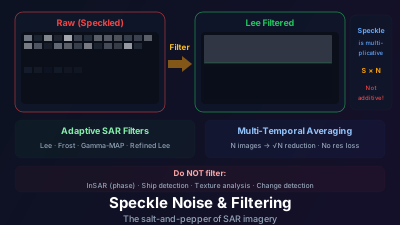
Quick Answer: Speckle is a granular noise pattern inherent to SAR imagery, caused by constructive and destructive interference of coherent radar waves scattered from multiple sub-pixel targets. Unlike sensor noise, speckle is multiplicative — it scales with signal strength. Common filters include Lee (adaptive local statistics), Frost (exponential weighting), and Gamma-MAP (Bayesian approach). Multi-temporal averaging of multiple acquisitions reduces speckle by √N while preserving spatial resolution. Never apply Gaussian or mean filters to SAR — they destroy edges and structural information.
A Sentinel-1 image looks grainy in a way that optical imagery does not, and the first reaction is often to suspect a broken sensor or a processing error. It is neither. That granular, salt-and-pepper texture is speckle, and it's a fundamental property of coherent imaging, not a defect.
Understanding speckle is essential for anyone working with SAR data, because how you handle it determines whether your analysis preserves or destroys the information you're after.
Why SAR Images Look Grainy
SAR transmits coherent microwave radiation — the waves have a precise, known phase relationship. When this radiation hits the ground, it's scattered by everything within each resolution cell: individual rocks, soil grains, plant stems, building facets. Each scatterer returns a wave with slightly different amplitude and phase.
At the sensor, these returned waves combine through interference:
- Where wave crests align (constructive interference), the signal is amplified — the pixel appears bright
- Where crests meet troughs (destructive interference), the signal is reduced — the pixel appears dark
This interference pattern is deterministic — for the same surface viewed from the same geometry, you'd get the same speckle pattern. But it looks random because the sub-pixel scatterer arrangement varies from pixel to pixel.
The result: adjacent pixels over the same uniform surface (a flat agricultural field, for instance) can differ in brightness by a factor of 3 or more. This makes visual interpretation difficult and complicates quantitative analysis.
You can see this grain for yourself by zooming into farmland in the Sentinel-1 SAR viewer.
Speckle Is Multiplicative
This is the critical technical detail that determines which filters work and which don't.
In optical imagery, noise is additive: Observed = True signal + Noise. The noise is independent of signal strength.
In SAR imagery, speckle is multiplicative: Observed = True signal × Speckle. Brighter areas have proportionally more noise. A forest (high backscatter) has larger absolute speckle fluctuations than a calm lake (low backscatter), even though the relative variation is the same.
This multiplicative nature means standard image processing filters designed for additive Gaussian noise perform poorly on SAR data. A Gaussian blur or simple mean filter will:
- Over-smooth dark areas (where speckle is relatively mild)
- Under-smooth bright areas (where speckle is proportionally stronger)
- Blur edges between different surface types
- Destroy point targets (ships, buildings) that appear as bright spots
Adaptive Filters for SAR
SAR-specific filters adapt their behavior based on local image statistics — applying stronger smoothing in homogeneous areas (where speckle dominates) and weaker smoothing near edges and point targets (where spatial structure is important).
Lee Filter
The workhorse of SAR speckle filtering. The Lee filter estimates the "true" backscatter for each pixel using a weighted combination of the pixel's own value and the local mean:
Filtered = Mean + Weight × (Original − Mean)
The weight depends on the ratio of local variance to expected speckle variance:
- In uniform areas (variance ≈ speckle variance): Weight → 0, output ≈ local mean (strong smoothing)
- Near edges (variance >> speckle variance): Weight → 1, output ≈ original value (preserves edges)
Window sizes of 5×5 to 7×7 are typical. Larger windows smooth more but risk blurring real features.
Refined Lee Filter
An improvement that considers edge direction. Instead of using a square window, the refined Lee filter selects one of several directional sub-windows (horizontal, vertical, diagonal) that best aligns with any local edge. This better preserves linear features like roads, coastlines, and field boundaries.
Frost Filter
Similar philosophy to Lee but uses an exponentially weighted kernel that decreases with distance from the center pixel. The decay rate adapts to local statistics — faster decay (less smoothing) in heterogeneous areas, slower decay in uniform areas.
Gamma-MAP Filter
A Bayesian approach that assumes speckle follows a Gamma distribution (which it does for multi-look SAR data). The Gamma Maximum A Posteriori (MAP) estimator produces a statistically optimal estimate of the true backscatter given the observed speckled value.
In practice, Gamma-MAP produces slightly sharper results than Lee but is more computationally expensive.
Multi-Temporal Averaging
If multiple SAR acquisitions over the same area are available (common with Sentinel-1's 6-12 day revisit), temporal averaging provides speckle reduction without spatial resolution loss:
- Co-register multiple images to sub-pixel accuracy
- Average the intensity values pixel by pixel
Speckle from different dates is statistically independent (the sub-pixel scatterer arrangement looks different from each satellite pass). Averaging N images reduces speckle by a factor of √N:
| Images Averaged | Speckle Reduction | Equivalent Number of Looks |
|---|---|---|
| 1 | None | Original ENL |
| 4 | 2× | 4 × original ENL |
| 9 | 3× | 9 × original ENL |
| 16 | 4× | 16 × original ENL |
The catch: The surface must be stable between acquisitions. If crops are growing, water levels changing, or construction progressing, the temporal average will blur these real changes. Multi-temporal averaging is best for stable surfaces — bare soil, rock, urban areas, permanent water bodies.
When NOT to Filter
Speckle isn't always noise — sometimes it carries information:
Change detection: Comparing speckle patterns between two dates can reveal surface changes. A building demolished between two passes changes the scatterer arrangement, which changes the speckle. Aggressive filtering removes this signal.
InSAR: Interferometry requires preserving the phase information, which is destroyed by most intensity filters. InSAR has its own coherence-based noise reduction methods (multi-looking, Goldstein filtering) that operate in the complex domain.
Ship detection: Vessels appear as bright point targets against dark ocean. Speckle filters that smooth these bright pixels reduce detection sensitivity.
Texture analysis: Forest structure, urban density, and agricultural field patterns produce characteristic speckle textures. Filtering homogenizes the texture, removing the very signal you want to measure.
Filter Performance Comparison
Choosing the right filter means understanding the trade-offs. The comparison below is qualitative and relative — it ranks the filters against each other for a 5×5 kernel on Sentinel-1 IW GRD data, rather than reporting measured benchmark values. The ENL column follows from how many independent samples each filter effectively averages: a plain 5×5 box filter averages all 25 pixels, and the adaptive filters deliberately average fewer near edges and point targets, which is exactly why they smooth less:
| Filter | ENL Improvement | Edge Preservation | Point Target Preservation | Relative Speed |
|---|---|---|---|---|
| Mean (box) | ~25× | Poor | Poor | Fastest |
| Gaussian | ~15× | Poor-moderate | Poor | Fast |
| Lee (5×5) | ~8–12× | Moderate | Moderate | Fast |
| Refined Lee (5×5) | ~6–10× | Good | Moderate | Moderate |
| Frost (5×5) | ~8–12× | Moderate-good | Moderate | Moderate |
| Gamma-MAP (5×5) | ~10–14× | Good | Moderate | Slow |
| Multi-temporal (4 scenes) | ~4× (spatial) | Excellent | Excellent | Depends on data |
ENL = Equivalent Number of Looks (higher is better — less speckle). The mean filter achieves the highest ENL but at the cost of destroying edges and point targets, making it largely useless for SAR analysis despite its apparent noise reduction performance.
The counter-intuitive result: Multi-temporal averaging with 4 scenes (2× speckle reduction) often outperforms a 5×5 Lee filter (8–12× ENL improvement) in practical applications, because it preserves full spatial resolution and doesn't blur edges or remove point targets. If you have 4–6 co-registered scenes, start there before reaching for spatial filters.
Practical Recommendations
For visual interpretation and mapping: Apply a 5×5 Refined Lee filter. It preserves edges while making the image readable.
For quantitative backscatter analysis (crop monitoring, soil moisture): Use multi-temporal averaging when possible (3-5 dates from the same orbit), supplemented by a gentle 3×3 Lee filter.
For change detection: Minimize filtering. Apply the same minimal filter to both dates, or work with unfiltered data and apply statistical change detection methods designed for multiplicative noise.
For classification: Filter before classifying. Speckle degrades classifier performance significantly — the noise introduces within-class variance that confuses the algorithm.
The key principle: filter as little as necessary for your application. Every filter makes a trade-off between noise reduction and information loss. Understanding that trade-off — and knowing when speckle is noise versus signal — is what separates competent SAR analysis from processing by default.
Frequently asked questions
What causes speckle in SAR images?
Speckle is a granular noise pattern inherent to SAR imagery. It arises because a radar transmits coherent waves, and within a single resolution cell many sub-pixel scatterers reflect those waves back with different phases. Their constructive and destructive interference produces the characteristic salt-and-pepper texture — it is a physical property of coherent imaging, not a sensor fault.
Is speckle the same as sensor noise?
No. Ordinary sensor noise is additive and roughly constant, whereas speckle is multiplicative — its magnitude scales with the strength of the underlying signal. That is why speckle filters are designed around local statistics and ratios rather than simple subtraction.
Which filters work best for SAR speckle?
Adaptive, edge-preserving filters such as Lee and Refined Lee (local statistics), Frost (exponential weighting), and Gamma-MAP (a Bayesian approach) are the standard choices. They suppress speckle in homogeneous areas while retaining edges and structure.
Can I use a Gaussian or mean filter on SAR imagery?
No. Gaussian and mean filters blur across edges and destroy the structural and textural information that makes SAR useful. Because speckle is multiplicative, these additive-noise filters also fail to suppress it correctly. Use adaptive SAR-specific filters instead.
How does multi-temporal averaging reduce speckle?
Averaging N co-registered acquisitions of the same scene reduces speckle by roughly the square root of N while preserving full spatial resolution. It is often the most effective option when a time series is available, since single-image spatial filters always trade some resolution for smoothing.

Remote sensing specialist with 10+ years in satellite data processing and AI. Founder of Off-Nadir Lab. Ph.D. in Informatics (Yokohama National University, 2026). Master's in Earth System Science and Technology (Kyushu University). Co-author, Remote Sensing Encyclopedia. More about the author →