
SAR Coherence for Change Detection: Finding What Changed Without Optical Data
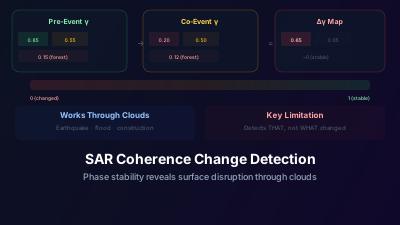
Quick Answer: SAR coherence measures how similar the radar scattering properties of a surface are between two acquisitions. High coherence (0.7-1.0) means the surface is unchanged; low coherence (0-0.3) means something changed — vegetation grew, buildings collapsed, soil was disturbed, or snow fell. Coherence change detection works through clouds and at night, making it invaluable for rapid disaster damage assessment. A sudden drop in coherence over urban areas after an earthquake indicates building damage, even when optical imagery is unavailable due to cloud cover.
Major earthquakes have an awkward habit of arriving under cloud. Optical satellites can be grounded for days at exactly the moment a damage map is most useful, and the first responders working the area have no synoptic view of which districts took the worst of it. SAR coherence is one of the few products that does not care: it is computed from radar phase, so it works through cloud and at night, and a pre-event/post-event pair can be turned into a map of where the ground surface was rearranged as soon as the post-event acquisition lands.
That's the operational value of coherence: it works when nothing else can.
What Coherence Measures
When a SAR satellite passes over the same area twice, it records the complex radar signal (amplitude and phase) from each pixel. Coherence quantifies how similar these two complex signals are.
Mathematically, it's the normalized cross-correlation of the complex signals from two SAR acquisitions, computed over a small window (typically 5×20 pixels):
γ = |⟨s₁ · s₂⟩| / √(⟨|s₁|²⟩ · ⟨|s₂|²⟩)*
Where s₁ and s₂ are the complex pixel values from the two images, * denotes complex conjugate, and ⟨⟩ denotes spatial averaging.
The result ranges from 0 to 1:
- γ ≈ 1: The surface scattering is identical in both images. Nothing has changed.
- γ ≈ 0: The scattering is completely different. The surface has changed dramatically.
Why Surfaces Lose Coherence
Several mechanisms cause coherence to decrease:
Physical Surface Change
Any alteration to the arrangement of scatterers within a resolution cell reduces coherence. Building collapse rearranges concrete and rebar. Plowing a field rearranges soil clumps. Harvesting removes crops. Tree growth adds new branches. Each of these changes the specific interference pattern within each pixel.
Vegetation Growth
This is the dominant source of coherence loss in vegetated areas. Leaves move in the wind, branches grow, and the canopy structure evolves. At C-band (Sentinel-1), temporal decorrelation over forests can be substantial within a single 6-day repeat cycle. Over dense tropical forests, coherence may be essentially zero after just one repeat pass.
Soil Moisture Changes
Changing the moisture content of soil alters its dielectric properties, which changes the radar return. A rainstorm between acquisitions can reduce coherence even without physical surface change.
Snow
Fresh snowfall or snowmelt dramatically changes the surface scattering properties, producing near-zero coherence.
Coherence Change Detection Workflow
The power of coherence for change detection comes from comparing coherence maps from different time periods:
Pre-Event Coherence
Compute coherence between two acquisitions before the event (e.g., 12 and 6 days before an earthquake). This establishes a baseline showing natural coherence levels — high over urban areas, moderate over agricultural fields, low over forests.
Co-Event Coherence
Compute coherence between one pre-event and one post-event acquisition. This captures the changes caused by the event.
Coherence Change
The difference or ratio between pre-event and co-event coherence reveals where the event caused changes beyond normal temporal variation:
ΔCoherence = Pre-event coherence − Co-event coherence
Areas where ΔCoherence is positive and large have experienced significant change. Over urban areas, this typically indicates building damage.
Applications
Earthquake Damage Assessment
In urban areas, buildings are strong persistent scatterers that maintain high coherence over time (typically 0.6-0.9). When buildings collapse or are severely damaged, coherence drops dramatically (to 0.1-0.3). This contrast makes coherence an effective proxy for building damage.
Coherence-based damage maps generally agree well with ground surveys at the city-block scale, and the agreement is best for the coarse distinction that matters most early on — heavily damaged versus largely intact. It degrades for finer gradings of damage severity, and for individual buildings it is not reliable at all, because the coherence estimate is spatially averaged over a window larger than a building footprint.
Flood Mapping
Flooded areas show low coherence because the water surface is temporally incoherent — water's scattering properties change from moment to moment. Even after waters recede, disturbed sediment and debris reduce coherence relative to pre-flood conditions.
Coherence is particularly useful for detecting flooding under vegetation canopy — where amplitude-based methods may fail due to the double-bounce effect.
Construction Monitoring
New construction sites produce a characteristic coherence signature: low coherence during active construction (constant surface change), transitioning to high coherence as the structure is completed and stabilizes. Monitoring coherence over time can track construction progress without visiting the site.
Volcanic Surface Change
Lava flows, ash deposits, and lahar deposits all produce dramatic coherence loss. Combined with InSAR deformation measurements, coherence maps help distinguish between areas affected by surface deposition and areas experiencing ground deformation.
Agricultural Practices
Plowing, planting, and harvesting all cause coherence drops. Time series of coherence over agricultural areas can track farming activities — useful for agricultural monitoring programs that need to verify farming practices without field visits.
Coherence Reference Values by Surface Type
Interpreting coherence maps requires knowing what "normal" looks like for different surfaces. These are typical Sentinel-1 C-band coherence values (6-day temporal baseline, IW mode):
| Surface Type | Typical Coherence (γ) | Interpretation |
|---|---|---|
| Concrete / asphalt roads | 0.85–0.95 | Very high; stable point scatterers |
| Urban buildings (intact) | 0.70–0.90 | High; persistent structure |
| Urban buildings (damaged) | 0.10–0.35 | Low; scatterer arrangement disrupted |
| Bare rock / dry desert | 0.70–0.85 | High; no change in scatterers |
| Bare agricultural soil (no tillage) | 0.50–0.75 | Moderate; some moisture variability |
| Plowed field | 0.10–0.30 | Low; physical surface change |
| Grassland (stable) | 0.25–0.50 | Moderate; wind movement causes some decorrelation |
| Agricultural crops (growing) | 0.05–0.25 | Low; rapid canopy change |
| Temperate deciduous forest | 0.05–0.20 | Very low; leaf movement decorrelates quickly |
| Tropical rainforest | 0.02–0.10 | Near-zero; dense canopy fully decorrelates in 6 days |
| Calm lake / open water | 0.02–0.15 | Near-zero; the water surface decorrelates between passes |
| Flooded field / inundated area | 0.05–0.20 | Low; water surface is temporally incoherent |
| Snow (stable, dry) | 0.60–0.80 | High; crystalline structure is stable |
| Wet snowfall / new snowfall | 0.02–0.15 | Very low; major scattering change |
The key insight from this table: forests, crops and open water have persistently low coherence regardless of what's happening on the ground, so a low value over them carries no information about change. Coherence-based change detection is most reliable on hard, non-vegetated surfaces — urban areas, bare soil, and rocky terrain — where the baseline is high and a drop therefore means something. For vegetated landscapes, amplitude-based methods or L-band SAR (which maintains coherence longer in vegetation) are more appropriate; for water, amplitude is the right tool.
Limitations
Baseline coherence varies by surface type: Forests always have low coherence at C-band, regardless of changes. Coherence change detection only works in areas that normally maintain moderate-to-high coherence (urban, bare soil, rock, sparse vegetation).
Temporal baseline matters: Longer time between acquisitions means more natural decorrelation. For damage detection, shorter baselines (6-12 days) are preferred. The 12-day Sentinel-1 revisit that followed Sentinel-1B's power anomaly in late 2021 was a significant limitation for operational coherence analysis until Sentinel-1C completed commissioning in 2025 and the two-satellite 6-day cadence was restored.
Spatial resolution: Coherence estimation requires spatial averaging over an estimation window, which reduces the effective resolution well below the nominal pixel size — typically to the scale of a city block rather than a building. That is too coarse for individual building assessment but sufficient for neighborhood-level damage mapping. Widening the window reduces estimator noise but coarsens the map further, so window size is a direct trade between reliability and detail.
Interpretation requires context: Low coherence doesn't tell you what changed — only that something changed. A coherence drop over an urban area after an earthquake likely means building damage. The same coherence drop in an agricultural area might just mean someone plowed a field. Ground truth or complementary data is needed for definitive interpretation.
Coherence vs. Amplitude Change Detection
Both approaches detect surface changes, but they're sensitive to different things:
| Aspect | Coherence-Based | Amplitude-Based |
|---|---|---|
| What it detects | Any change in scatterer arrangement | Changes in surface roughness or moisture |
| Sensitivity | Very high — rearrangement on the scale of the radar wavelength (centimetres at C-band) is enough to decorrelate a pixel | Moderate (significant changes required) |
| Spatial resolution | Degraded by estimation window | Full SAR resolution |
| Cloud penetration | Yes | Yes |
| Best for | Damage assessment, construction, vegetation | Flooding, deforestation, ship detection |
In practice, the most robust change detection combines both coherence and amplitude information, using each to compensate for the other's weaknesses.
Coherence is one of SAR's unique capabilities — no optical system can provide anything comparable. It detects changes that are invisible in optical imagery and works in conditions that defeat optical sensors entirely. For time-critical applications like disaster response, that's not just a technical advantage — it's a potentially life-saving capability.

Remote sensing specialist with 10+ years in satellite data processing and AI. Founder of Off-Nadir Lab. Ph.D. in Informatics (Yokohama National University, 2026). Master's in Earth System Science and Technology (Kyushu University). Co-author, Remote Sensing Encyclopedia. More about the author →