Change Detection from Space: Three Approaches That Actually Work
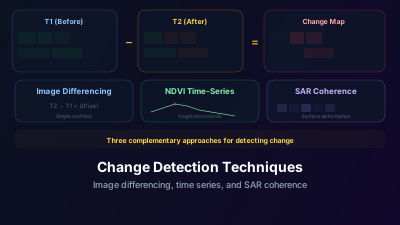
Quick Answer: Satellite change detection identifies what changed between two dates. Image differencing is simplest but noisy. NDVI time-series is best for vegetation monitoring. SAR coherence detects subtle surface disturbances invisible to optical sensors. Choose your method based on what you're looking for, not what's easiest.
The Core Idea
Satellite change detection is conceptually simple: compare images from two dates and identify what's different. In practice, it's riddled with pitfalls — atmospheric differences, seasonal variation, misregistration, and the fundamental question of whether an observed change is real or an artifact.
Across applications as different as deforestation tracking, post-earthquake damage assessment and coastal erosion monitoring, method selection matters more than algorithmic sophistication. Picking the right approach for your specific question is 80% of the work.
Approach 1: Image Differencing
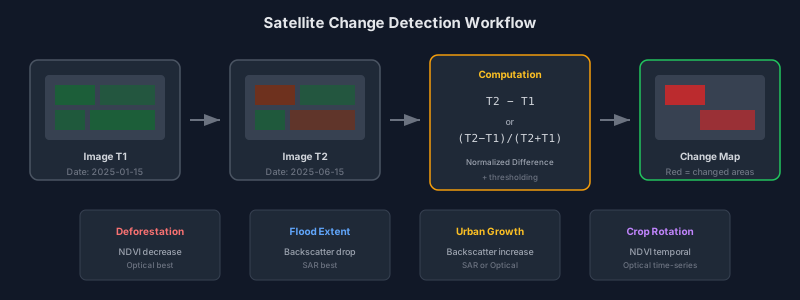
The most straightforward method. Subtract one image from another, and non-zero values indicate change.
Change = Image_T2 - Image_T1
For optical data, this might mean differencing NDVI values, specific band reflectances, or even simple brightness. For SAR, you'd difference calibrated backscatter (σ⁰) values.
When it works well
- Flood extent mapping: Pre-flood SAR minus post-flood SAR clearly delineates inundated areas as strongly negative difference values (backscatter drops when land becomes water)
- Burn scar detection: Post-fire optical imagery shows dramatically lower NIR reflectance, making the difference signal strong and unambiguous
- Large-scale deforestation: Clear-cut logging creates a stark contrast in both optical and SAR data
When it fails
- Gradual changes: If the change happens slowly over months, the difference between any two adjacent dates may be too small to reliably detect
- Seasonal confusion: A deciduous forest will look dramatically different between summer and winter without anything actually "changing" in the meaningful sense. Always compare the same season across years
- Atmospheric differences: Two optical scenes acquired under different atmospheric conditions will produce a non-zero difference everywhere, even if nothing on the ground changed
Practical tip
Normalizing the difference helps. Instead of simple subtraction, use:
Normalized Difference = (T2 - T1) / (T2 + T1)
This ratio partially compensates for absolute brightness differences and produces values between -1 and +1, making threshold selection more consistent across scenes.
Approach 2: NDVI Time-Series
Rather than comparing just two dates, track NDVI continuously over months or years. This approach excels for vegetation-related questions because NDVI has well-understood seasonal patterns that serve as a baseline.
The key insight
Healthy vegetation follows a predictable annual NDVI cycle. In temperate regions, NDVI rises in spring, peaks in summer, and declines in autumn. Deviations from this expected pattern indicate something happened — drought stress, disease, harvest, or land use change.
What to look for
- Sudden drops: An abrupt NDVI decrease outside the normal seasonal pattern suggests disturbance — logging, fire, flooding, or crop failure
- Failed green-up: If spring NDVI doesn't rise to historical levels, the vegetation may be damaged or the land use may have changed
- Permanent baseline shift: A step change that doesn't recover indicates land cover conversion (e.g., forest to farmland)
Limitations
NDVI time-series requires cloud-free optical imagery at regular intervals. In tropical regions with persistent cloud cover, gaps of weeks or months are common, making continuous monitoring difficult. This is where SAR becomes the better choice.
Sentinel-2's 5-day revisit cycle helps, but cloud contamination still reduces the actual usable frequency to perhaps once every 2-4 weeks in many areas.
Approach 3: SAR Coherence
This is the least intuitive approach but potentially the most powerful for certain applications. It exploits the phase information in SAR data that most users never look at.
What coherence measures
When the SAR satellite revisits the same area, the phase of the returned signal should be similar if nothing on the ground has changed. Coherence quantifies this phase consistency on a scale from 0 (completely different) to 1 (identical).
High coherence = stable surface. Low coherence = something changed between acquisitions.
What causes coherence loss
- Physical displacement: Ground subsidence, building collapse, or landslide
- Surface reworking: Plowing, construction activity, or flooding
- Vegetation growth: Growing vegetation changes the scattering geometry, reducing coherence even in the absence of disturbance
That last point is important. In vegetated areas, coherence tends to be naturally low because plants grow and move between acquisitions. Coherence-based change detection works best over urban areas, bare rock, and other stable surfaces.
Where coherence excels
Post-earthquake damage assessment is a textbook application. Undamaged buildings maintain high coherence; collapsed or tilted structures lose it. This can be mapped within hours of a SAR acquisition — far faster than optical damage assessment, which requires clear weather and often manual interpretation.
Choosing Your Method
| Question | Best Approach | Data Source |
|---|---|---|
| Where did flooding occur? | Image differencing (SAR) | Sentinel-1 VV |
| Is this forest degrading over time? | NDVI time-series | Sentinel-2 |
| Was this area burned? | Image differencing (optical) | Sentinel-2 NBR |
| Which buildings were damaged? | SAR coherence | Sentinel-1 SLC |
| Is cropland being converted? | NDVI time-series | Sentinel-2 |
| Where is illegal mining happening? | Image differencing + coherence | Both |
Most real-world projects benefit from combining approaches. Use SAR change detection for rapid initial assessment (it works regardless of weather), then refine with optical analysis when clear imagery becomes available.
Choosing a Threshold
Getting threshold selection right is often the difference between a useful result and noise. There is no universally correct value — a threshold is a trade between missed detections and false alarms, and where you set it depends on your site's baseline variability and on which of those two errors costs you more. The values below are starting points to calibrate against your own data, not settings to adopt:
SAR backscatter differencing (image differencing approach):
- Open flood detection: VV backscatter drop of −3 to −5 dB from baseline. Tighten to −6 dB in wet agricultural regions with high false-positive risk; loosen to −2 dB in arid zones with high baseline variability.
- Construction / land clearing: Look for VV increases of +3 to +5 dB as exposed soil replaces vegetated surfaces. Paired VH changes reinforce the signal.
- Logging in tropical forest: VV change of −2 to −4 dB over forested areas outside normal seasonal range; VH change tends to be larger (−3 to −6 dB) because VH is more sensitive to canopy volume.
Optical NDVI differencing:
- Crop failure / drought stress: ΔNDVI < −0.20 compared to the same season in the prior year warrants investigation.
- Deforestation: ΔNDVI < −0.35 in forest pixels, compared to a multi-year median, is a strong deforestation signal.
- Burn scar (using NBR, Normalized Burn Ratio): the USGS FireMon classification treats dNBR of 0.1–0.27 as low-severity burn, 0.27–0.44 as moderate-low, 0.44–0.66 as moderate-high, and above 0.66 as high severity. Unlike the SAR thresholds above, these are published values you can adopt directly as a first approximation.
One thing worth checking before applying any SAR threshold: the incidence angle. Sentinel-1 IW incidence angles span roughly 29–46° across the 250 km swath. Backscatter decreases by approximately 0.1–0.2 dB per degree of increasing incidence angle. A threshold calibrated at 35° will over-classify changes at 45°. If your images come from the same relative orbit and track number, each pixel has the same incidence angle across dates — no correction needed. Comparing scenes from different orbits requires either normalizing by incidence angle or accepting that your results will be less consistent across the swath.
Try It
Off-Nadir Delta supports multi-temporal satellite imagery comparison. Load Sentinel-1 or Sentinel-2 data from two different dates over the same area and visually compare them. For a hands-on start, pick an area where you know something changed — a recent construction site, a harvested field, or a fire scar — and build your interpretation skills from there.

Remote sensing specialist with 10+ years in satellite data processing and AI. Founder of Off-Nadir Lab. Ph.D. in Informatics (Yokohama National University, 2026). Master's in Earth System Science and Technology (Kyushu University). Co-author, Remote Sensing Encyclopedia. More about the author →