
Land Surface Temperature: Measuring Earth's Heat from Space
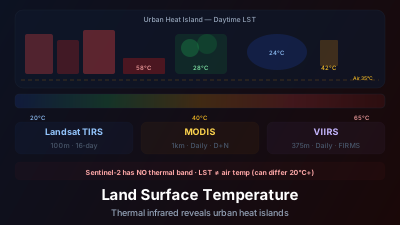
Quick Answer: Land Surface Temperature (LST) is measured by thermal infrared sensors on satellites like Landsat (100m), MODIS (1km), and VIIRS (375m). LST is NOT air temperature — it measures the radiative temperature of the surface, which can differ by 10-20°C from air temperature over asphalt or bare soil. Applications include urban heat island mapping, drought monitoring, volcanic activity detection, and wildfire identification. Sentinel-2 lacks thermal bands, so LST requires Landsat, MODIS, or dedicated thermal missions.
During a summer heat wave, a thermal satellite passing over a city will record far higher temperatures over asphalt parking lots and rooftops than the nearby weather station reports for the same moment. Dark, dry, impervious surfaces absorb solar radiation and have no way to shed it through evaporation, so they run well above the air around them. That gap is not a sensor error — it's the fundamental difference between air temperature and land surface temperature, and understanding that difference is essential to interpreting thermal satellite data correctly.
Surface Temperature vs. Air Temperature
This is the single most important concept in thermal remote sensing, and the one most frequently misunderstood:
Land Surface Temperature (LST) is the radiative temperature of the ground surface — what a thermometer placed directly on the surface would measure. A black asphalt road in full sun can reach 60–70°C. A tree-shaded lawn nearby might be 25°C.
Air temperature is measured by weather stations at 1.5–2 meters above ground, in a ventilated shelter shielded from direct sunlight. It's what you see in weather forecasts.
The two are related but can differ enormously:
| Surface Type | LST (Summer Noon) | Air Temp | Difference |
|---|---|---|---|
| Asphalt parking lot | 55–65°C | 35°C | +20–30°C |
| Concrete building roof | 50–60°C | 35°C | +15–25°C |
| Bare dry soil | 45–55°C | 35°C | +10–20°C |
| Grass lawn | 28–35°C | 35°C | −7 to 0°C |
| Tree canopy | 25–32°C | 35°C | −10 to −3°C |
| Water body | 22–28°C | 35°C | −13 to −7°C |
This table explains why cities are hotter than surrounding countryside — the urban heat island effect is driven by surface materials that absorb and re-emit solar energy far more efficiently than vegetation.
How Thermal Sensors Work
Every object above absolute zero emits thermal radiation. The wavelength and intensity of this emission depends on the object's temperature, following Planck's radiation law. At Earth-surface temperatures (roughly −40 to +70°C), the emission peaks in the thermal infrared window around 8–13 μm.
Satellite thermal sensors measure this emitted radiation and convert it to "brightness temperature" — the temperature a perfect emitter (blackbody) would need to be to produce the observed radiation. Real surfaces aren't perfect emitters, so a correction for emissivity is required to get actual surface temperature.
Emissivity varies by material:
- Water: ~0.99 (nearly perfect emitter)
- Vegetation: ~0.97–0.98
- Soil: ~0.92–0.96
- Concrete: ~0.91–0.93
- Metal: ~0.20–0.60 (highly variable)
Low-emissivity surfaces (metal roofs, for instance) appear cooler than they actually are in satellite thermal data, because they emit less radiation than a blackbody at the same temperature. This is a real source of error in urban LST mapping.
Available Thermal Satellites
Landsat 8/9 (TIRS)
Landsat's Thermal Infrared Sensor provides LST at 100-meter resolution (resampled to 30 m in the data products). Two thermal bands:
- Band 10: 10.6–11.2 μm (primary LST band)
- Band 11: 11.5–12.5 μm (designed for split-window correction, but calibration issues limit its use on Landsat 8)
Revisit: 16 days per satellite, 8 days with both Landsat 8 and 9. Only daytime passes are useful for standard LST (the ascending equatorial crossing at ~10:00 AM local time).
The 100-meter resolution is the best freely available thermal data — sufficient to map individual city blocks, large industrial facilities, and agricultural fields.
MODIS (Terra and Aqua)
MODIS provides daily global thermal coverage at 1-kilometer resolution. The MYD11 and MOD11 LST products are among the most widely used thermal datasets globally.
Key advantage: four daily observations. Terra crosses the equator at approximately 10:30 AM and 10:30 PM; Aqua at 1:30 PM and 1:30 AM. This captures both daytime maximum and nighttime minimum surface temperatures.
Nighttime LST is particularly valuable because it removes the influence of solar illumination, revealing intrinsic thermal properties of the surface. Urban materials retain heat longer than vegetation — this thermal inertia signal is strongest at night.
VIIRS
The Visible Infrared Imaging Radiometer Suite on NOAA-20 and NOAA-21 (and on Suomi NPP, whose data distribution NOAA ends on November 1, 2026) provides thermal bands at 375-meter resolution — a significant improvement over MODIS for applications that need more spatial detail.
ECOSTRESS (ISS)
NASA's ECOsystem Spaceborne Thermal Radiometer Experiment on the International Space Station provides high-resolution thermal data (~70 m) at variable overpass times. Its non-sun-synchronous orbit means it captures different times of day, enabling studies of the diurnal temperature cycle.
Applications
Urban Heat Island Mapping
Cities are typically 2–8°C warmer than surrounding rural areas in daytime LST, and 1–3°C warmer at night. Thermal satellite data quantifies this effect spatially, identifying:
- Hotspot zones (industrial areas, parking lots, dense commercial districts)
- Cool islands (parks, water bodies, tree-lined neighborhoods)
- The effectiveness of mitigation strategies (green roofs, reflective surfaces)
Urban planners in cities from Singapore to Phoenix use LST maps to guide heat-mitigation policy. During heat wave events, LST data identifies neighborhoods most at risk.
Agricultural Drought Monitoring
Healthy, well-watered crops cool themselves through transpiration — the plant equivalent of sweating. When water stress occurs, stomata close, transpiration decreases, and canopy temperature rises.
The Crop Water Stress Index (CWSI) uses the difference between actual canopy temperature and the expected temperature of a well-watered crop to quantify water stress. MODIS daily LST enables continent-scale drought monitoring.
Fire Detection
Surface temperature anomalies are the primary method for detecting active fires from space. NASA's FIRMS system uses MODIS and VIIRS thermal bands to detect fire hotspots globally, with sub-daily update frequency.
The thermal signal from even a small fire (~100 m²) can be detected by VIIRS at 375-meter resolution because the fire temperature (500–1200°C) is so much higher than the background (~20–40°C) that it dominates the pixel's thermal emission even when the fire covers only a fraction of the pixel.
Volcanic Monitoring
Pre-eruption thermal anomalies — elevated surface temperatures caused by magma approaching the surface — have been detected weeks to months before eruptions using MODIS and Landsat thermal data. Regular monitoring of known volcanoes can serve as an early warning indicator.
Geothermal Resource Mapping
Geothermal areas often produce elevated surface temperatures due to subsurface heat flow. Nighttime thermal imagery is particularly useful because daytime solar heating masks the subtle geothermal signal. Landsat nighttime scenes (available at some latitudes) and MODIS nighttime LST products are used in geothermal exploration.
Limitations
Clouds block thermal radiation just as they block visible light. Cloud-free conditions are required for thermal measurements.
Emissivity uncertainty introduces systematic errors, particularly in heterogeneous urban environments. A 0.02 error in emissivity can translate to a 1–2°C error in LST.
Mixed pixels: At 100 m (Landsat) or 1 km (MODIS) resolution, most pixels contain a mixture of surface types. The measured LST is a weighted average, which smooths out extreme temperatures (a 60°C parking lot mixed with a 25°C tree row produces a pixel temperature somewhere in between).
Sentinel-2 has no thermal band: This is a common source of confusion. Sentinel-2's spectral coverage stops at SWIR (2.2 μm). For thermal analysis, you need Landsat, MODIS, VIIRS, or dedicated thermal missions.
The surface temperature of our planet is one of the most fundamental variables in Earth science — driving weather, ecology, and human comfort. Satellites can't measure air temperature directly, but what they do measure — the thermal state of the surface itself — carries information that no network of weather stations can match in spatial completeness.

Remote sensing specialist with 10+ years in satellite data processing and AI. Founder of Off-Nadir Lab. Ph.D. in Informatics (Yokohama National University, 2026). Master's in Earth System Science and Technology (Kyushu University). Co-author, Remote Sensing Encyclopedia. More about the author →