
Coastal Erosion Monitoring from Satellites: Tracking Shoreline Change
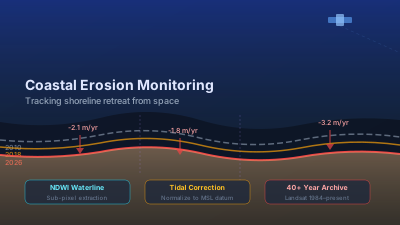
Quick Answer: Satellites provide the only practical way to monitor shoreline change across entire coastlines over decades. The standard approach extracts the land-water boundary from each image using NDWI or MNDWI thresholding, then measures how that boundary moves over time. Landsat's archive back to 1984 enables long-term erosion rate calculation, while Sentinel-2's 10m resolution and 5-day revisit improve detection of rapid changes. Sub-pixel waterline extraction locates the boundary more precisely than the pixel grid alone allows, but published validations against surveyed beach profiles report errors on the order of the pixel size rather than a few metres, and the dominant error term is tidal and wave runup correction rather than the extraction algorithm. Key challenges include tidal variation (images must be normalized to a consistent tidal datum), wave runup effects, and seasonal beach changes that can mask long-term erosion trends. Global datasets like the Digital Earth Australia Coastlines project now provide freely available shoreline change data derived from satellite archives.
The 2011 Tohoku tsunami is remembered for its inundation, but the inundation was temporary. What persisted on the Sendai coast was geomorphic: sand redistributed along the shore, barrier beaches migrated, and some sections continued to change at rates visible from one year to the next long after the water receded.
Changes of that kind are recorded in the Landsat archive, and the archive supplies what any single survey cannot — a trajectory. The same stretch of coast can be examined as it looked before the event, immediately after it, and through the years of subsequent adjustment. That time dimension is what makes satellite monitoring invaluable for coastal management.
Why Satellites for Coastal Monitoring?
Traditional coastal surveys — GPS beach profiles, aerial photography, LiDAR — provide high accuracy but cover limited areas at high cost. A GPS survey might cover a few kilometers of beach in a day. Satellite imagery covers thousands of kilometers in a single scene, and the Landsat archive stretches back to 1984 (Landsat 5).
What satellites can measure:
- Shoreline position over time → erosion/accretion rates
- Beach width changes
- Sediment plume dynamics
- Coastal habitat changes (mangroves, salt marshes, seagrass)
- Storm impact and recovery
What satellites cannot easily measure:
- Vertical beach profiles (elevation changes)
- Underwater bathymetry changes (limited to clear, shallow water)
- Sub-meter shoreline changes (sub-pixel methods do better than the pixel size, but not by an order of magnitude)
How do you extract the shoreline from an image?
The fundamental task is deceptively simple: for each satellite image, determine where the land meets the water. In practice that means thresholding a water index (NDWI or MNDWI) to build a land/water mask and tracing its boundary, then refining that boundary to sub-pixel precision. The steps below cover each stage, from the index math to the machine-learning shortcuts.
NDWI/MNDWI Thresholding
The most common approach uses water indices:
- NDWI = (Green - NIR) / (Green + NIR)
- MNDWI = (Green - SWIR) / (Green + SWIR)
Water has positive values; land has negative values. A threshold (typically around 0) separates them, producing a binary land/water mask. The boundary of this mask is the waterline. Combining these optical indices with radar, as in NDWI + SAR coastal change monitoring, keeps the shoreline visible even under the cloud cover that shadows many coasts.
MNDWI is preferred for coastal applications because SWIR provides better separation between water and built-up areas (concrete seawalls, harbors) that can confuse NDWI.
Sub-Pixel Waterline Extraction
A 10m pixel that's half water and half sand will have an intermediate NDWI value. Instead of binary thresholding, you can fit a continuous function across the land-water transition and identify the precise position where the water fraction equals 50%.
This sub-pixel approach locates the waterline more precisely than the pixel grid alone allows in the 10m bands of Sentinel-2 — a real improvement over binary pixel-level extraction. It is worth being clear about the limit, though: published validations of automated satellite shoreline tools against surveyed beach profiles report errors on the order of the pixel size, not a few metres, and the dominant error term is usually tidal and wave runup correction rather than the extraction algorithm itself.
Machine Learning Approaches
Recent work uses neural networks trained on manually digitized shorelines to extract waterlines directly from imagery. CoastSat, developed at the University of New South Wales, uses a combination of NDWI, classification, and morphological processing to automate shoreline extraction from Landsat and Sentinel-2 imagery.
Why does the tide distort shoreline measurements?
Because the waterline you extract is wherever the sea happens to be standing at the moment of acquisition, not the fixed edge of the beach. A beach with a gentle 1:20 slope and a 2m tidal range shows a 40m difference in waterline position between high and low tide. If you compare a low-tide image from 2010 with a high-tide image from 2020, you'll measure 40m of apparent "erosion" that's actually just tidal variation.
Solutions:
- Tidal correction: Use a tidal model to estimate the water level at each image acquisition time, then correct the waterline position to a reference datum (e.g., mean sea level)
- Composite approach: Use many images per time period and extract the median waterline, which averages out tidal variation
- Same-tide comparison: Select images acquired at similar tidal stages (practical only when you have dense time series)
Long-Term Change Analysis
The real power of satellite monitoring is quantifying erosion rates over decades.
Standard workflow:
- Extract waterlines from all available images (e.g., every clear Landsat/Sentinel-2 scene from 1984-2026)
- Apply tidal correction to normalize all waterlines to the same datum
- Define shore-perpendicular transects at regular intervals along the coast
- For each transect, measure the waterline position over time
- Fit a trend line (linear regression) to get the erosion/accretion rate in meters per year
Typical erosion rates:
- Sandy beaches: 0.5-5 m/year erosion is common; >10 m/year indicates severe erosion
- Cliff coasts: 0.1-1 m/year (slower but irreversible)
- Delta coasts: Highly variable; subsiding deltas can lose >50 m/year
Erosion Rate Reference by Coastal Type
Knowing what typical erosion rates look like helps distinguish signal from noise in satellite-derived shoreline change data:
| Coastal Type | Typical Erosion Rate | Notable Examples | Monitoring Priority |
|---|---|---|---|
| Barrier island / sandy beach | 0.5–5 m/year | US East Coast barriers, Outer Banks | High; dynamic and vulnerable |
| River delta (stable / prograding) | +0 to +20 m/year (accretion) | Nile Delta before Aswan Dam | Historical accretion now reversed |
| Subsiding river delta | 5–50+ m/year | Mississippi, Niger, Mekong deltas | Critical; combined subsidence + SLR |
| Sandy beach with littoral drift | 1–10 m/year | Mediterranean beaches, Australian coast | Moderate; updrift/downdrift patterns |
| Soft cliffed coast (clay/chalk) | 0.1–2 m/year | UK North Sea coast | Slow but irreversible |
| Rocky/hard cliff coast | < 0.1 m/year | Norwegian fjords, granite headlands | Negligible at decadal scale |
| Mangrove-protected coast | < 0.1–0.5 m/year | Protected; loss of mangrove → rapid acceleration | |
| Arctic permafrost coast | 1–10+ m/year | Siberian coast, North Slope Alaska | Accelerating with warming |
The delta erosion crisis: Global river deltas are some of the fastest-changing coastlines on Earth, and they are changing for three compounding reasons at once — reduced sediment supply where dams trap sediment upstream, ground subsidence from groundwater extraction and natural compaction, and rising sea level. The Nile Delta is the textbook case: its promontories prograded for centuries on Nile sediment and began retreating after that sediment was impounded upstream. Because all three drivers act in the same direction, delta shorelines are where satellite time series show the largest and most consistent retreat signals — and where a measured retreat rate should never be attributed to sea level rise alone.
Available Global Datasets
You don't need to build this pipeline from scratch:
- Digital Earth Australia Coastlines — annual shoreline positions for all of Australia, derived from Landsat, freely available
- Global Surface Water (GSW) — monthly water occurrence maps from the Joint Research Centre, covering 1984-present
- CoastSat — open-source Python toolkit for extracting shorelines from Google Earth Engine
Monitoring Coastal Habitats
Shoreline position is just one metric. Satellites also track the ecosystems that protect coastlines:
Mangrove loss detection: Mangroves attenuate wave energy and reduce erosion. Sentinel-2 NDVI time series can detect mangrove clearing events and track regrowth — the workflows in mangrove mapping from satellite imagery apply directly. Loss of mangrove buffer often precedes accelerated shoreline retreat.
Salt marsh mapping: Sentinel-1 SAR is particularly effective for mapping salt marshes because C-band backscatter responds to the water-vegetation interaction in intertidal zones. Multi-temporal SAR composites distinguish salt marsh from adjacent land uses even when optical imagery is ambiguous, as covered in wetland mapping with SAR and optical data.
Seagrass monitoring: In clear shallow waters, Sentinel-2's coastal aerosol band (B1, 443nm) and blue band (B2, 490nm) can detect submerged aquatic vegetation to depths of 5-10m, depending on water clarity — the same water-column penetration that makes coral reef monitoring from space possible.
Storm Impact Assessment
After major storms, satellite imagery provides rapid assessment of coastal damage:
- Pre-storm baseline: Most recent clear image before the event
- Post-storm assessment: First available image after the event
- Difference analysis: Compare waterline positions, detect overwash, identify barrier island breaches
Sentinel-1 SAR is particularly valuable here because it can image through the cloud cover that typically accompanies major storms. It also drives SAR flood mapping of the inundation that storms leave behind. Pre/post SAR coherence maps reveal areas where the surface structure changed — flattened dunes, deposited sediment, destroyed infrastructure.
Climate Change Context
Global sea level rise (averaging ~3.4 mm/year since 1993, with the recent rate exceeding 4.5 mm/year and accelerating) doesn't directly cause the dramatic erosion visible in satellite imagery — local factors like sediment supply, wave energy, and human intervention dominate at decadal scales. But sea level rise shifts the baseline: higher average water levels mean storm surges reach further inland, and beaches that were stable under historical conditions may begin eroding.
Satellite monitoring quantifies these trends objectively, providing the evidence base that coastal planners need to make decisions about managed retreat, beach nourishment, and seawall construction. The 40-year Landsat archive is increasingly valuable as climate impacts accelerate — it tells us not just where the coast is today, but how fast it's moving and in which direction.

Remote sensing specialist with 10+ years in satellite data processing and AI. Founder of Off-Nadir Lab. Ph.D. in Informatics (Yokohama National University, 2026). Master's in Earth System Science and Technology (Kyushu University). Co-author, Remote Sensing Encyclopedia. More about the author →