
Water Quality Monitoring with Sentinel-2: From Turbidity to Algal Blooms
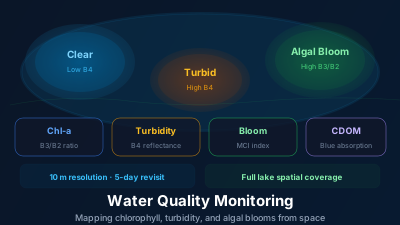
Quick Answer: Sentinel-2's 10-meter visible and NIR bands can estimate water quality parameters without in-situ sampling. Turbidity correlates with red band reflectance (B4); chlorophyll-a concentration in water is estimated using green-to-blue band ratios (B3/B2) or the Maximum Chlorophyll Index using red edge bands; suspended sediment maps use NIR reflectance. Limitations include atmospheric correction sensitivity over water, shallow-water bottom interference, and the need for local calibration. Best applied to lakes, reservoirs, and coastal zones.
Lake Kasumigaura in Ibaraki Prefecture, Japan, has been battling cyanobacterial blooms for decades. Traditional monitoring involves boats, sample bottles, and lab analysis — covering maybe 10 points across a 220 km² lake. A single Sentinel-2 image covers the entire lake at 10-meter resolution, providing roughly 2.2 million data points. The spatial coverage difference is staggering.
That's the fundamental promise of satellite water quality monitoring: turning point measurements into complete spatial maps.
What can satellites measure in water?
Satellites estimate the constituents that change water's color: chlorophyll-a (a proxy for phytoplankton), suspended sediment and turbidity, and colored dissolved organic matter. When light enters a water body it interacts with these dissolved and suspended materials, and each one absorbs and scatters specific wavelengths that a multispectral sensor like Sentinel-2 can separate:
Chlorophyll-a (phytoplankton pigment): Absorbs blue (~440 nm) and red (~675 nm) light; reflects green (~560 nm). High chlorophyll makes water appear green.
Suspended sediments (turbidity): Scatter light broadly, increasing reflectance across visible and NIR wavelengths. High turbidity makes water appear brown or milky.
Colored dissolved organic matter (CDOM): Absorbs strongly in blue wavelengths, giving water a tea-colored or yellowish appearance. High CDOM reduces blue reflectance.
Clear water: Absorbs red and NIR strongly; reflects blue weakly. Deep, clear water appears dark blue to nearly black, especially in NIR.
Key Band Ratios for Water Quality
Turbidity and Suspended Sediment
Turbid water reflects more light than clear water across the visible spectrum, with the strongest signal in red and NIR:
Simple turbidity indicator: B4 (Red, 665 nm) reflectance directly correlates with total suspended matter (TSM). Higher B4 reflectance = more turbid water.
Normalized Suspended Material Index: NSMI = (B4 + B3) / (B4 + B3 + B2). Values closer to 1 indicate higher turbidity.
In practice, B4 reflectance alone gives surprisingly good results for turbidity mapping, especially for relative comparisons within a single scene — you can inspect these bands directly in a Sentinel-2 viewer. For absolute TSM concentrations, you need to calibrate against in-situ measurements.
Chlorophyll-a (Phytoplankton)
Estimating chlorophyll concentration in inland and coastal waters is trickier than turbidity because the signal is weaker and more easily confused with other constituents.
Two-band ratio: B3/B2 (Green/Blue). As chlorophyll increases, green reflectance rises (phytoplankton scatter green light) while blue reflectance decreases (chlorophyll absorbs blue). The ratio increases with chlorophyll concentration.
Three-band model: (B5 − B4) / (B5 + B4). Using the red edge band B5 instead of green provides better sensitivity in eutrophic (nutrient-rich) waters where chlorophyll concentrations exceed ~30 μg/L.
Maximum Chlorophyll Index (MCI): Uses B4, B5, and B6 to detect the reflectance peak near 709 nm caused by chlorophyll fluorescence. MCI = B5 − B4 − 0.53 × (B6 − B4). Effective for detecting surface blooms in eutrophic to hypereutrophic water bodies.
Harmful Algal Bloom Detection
Cyanobacterial blooms (blue-green algae) are a public health concern due to toxin production. They create dense surface accumulations that are readily detectable:
Visual indicators: Bright green patches visible even in true-color imagery. When bloom intensity is high, the water surface can appear almost opaque green.
Floating Algal Index (FAI): Uses NIR reflectance to detect surface scums. FAI = B8 − B4 − (B12 − B4) × (842 − 665) / (2190 − 665). Positive FAI values indicate floating vegetation or algal scums on the water surface.
The stakes are high because some cyanobacteria produce toxins (microcystins). Lake Erie's western basin offers the clearest cautionary example: in 2014, a cyanobacterial bloom contaminated the drinking water supply of Toledo, Ohio, leaving roughly half a million people unable to use tap water for several days. The value of satellite monitoring in a case like that is lead time — a bloom is visible as a spatial pattern in the water while it is still offshore and still developing, before it reaches an intake and before it is obvious to a shoreline observer, which is what gives a utility room to adjust treatment. Operational programs such as NOAA's Lake Erie HAB Bulletin, part of the agency's satellite ocean-color monitoring, combine satellite observations with bloom-growth models to issue advisories.
Reference: What the Values Mean
Interpreting a band ratio starts with knowing the trophic vocabulary it is meant to land in. The chlorophyll-a bands below are the standard limnological trophic classes:
| Chlorophyll-a Concentration | Water Body Status | Trophic State |
|---|---|---|
| < 2 μg/L | Oligotrophic (very clear, nutrient-poor) | Pristine |
| 2–10 μg/L | Mesotrophic | Moderate nutrients |
| 10–30 μg/L | Eutrophic | High nutrients |
| 30–100 μg/L | Hypereutrophic | Severely enriched |
| > 100 μg/L | Bloom conditions (cyanobacteria risk) | Critical |
What a specific B3/B2 value or B4 reflectance corresponds to in those classes is not transferable. The mapping from reflectance to concentration is basin-specific: it depends on sediment mineralogy, the ratio of organic to mineral particles, CDOM background, and the atmospheric correction you used. A ratio that means "eutrophic" in one reservoir can mean "moderately turbid but not productive" in another 50 km away. Published coefficients exist for many individual lakes and estuaries; none of them is a universal lookup table.
The practical consequence: use the reflectance for relative structure and the in-situ samples for absolute level. Within one scene, higher B4 reliably means more suspended matter, and the spatial pattern of that increase is the product — where the plume is, which arm of the reservoir is worst, where the gradient is steepest. Converting that pattern into mg/L requires that you first fit the relationship against your own samples.
How Accurate Are These Retrievals?
Inland water quality retrieval is inherently less accurate than ocean color because inland waters are optically complex — multiple constituents (algae, sediment, CDOM) interact simultaneously, and small water bodies amplify atmospheric and shoreline adjacency effects. Published error figures vary widely between studies, sites and algorithms, so rather than quote a number, the useful thing is the ranking and what drives it:
| Parameter | Typical Range | Relative Reliability | Notes |
|---|---|---|---|
| Turbidity / TSM | 0.5–1,000 mg/L | Best of the four | Strong, direct optical signal; but saturates at very high TSM near river mouths |
| Chlorophyll-a | 0.1–200+ μg/L | Moderate | Weaker signal, confounded by sediment and CDOM; red-edge bands help in eutrophic water |
| Cyanobacteria (bloom presence) | presence/absence | Moderate for presence, poor for concentration | Detects surface scums and dominance, not cell counts |
| CDOM | 0.1–50 m⁻¹ (absorption) | Weak | Confounded with chlorophyll absorption in the blue |
| Secchi depth (clarity) | 0.1–20+ m | Moderate | More reliable in clear water than in turbid or shallow water |
Accuracy degrades sharply in shallow water with bottom reflectance, in pixels adjacent to bright shorelines, and whenever atmospheric correction over dark water fails. If you need defensible absolute numbers, the accuracy figure that applies to you is the one you measure against your own in-situ samples, not one carried over from a paper about a different lake.
Why is atmospheric correction over water so hard?
Because the water signal is tiny. Water-leaving reflectance is often only 1–5% of what the sensor measures, while the atmosphere contributes 80–95%. Standard atmospheric correction algorithms like Sen2Cor are tuned for bright land surfaces, so an error that is negligible over a forest can swamp the weak signal leaving dark water.
Errors in atmospheric correction that are negligible over bright land surfaces become dominant over dark water. A 1% absolute error in atmospheric correction might be irrelevant for NDVI over a forest, but it could be 50–100% of the actual water-leaving signal.
Recommendations:
- Use specialized water atmospheric correction when available (ACOLITE, iCOR, C2RCC)
- For relative comparisons within a single scene, even imperfect correction may suffice
- Validate with in-situ data whenever possible
- Be cautious interpreting absolute values without local calibration
Depth and Bottom Effects
In shallow water (typically < 2–5 meters in clear conditions), Sentinel-2 can "see" the bottom. The signal becomes a mixture of water column properties and bottom reflectance. A sandy bottom appears brighter than a weedy bottom, which can be confused with different water quality.
For water quality analysis, either:
- Restrict analysis to areas deeper than the visible depth threshold
- Use bottom-reflectance correction models (requires bathymetry data)
- Focus on relative changes over time (the bottom doesn't change quickly, so temporal differences reflect water quality changes)
Real-World Monitoring Examples
Reservoir Eutrophication
Many drinking water reservoirs face eutrophication — excess nutrient loading that promotes algal growth. Monthly Sentinel-2 monitoring can track:
- Spatial distribution of bloom intensity
- Seasonal patterns (blooms typically peak in late summer)
- Year-to-year trends
- Response to management interventions (phosphorus loading reduction, aeration)
Pairing color trends with reservoir water-level data helps separate real concentration changes from the effect of a rising or falling pool.
River Plume Mapping
Where rivers discharge into coastal waters or lakes, suspended sediment creates visible plumes. Sentinel-2's 10-meter resolution maps these plumes with sufficient detail to track dispersion patterns, identify sediment sources, and — combined with NDWI water-extent mapping — assess the impact of upstream land use changes.
Illegal Discharge Detection
Industrial discharges sometimes produce visible changes in water color or turbidity. Time series change detection can flag anomalous events — a sudden increase in turbidity at a specific location, or an unusual color signature that doesn't match natural variability, using the same anomaly-detection logic applied to vegetation and land. Setting up recurring area monitoring over a stretch of river turns this from a one-off check into a standing watch.
Limitations to Keep in Mind
Temporal resolution: Sentinel-2's 5-day revisit isn't sufficient for tracking rapidly evolving events like harmful algal bloom formation (which can develop in 2–3 days). And cloud cover reduces the actual observation frequency further.
Spatial resolution: 10 meters is excellent for lakes and reservoirs but marginal for narrow rivers. A 20-meter-wide river occupies only 2 pixels — sub-pixel mixing with riparian vegetation becomes significant.
Spectral limitation: Sentinel-2 lacks dedicated ocean color bands. Purpose-built ocean color sensors like OLCI on Sentinel-3 have finer spectral resolution in the visible range, better suited for open-ocean monitoring.
No subsurface information: Satellites measure surface reflectance. Vertical distribution of water quality parameters (stratification, deep chlorophyll maxima) requires in-situ profiling.
Despite these limitations, satellite-based water quality monitoring fills a critical gap between sparse in-situ point measurements and the complete spatial coverage needed for effective water resource management. It doesn't replace field sampling — it complements it, showing you where to sample and how to extrapolate between points.

Remote sensing specialist with 10+ years in satellite data processing and AI. Founder of Off-Nadir Lab. Ph.D. in Informatics (Yokohama National University, 2026). Master's in Earth System Science and Technology (Kyushu University). Co-author, Remote Sensing Encyclopedia. More about the author →