
CO₂ and Carbon Monitoring from Satellites: Measuring the Invisible
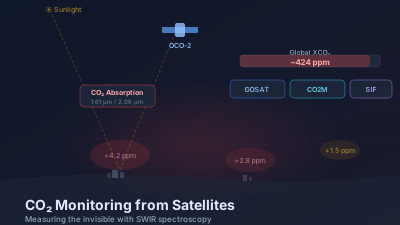
Quick Answer: Satellites measure atmospheric CO₂ by analyzing sunlight reflected through the atmosphere — CO₂ absorbs specific infrared wavelengths, and the depth of these absorption features reveals the column-averaged CO₂ concentration (XCO₂) with ~1 ppm precision. NASA's OCO-2 (2014-present) provides global XCO₂ measurements at ~2.25 km resolution along its orbital track, while Japan's GOSAT provides broader coverage at coarser resolution since 2009. OCO-3 on the ISS adds targeted observations of emission hotspots. The key challenge is that anthropogenic CO₂ signals (a few ppm of enhancement downwind of a city, around 1 ppm for a very large power plant) sit on top of a ~424 ppm background (2025), requiring extreme measurement precision. Emerging commercial satellites (GHGSat, Carbon Mapper) focus on point-source detection at facility scale, while ESA's upcoming CO2M mission will provide the first systematic monitoring of national emissions from space.
Space-based CO₂ measurements have repeatedly turned up regional carbon fluxes that ground networks and models had not anticipated. A prominent example came from combining GOSAT and OCO-2 column measurements over tropical Africa, where the inferred net emissions were far larger than expected and concentrated over a region — western Ethiopia and South Sudan — with no obvious fossil-fuel source. The study team proposed that land-use change over soils with high organic carbon content was releasing the carbon, and other researchers have questioned that attribution. That is the point: the satellites resolved a signal nobody could have found from the sparse ground network, and it took years of further work to explain it.
Measuring CO₂ from space is arguably the most technically demanding task in Earth observation. The signal you're looking for is a 1-2% variation on top of a large background, through an atmosphere that's constantly changing. But the stakes — verifying national emissions, tracking the global carbon budget, and identifying unknown sources — make it one of the most consequential.
How Satellites Measure CO₂
Unlike trace gases like NO₂ or methane that have strong, distinctive absorption features, CO₂'s spectral signature is subtle and overlaps with water vapor. Satellites use shortwave infrared (SWIR) spectroscopy, analyzing sunlight that has passed through the atmosphere twice — down to the surface and back up to the sensor.
The measurement principle:
- Sunlight passes through the full atmospheric column to the surface
- The surface reflects some of this light back through the atmosphere
- The satellite sensor measures the reflected spectrum at very high spectral resolution
- CO₂ absorption features near 1.61 μm and 2.06 μm are analyzed
- The depth and shape of these absorption lines reveal the total CO₂ in the atmospheric column
The result is XCO₂ — the column-averaged dry-air mole fraction of CO₂ — reported in parts per million (ppm).
Current Satellite Missions
OCO-2 (NASA, 2014-present)
The gold standard for space-based CO₂ measurement.
- Resolution: ~2.25 km × 1.29 km footprint
- Coverage: Along-track measurements only (narrow swath, ~10 km wide)
- Precision: ~1 ppm for individual soundings, <0.5 ppm for regional averages
- Revisit: 16-day repeat cycle (same ground track), but only useful in clear-sky conditions
OCO-2 has fundamentally changed our understanding of the carbon cycle, revealing seasonal breathing patterns of terrestrial ecosystems, quantifying urban CO₂ domes, and detecting enhanced concentrations downwind of large power plants.
GOSAT / GOSAT-2 (JAXA, 2009-present)
Japan's Greenhouse gases Observing SATellite was the first dedicated CO₂ monitoring satellite.
- Resolution: ~10.5 km footprint
- Coverage: Discrete point measurements on a grid pattern
- Precision: ~2 ppm for individual soundings
- Advantage: Also measures methane (CH₄), enabling combined greenhouse gas analysis
OCO-3 (NASA, ISS, 2019-present)
Mounted on the International Space Station, OCO-3 adds a unique capability: snapshot area mapping (SAM mode) that can image a 80 × 80 km area in a single overpass.
This mode is specifically designed for mapping CO₂ plumes from cities and industrial facilities, providing spatial context that OCO-2's narrow track cannot.
Upcoming: CO2M (ESA/Copernicus)
The CO₂ Monitoring Mission, with the first satellite currently planned for launch in 2027, will be the first operational mission designed specifically to monitor anthropogenic CO₂ emissions at national scales. Key improvements:
- Wide swath: ~250 km (vs. OCO-2's ~10 km)
- Simultaneous NO₂ measurement: NO₂ is co-emitted with CO₂ from combustion and serves as a tracer to separate fossil fuel CO₂ from biogenic CO₂
- Constellation of three satellites (CO2M-A, B, C) for near-daily coverage
The Detection Challenge
Global average atmospheric CO₂ is approximately 424 ppm (2025). The enhancement from a large city might add 2-5 ppm. A single power plant might add 1-3 ppm in its immediate downwind plume. Detecting these signals requires measurement precision better than 0.25% of the background — an extraordinary technical requirement.
Factors that complicate measurement:
- Clouds: Any cloud in the light path invalidates the measurement. Only a minority of soundings survive cloud and aerosol screening, which is why global XCO₂ coverage is far sparser than the orbit track alone would suggest
- Aerosols: Particles scatter light, changing the effective path length and biasing the CO₂ retrieval
- Surface albedo: Dark surfaces (water, dense forest) reflect less light, reducing signal-to-noise ratio
- Topography: Mountains alter the atmospheric column length, requiring precise elevation corrections
Applications
Urban Emissions Monitoring
OCO-2 and OCO-3 have detected CO₂ enhancements over cities including Los Angeles, Beijing, São Paulo, and Mumbai. By combining satellite XCO₂ with wind data and atmospheric transport models, researchers can estimate city-level CO₂ emission rates.
Current accuracy: For well-observed cities, satellite-derived emission estimates land in the same range as inventory-based estimates, but the residual uncertainty is still wide — driven by the number of usable cloud-free overpasses, the wind fields used in the transport model, and the difficulty of separating the urban plume from the regional background. That is not yet tight enough to verify a national commitment. Narrowing it is the explicit design goal of CO2M's wide swath and co-located NO₂ measurement.
Power Plant and Facility Monitoring
Individual large power plants (>10 Mt CO₂/year) can be detected by OCO-2 as localized XCO₂ enhancements downwind. Commercial satellites like GHGSat and Carbon Mapper are pushing toward facility-level monitoring with higher spatial resolution.
Carbon Cycle Science
The most impactful application to date: understanding how terrestrial ecosystems and oceans absorb CO₂. OCO-2 data has revealed:
- Tropical forests are more variable carbon sinks than previously thought
- El Niño events cause massive CO₂ releases from tropical ecosystems
- The Northern Hemisphere land sink is larger than estimated by ground-based networks
- Seasonal CO₂ patterns track photosynthesis and respiration cycles at continental scales
Verification of National Emissions
The Paris Agreement requires countries to report their greenhouse gas emissions, but reported inventories are based on activity data (fuel consumption, industrial output) and emission factors — not direct measurements. Satellite CO₂ monitoring will eventually provide an independent verification layer.
This is the primary motivation behind ESA's CO2M mission: creating a measurement system that can detect whether a country's actual emissions match its reported numbers.
XCO₂ Signal Strength: What Satellites Can and Cannot Detect
The detection challenge becomes concrete when you put numbers on the signals:
| Source / Phenomenon | XCO₂ Enhancement | Detectable by OCO-2? | Notes |
|---|---|---|---|
| Global background (2025) | ~424 ppm (baseline) | N/A | Everything is measured against this |
| Seasonal cycle (Northern Hemisphere) | ±5–9 ppm (summer vs. winter) | Yes | Largest regular signal in data |
| El Niño release (2015–16) | +2–3 ppm global | Yes | CO₂ flux from tropical ecosystems |
| Megacity plume (e.g., Los Angeles) | A few ppm downwind | Marginal | Requires many overpasses to average |
| Very large power plant (>10 Mt CO₂/year) | Around 1 ppm downwind | Marginal | Detected in targeted studies |
| Individual industrial facility | Well under 1 ppm | No (OCO-2) | Commercial satellites needed |
| Country-level emission discrepancy | Sub-ppm signature | Future (CO2M) | Drives CO2M's sub-ppm precision requirement |
The ordering reveals why "satellite CO₂ monitoring" encompasses very different capabilities depending on the scale:
- Scientific cycle monitoring (continental, seasonal): Very well established. The Northern Hemisphere seasonal swing is the largest signal in the record and OCO-2 resolves it clearly in every year of operation.
- City-scale emissions (a few ppm signal): Possible but requires many cloud-free passes and careful wind modeling. OCO-3 snapshot mode helps.
- Facility-level monitoring (sub-ppm signal): Requires commercial satellites with much finer spatial sampling (GHGSat) or hyperspectral instruments — not achievable with OCO-2.
This tiered capability explains why CO2M's wide-swath design (250 km, near-daily) is focused on the national emissions verification level, while commercial satellites fill the facility-level gap.
Complementary: Solar-Induced Fluorescence (SIF)
OCO-2 accidentally became one of the most important tools for measuring photosynthesis from space. Plants emit a faint fluorescent glow (Solar-Induced Fluorescence, SIF) when photosynthesizing, detectable in the same spectral region where OCO-2 measures CO₂.
SIF provides a direct proxy for photosynthetic activity — fundamentally different from vegetation indices like NDVI, which measure greenness (a proxy for potential photosynthesis) rather than actual carbon uptake. The combination of CO₂ and SIF from the same sensor provides unprecedented insight into the carbon cycle: SIF shows where carbon is being absorbed, while XCO₂ shows the net atmospheric effect.
The Road Ahead
The next decade will transform satellite CO₂ monitoring from a scientific research tool to an operational monitoring system:
- CO2M constellation (ESA, first launch planned 2027) — first systematic monitoring of national emissions
- MicroCarb (CNES, 2025) — French microsatellite providing additional global XCO₂ measurements
- TanSat-2 (China, planned) — Chinese contribution to the global monitoring constellation
- Commercial sector — GHGSat, Carbon Mapper, and others providing facility-level monitoring
The convergence of these missions means that by 2030, atmospheric CO₂ will be monitored with sufficient coverage and precision to independently verify emission reduction commitments. For a gas that's invisible to the human eye, satellites are making it increasingly difficult to hide.

Remote sensing specialist with 10+ years in satellite data processing and AI. Founder of Off-Nadir Lab. Ph.D. in Informatics (Yokohama National University, 2026). Master's in Earth System Science and Technology (Kyushu University). Co-author, Remote Sensing Encyclopedia. More about the author →