
Tracking Glacier Retreat from Space: Four Decades of Satellite Evidence
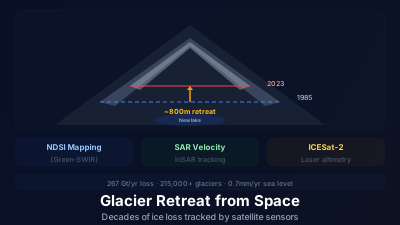
Quick Answer: Satellites have documented accelerating glacier retreat since Landsat began imaging in 1972. Glacier extent is mapped using the Normalized Difference Snow Index (NDSI) and band ratios that distinguish ice from surrounding rock. Sentinel-2 enables glacier boundary mapping at 10-20m resolution. SAR interferometry measures glacier flow velocity (mm/day precision). ICESat-2 laser altimetry detects surface elevation changes indicating mass loss. Globally, glaciers lost ~267 Gt of ice per year from 2000-2019, contributing ~0.7mm/year to sea level rise. The Randolph Glacier Inventory catalogs over 215,000 glaciers worldwide using satellite data.
Landsat's multi-decadal archive makes it possible to compare images of the same glacier decades apart and measure terminus retreat directly — including the proglacial lakes that form where the ice has withdrawn. These are not modeled projections. They are direct observations from a consistent sensor platform spanning nearly four decades, which is what makes glacier change measurable rather than merely inferred.
Glaciers are among the most visually compelling indicators of climate change, and satellites provide the only practical means of monitoring all 215,000+ glaciers on Earth.
Mapping Glacier Extent
Snow and Ice Classification
Glaciers are relatively straightforward to map from multispectral satellites because snow and ice have distinctive spectral properties:
- Visible bands: Very high reflectance (0.8-0.95) — snow and ice are bright
- NIR: Still high reflectance (~0.6-0.8)
- SWIR (1.6 μm): Low reflectance (~0.1-0.3) — ice absorbs SWIR strongly
This unique combination — bright in visible, dark in SWIR — distinguishes glaciers from clouds (which are bright in both visible and SWIR) and from rock/soil (which has moderate reflectance across both).
Normalized Difference Snow Index (NDSI): NDSI = (Green − SWIR) / (Green + SWIR)
NDSI > 0.4 reliably identifies snow and ice surfaces. Combined with a slope mask (to exclude flat snow-covered areas that aren't glaciers) and manual editing of debris-covered termini, NDSI-based mapping produces usable glacier outlines. The residual area uncertainty is driven almost entirely by two things: seasonal snow lying outside the glacier, and debris-covered ice at the terminus that the index cannot see at all.
The Debris-Covered Glacier Problem
Many mountain glaciers, especially in the Himalayas and Andes, have their lower sections covered by rock debris — fallen from valley walls above. This debris obscures the ice surface, making the glacier spectrally indistinguishable from surrounding moraine.
Mapping debris-covered glaciers requires:
- Thermal data: Ice beneath debris is cooler than surrounding exposed rock (detectable by Landsat thermal)
- SAR coherence: Glacier flow beneath debris reduces coherence compared to stable moraine
- DEM analysis: Glacier surfaces have distinct slope and curvature patterns
- Manual interpretation: Often still necessary for accurate terminus delineation
Debris-covered glacier mapping remains one of the most challenging problems in glaciology remote sensing.
Measuring Glacier Flow
Glaciers move. The ice flows downhill under gravity at rates typically ranging from centimeters to meters per day. Satellite-based velocity measurement uses two techniques:
Feature Tracking (Optical)
Cross-correlation of features (crevasses, surface patterns) between two optical images separated by days to months. Sentinel-2's 10m resolution enables velocity measurement for glaciers flowing faster than ~10 m/year.
SAR Offset Tracking and InSAR
SAR-based methods work through clouds and during polar darkness:
- Offset tracking: Cross-correlates SAR amplitude images (similar to optical feature tracking)
- InSAR: Measures phase differences to detect sub-wavelength surface displacement — precision of millimeters per day
Velocity maps reveal:
- Surge events: Sudden acceleration of glacier flow (10-100× normal speed)
- Calving dynamics: Acceleration as glaciers approach tidewater termini
- Seasonal variation: Faster flow in summer when meltwater lubricates the glacier base
- Long-term acceleration: Indicating dynamic thinning and potential instability
Elevation Change and Mass Balance
ICESat-2 Laser Altimetry
NASA's ICESat-2 (launched 2018) measures surface elevation using a photon-counting laser altimeter. Comparing elevation profiles over glaciers from different years reveals thinning or thickening:
- Thinning: Surface elevation decreasing → ice mass loss
- Thickening: Surface elevation increasing → mass gain (rare in current climate)
Global analysis shows most glaciers are thinning, at rates of order a metre per year in many mountain regions — enough to be resolved unambiguously by repeat altimetry over a few years, though the rate varies widely between and within regions.
TanDEM-X and SRTM Differencing
Comparing digital elevation models from different epochs:
- SRTM (2000) vs. TanDEM-X (2010-2015) provides a decade of elevation change
- Sentinel-1 repeat-pass InSAR provides ongoing monitoring
Converting surface elevation change to mass change requires assumptions about density (typically 850 ± 60 kg/m³ for glacier ice), introducing systematic uncertainty.
Global Glacier Monitoring
Randolph Glacier Inventory (RGI)
The RGI catalogs over 215,000 glaciers worldwide (excluding the ice sheets of Greenland and Antarctica), primarily using Landsat imagery. Each glacier has an outline, area, and various morphological attributes.
This inventory is the foundation for global glacier change studies — without knowing where glaciers are and how big they are, you can't measure how much they're changing.
Global Glacier Change Rates
A global satellite elevation-change analysis covering essentially every glacier on Earth found that glaciers lost 267 ± 16 gigatonnes per year between 2000 and 2019, equivalent to 21 ± 3 per cent of observed sea-level rise — and that the rate accelerated over those two decades.
- Acceleration: The loss rate in the second half of the period was measurably higher than in the first — glacier retreat is not a steady background trend.
- Regional variation: Loss is far from uniform. Alaska, the Southern Andes, and Central Europe stand out; a minority of glaciers in maritime climates such as Norway and New Zealand had brief periods of advance before reversing.
Key Regional Observations
High Mountain Asia: Contains the largest ice mass outside the polar regions. Heterogeneous response — the Karakoram showed anomalous stability or slight gain (the "Karakoram anomaly"), while Himalayan glaciers lost mass rapidly. Recent data suggests even the Karakoram anomaly is diminishing.
European Alps: Have lost a large fraction of their ice volume since the end of the Little Ice Age in the mid-19th century, and the record is unusually well documented because Alpine glaciers have been surveyed longer than almost any others. The 2022 European heat wave produced exceptional glacier mass loss — the Marmolada glacier collapse in Italy killed 11 people.
Tropical glaciers: Nearly gone. The ice caps of Kilimanjaro and the tropical Andes have lost the great majority of their early-20th-century extent, and most tropical glaciers are expected to vanish within decades.
Water Resource Implications
Glaciers serve as natural water towers — storing precipitation as ice during wet/cool periods and releasing meltwater during dry/warm periods. As glaciers shrink:
Short-term (current): Increased meltwater as glaciers lose mass. Rivers fed by glacier melt may temporarily have higher summer flows — a paradox of decline.
Long-term (decades ahead): Once glaciers shrink past a threshold, meltwater contribution decreases. Rivers that depended on glacier melt for dry-season flow will see reduced water availability. This affects:
- Hydropower generation (Andes, Alps, Himalayas)
- Irrigation water supply (Central Asia, Indus basin)
- Drinking water for downstream cities
Satellite monitoring quantifies these changes and projects future water availability, informing infrastructure planning and water management policy in glacier-dependent regions.
Reading Regional Glacier Loss Correctly
Two different quantities get reported for the same region and they are not interchangeable, which is the single most common source of confusion when comparing glacier figures:
- Absolute mass loss (gigatonnes per year) scales with how much ice a region contains. Large, heavily glaciated regions — Alaska, the Arctic, the Southern Andes, High Mountain Asia — dominate this measure and therefore dominate the sea-level contribution.
- Relative loss (percent of area or volume) scales with how vulnerable the ice is. Small, warm, low-elevation glacier systems — tropical Andean and African glaciers, the smaller Alpine glaciers — dominate this measure, and are the ones facing outright disappearance.
A region can be near the top of one list and near the bottom of the other. Tropical glaciers are a rounding error for sea level and an existential local water problem at the same time; Alaska is the reverse. When you see a regional glacier figure, check which of the two it is before comparing it to anything.
The peak water concept: Glaciers experiencing mass loss initially contribute more meltwater to rivers than stable glaciers — a temporary surplus before the inevitable decline. The moment of maximum meltwater contribution is "peak water." Many alpine and Andean basins have already passed it, meaning dry-season flows will decline from here even if warming stabilizes; larger, more heavily glaciated Asian basins are at varying stages. That timing, basin by basin, is what determines when downstream water users have to adapt — and it is the reason satellite mass-balance monitoring feeds directly into water resource planning.
The satellite record of glacier change — now spanning over 40 years with Landsat — provides some of the most direct, visually powerful evidence of global climate change. Every retreat, every thinning measurement, every velocity anomaly is a data point in our understanding of how Earth's cryosphere responds to warming. And with current satellite capabilities, we can monitor this response across every glacier on the planet.

Remote sensing specialist with 10+ years in satellite data processing and AI. Founder of Off-Nadir Lab. Ph.D. in Informatics (Yokohama National University, 2026). Master's in Earth System Science and Technology (Kyushu University). Co-author, Remote Sensing Encyclopedia. More about the author →