How to Choose the Right Satellite Data for Your Project
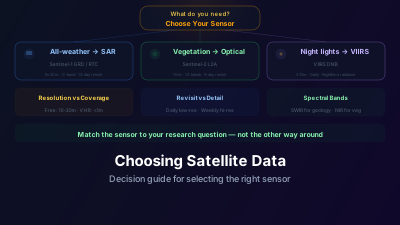
Quick Answer: Start by asking what you need to detect (determines if you need optical or SAR), how often you need observations (determines temporal resolution requirements), and whether clouds are a factor (if yes, SAR is essential). For most environmental and land monitoring tasks, Sentinel-1 SAR plus Sentinel-2 optical covers the majority of needs at zero cost.
The Wrong Way to Choose
Most newcomers to satellite imagery start by asking: "What's the highest resolution available?" Then they spend weeks trying to access data that's either too expensive, updated too infrequently, or missing the spectral bands they actually need.
The right approach is to start from the analysis requirement and work backward to the data source. The questions below are in the order you should ask them.
Question 1: What Are You Trying to Detect?
This determines the fundamental sensor type.
Surface properties that change color or reflectance → Optical
- Vegetation health (greenness, stress, crop type)
- Water quality (algal blooms, sediment, turbidity)
- Land cover and land use classification
- Snow and ice extent
- Burn scars and fire damage
- Mineral and geological mapping
Optical sensors measure reflected sunlight in multiple wavelength bands. They work like a camera with superpowers — capturing wavelengths beyond what the human eye can see (near-infrared, shortwave infrared).
Key limitation: Clouds block the signal completely. If your study area has frequent cloud cover, optical-only monitoring will have gaps.
Surface properties related to structure, roughness, or moisture → SAR
- Flood extent (water vs. non-water)
- Ship and vessel detection
- Building and infrastructure damage (post-earthquake)
- Ground deformation (subsidence, tectonic movement)
- Sea ice monitoring
- Soil moisture estimation
- Forest structure and biomass
SAR sends its own microwave pulses and measures the echo. It works day or night, through clouds, rain, and smoke.
Key limitation: SAR images look nothing like photographs. They require specialized interpretation, and many common optical analysis techniques (like NDVI) don't apply.
Both → Use Both
For many real-world monitoring tasks, the best answer is to use optical and SAR together:
- Deforestation: Detect change with SAR (cloud-free, frequent), confirm and characterize with optical (species information, burn severity)
- Flood response: Map flood extent with SAR (immediate, weather-independent), assess agricultural damage with optical (when clouds clear)
- Urban monitoring: Track construction with SAR (structural changes), classify land use with optical (materials, vegetation)
Question 2: How Often Do You Need Observations?
| Requirement | Minimum Revisit | Recommended Source |
|---|---|---|
| Real-time or daily monitoring | < 3 days | Commercial constellations or SAR |
| Weekly monitoring | 5-7 days | Sentinel-1 or Sentinel-2 |
| Monthly assessment | 10-16 days | Landsat + Sentinel-2 |
| Annual or seasonal | Any | Any (choose by other criteria) |
Critical consideration: The stated revisit time assumes cloud-free conditions for optical data. In practice, tropical regions might get one usable optical observation per month even with a 5-day revisit sensor. Factor cloud probability into your temporal resolution calculation.
For time-critical applications (disaster response, illegal activity detection), SAR's weather independence makes it the primary data source regardless of other preferences.
Question 3: What's the Smallest Feature You Need to See?
| Feature | Minimum Spatial Resolution Needed |
|---|---|
| Regional land cover patterns | 30-100m |
| Individual agricultural fields | 10-20m |
| Roads and major infrastructure | 5-10m |
| Individual buildings | 1-3m |
| Vehicles, small structures | < 1m |
The common mistake: Overestimating required resolution. If you're monitoring forest loss at national scale, 10-30m resolution is more than adequate. Data volume scales with the square of the resolution ratio, so dropping from 10 m to 0.5 m pixels means orders of magnitude more data to store and process — without improving the analysis.
Rule of thumb: Your target feature should span at least 3-5 pixels in the image. A single bright pixel could be noise; a cluster of 3×3 pixels showing the same signature is a reliable detection.
Question 4: What Spectral Information Do You Need?
| Analysis Type | Required Bands | Available From |
|---|---|---|
| True color visualization | Red, Green, Blue | Almost all optical sensors |
| Vegetation indices (NDVI) | Red + NIR | Sentinel-2, Landsat, most optical |
| Early stress detection (NDRE) | Red Edge + NIR | Sentinel-2 (not all sensors have red edge) |
| Moisture/drought assessment | SWIR + NIR | Sentinel-2, Landsat |
| Geological mapping | Multiple SWIR bands | Sentinel-2, ASTER, Landsat |
| Thermal analysis | Thermal IR | Landsat (but at 100m resolution) |
Sentinel-2's 13-band coverage handles the vast majority of optical analysis needs. The main gaps are thermal infrared (use Landsat) and hyperspectral analysis (requires specialized missions).
Question 5: What's Your Budget?
| Budget | Best Option |
|---|---|
| $0 (free) | Sentinel-1 + Sentinel-2 + Landsat |
| Low ($100s-$1,000s/year) | Free data + occasional commercial archive scenes |
| Medium ($10,000s/year) | Free data for wide area + commercial VHR for specific sites |
| High ($100,000+/year) | Commercial constellation subscription for daily monitoring |
For the large majority of Earth observation use cases, free data is sufficient. The cases that genuinely require commercial data are characterized by sub-meter spatial resolution needs, daily revisit requirements, or a guaranteed tasking commitment over a specific site.
Decision Flowchart
Step 1: Can clouds be a problem in your study area?
- Yes → Include SAR (Sentinel-1) in your data sources
- No → Optical may be sufficient alone
Step 2: Do you need to detect structural/physical properties, or spectral/color properties?
- Structural (moisture, roughness, deformation) → SAR primary
- Spectral (vegetation, water quality, minerals) → Optical primary
- Both → Use both
Step 3: What spatial resolution is genuinely needed?
- ≥ 10m → Free data (Sentinel-1, Sentinel-2, Landsat)
- 1-10m → Free data may work; commercial for guaranteed quality
- < 1m → Commercial VHR required
Step 4: What temporal frequency?
- ≥ Weekly → Sentinel constellation (free)
- Daily → Commercial constellation (paid)
Common Scenarios Mapped to Data Sources
| Scenario | Recommended Primary | Recommended Secondary |
|---|---|---|
| Farm crop monitoring | Sentinel-2 (optical) | Sentinel-1 (SAR, for cloudy periods) |
| Flood disaster response | Sentinel-1 (SAR) | Sentinel-2 (post-event optical) |
| Urban growth tracking | Sentinel-2 (optical) | Sentinel-1 (SAR, structural change) |
| Forest deforestation | Sentinel-1 (SAR) | Sentinel-2 (classification) |
| Ocean/maritime monitoring | Sentinel-1 (SAR) | — |
| Glacier/ice sheet | Sentinel-1 (SAR, InSAR) | Sentinel-2 (optical, snow line) |
| Geological survey | Sentinel-2 (SWIR bands) | Landsat (thermal) |
| Air quality / atmospheric | Sentinel-5P (dedicated) | — |
Start Simple, Add Complexity
If you're unsure, start with Sentinel-2 for optical and Sentinel-1 for SAR. These two satellites together cover the vast majority of monitoring needs, they're free, they have excellent temporal coverage, and there's extensive documentation and community support.
Once you've established what works and identified specific limitations, you can evaluate whether commercial data sources address those limitations — with a clear understanding of what you're paying for and why.
Off-Nadir Delta provides access to Sentinel-1 SAR, Sentinel-2 optical, and VIIRS nighttime lights — the core free data sources that cover most monitoring scenarios. Start exploring your area of interest to understand what these sensors reveal before investing in additional data.

Remote sensing specialist with 10+ years in satellite data processing and AI. Founder of Off-Nadir Lab. Ph.D. in Informatics (Yokohama National University, 2026). Master's in Earth System Science and Technology (Kyushu University). Co-author, Remote Sensing Encyclopedia. More about the author →