Free vs Commercial Satellite Imagery: Resolution & Cost
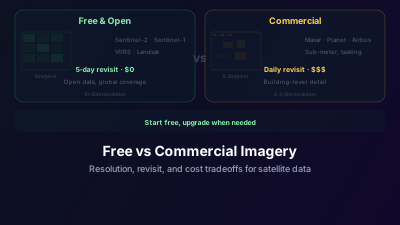
Quick Answer: Free satellite imagery (Sentinel-2 at 10m, Sentinel-1 SAR at 20m, Landsat at 30m) is sufficient for most environmental monitoring, agriculture, and regional analysis. Commercial imagery (0.3-3m resolution) is worth the cost when you need to identify individual buildings, vehicles, or small infrastructure — tasks that 10m pixels simply cannot resolve.
The Price Gap Is Enormous
Free satellite imagery — primarily from ESA's Copernicus programme (Sentinel-1, Sentinel-2) and USGS/NASA (Landsat) — costs exactly zero. You can access decades of global coverage without paying a cent.
Commercial very-high-resolution (VHR) imagery, by contrast, is sold by the square kilometre, with a minimum order area, and tasking (requesting a new acquisition rather than pulling one from the archive) costs substantially more than archive. Published rates differ by provider, resolution, licence terms, and volume commitment, and they change — check the vendor's current price list rather than any figure quoted in an article.
The gap between "free" and "priced per square kilometre" is what actually shapes project design. The question is whether it buys you something you need.
What Free Imagery Provides
Sentinel-2 (Optical)
- Resolution: 10m (visible + NIR), 20m (red edge + SWIR), 60m (atmospheric)
- Revisit: 5 days (at the equator, more frequent at higher latitudes)
- Bands: 13 spectral bands from visible through SWIR
- Coverage: Global land surfaces
- Archive: 2015-present
At 10m resolution, one pixel covers a 10×10 meter area. You can distinguish:
- Agricultural field boundaries
- Forest clearings larger than ~0.01 hectare
- Urban areas vs. rural areas
- Water bodies and coastlines
- Major roads and highways
You cannot distinguish:
- Individual buildings (unless they're very large)
- Vehicle types
- Small paths or trails
- Crop rows within a field
Sentinel-1 (SAR)
- Resolution: ~20m (IW mode), ~5m (SM mode)
- Revisit: 6 days
- Bands: C-band (5.405 GHz), dual-pol VV+VH
- Coverage: Global (systematic over land and coastal areas)
- Archive: 2014-present
You can look at this data for your own area in the Sentinel-1 SAR viewer.
Landsat (Optical)
- Resolution: 30m (multispectral), 15m (panchromatic)
- Revisit: 16 days (8 days with two satellites)
- Bands: 11 bands
- Coverage: Global
- Archive: 1972-present (the longest continuous Earth observation record)
The Landsat archive's length is its unique strength. No commercial provider offers 50+ years of consistent global coverage.
What Commercial Imagery Provides
Sub-Meter Optical
- Resolution: 0.3-0.5m (panchromatic), 1-2m (multispectral)
- Revisit: Daily or near-daily (from constellation operators)
- Bands: Typically 4-8 bands
- Archive: Varies by provider
At 0.3m resolution, one pixel covers a 30×30 cm area. You can identify:
- Individual vehicles and their approximate type
- Building footprints and roof materials
- Tennis courts, swimming pools, and playground equipment
- Individual trees in an urban setting
- Small boats at a marina
Commercial SAR
- Resolution: 0.25-3m
- Revisit: Daily or near-daily (constellation operators)
- Modes: Various polarizations, spotlight/stripmap/scanSAR
Commercial SAR typically offers higher resolution than Sentinel-1, enabling detection of smaller objects and finer structural details.
When Free Is Enough
For a surprisingly large number of professional applications, free imagery is not just adequate — it's actually preferred:
Agriculture (Field-Level)
Monitoring crop health across a farm or region with NDVI works well at 10m resolution. Each field typically contains hundreds to thousands of Sentinel-2 pixels, providing statistically robust index values. The 5-day revisit captures the full growing season at a frequency that matches relevant biological timescales.
Deforestation Monitoring
Detecting forest loss at the scale that matters for national reporting and carbon accounting works at 10-30m. A cleared area large enough to be ecologically significant (>0.1 hectare) is resolvable. Sentinel-1 SAR adds cloud-free monitoring capability in tropical regions.
Flood Mapping
Sentinel-1 SAR at 20m resolution reliably delineates flood extent for emergency response. The difference between flooded and non-flooded areas produces a strong backscatter contrast that doesn't require sub-meter resolution to detect.
Urban Expansion Tracking
Distinguishing urban from non-urban land cover at 10m resolution is straightforward. Multi-year time series reveal growth patterns clearly.
Water Quality Monitoring
Algal blooms, sediment plumes, and water clarity indicators work at 10-60m scales. The phenomena themselves span hundreds of meters to kilometers.
When You Need Commercial
Infrastructure Monitoring
Assessing the condition of individual bridges, dams, or pipelines requires resolving structural details that are invisible at 10m. A bridge might be 10-20m wide — that's 1-2 pixels in Sentinel-2, which tells you the bridge exists but nothing about its condition.
Damage Assessment (Building-Level)
After an earthquake or conflict, determining which specific buildings are damaged vs. intact requires sub-meter resolution. At 10m, you can see that a neighborhood was affected, but not which individual structures were destroyed.
Precise Change Detection
If you need to detect a new structure, a removed tree, or a filled excavation, you need resolution that matches the size of the change. A 5m-wide construction site is half a pixel in Sentinel-2.
Defense and Intelligence
Identifying equipment types, counting vehicles, and monitoring specific facilities are inherently high-resolution tasks.
The Hybrid Approach
The most cost-effective strategy for many organizations:
-
Use free imagery for wide-area screening — Sentinel-2 and Sentinel-1 cover the entire Earth every few days. Use this for ongoing monitoring, anomaly detection, and identifying areas of interest.
-
Task commercial imagery only where needed — When free data flags something that requires closer inspection, order a high-resolution scene of that specific location. This limits commercial imagery costs to the small fraction of your study area that actually requires it.
-
Use free data for time-series context — Even when you have a commercial image for a specific date, the free archive provides temporal context (what did this area look like last month? Last year?) at no additional cost.
Because commercial imagery is priced by area, restricting it to the small fraction of your study area that free screening has already flagged is what makes the cost difference — not negotiating a better rate.
Resolution, Cost, and Application: Consolidated Reference
Consolidating the capability trade-offs into one table for practical decision-making:
| Tier | Sensor Examples | Resolution | Cost model | Key Use Cases | Clear Limitation |
|---|---|---|---|---|---|
| Free Optical | Sentinel-2, Landsat | 10–30m | Free global archive; no tasking | Agriculture, land cover, forest monitoring | Cannot resolve individual buildings |
| Free SAR | Sentinel-1 | 10–20m | Free global archive; no tasking | Flood, subsidence, ship detection | Lower resolution than commercial SAR |
| Commercial mid-res | Planet SuperDove | 3–5m | Area subscription | Construction monitoring, small-scale change | Limited spectral bands (4–8) |
| Commercial high-res optical | Maxar WorldView, Airbus Pléiades | 0.3–0.5m | Per km², archive cheaper than tasking | Damage assessment, vehicle detection | Highest cost per km²; tasking constrained by revisit and weather |
| Commercial SAR | Capella Space, ICEYE | 0.25–3m | Per km² or per scene | Maritime, rapid revisit through clouds | Complex processing; high cost |
| Nighttime/Thermal | VIIRS, Landsat TIRS, ECOSTRESS | 375m–100m | Free | Urban energy, fire, ET mapping | Coarse resolution; ECOSTRESS ISS-limited |
The actual cost of "free" data: Sentinel-2 and Landsat are free to download, but processing, storage, and analysis are not. A full-year, full-resolution time series over a region of continental scale runs to terabytes of raw data and non-trivial compute. Cloud platforms such as Google Earth Engine absorb much of that cost but introduce platform dependency. When comparing against a commercial offer that bundles processing, price your own storage and compute into the comparison rather than treating the data licence as the whole cost.
Where the hybrid approach delivers the best value: in monitoring programmes over large areas where only a small share of the area changes in any given period. Free imagery answers where and when something changed across the whole footprint; commercial imagery is then bought only for those locations and dates. The saving scales with how selective the screening step is — the smaller the flagged fraction, the larger the gap between blanket VHR coverage and a screened approach.
Resolution Is Not Everything
A common misconception is that higher resolution is always better. In practice:
- More pixels means more storage and processing — A 30cm scene is ~1,000× larger than a 10m scene of the same area
- Spectral coverage matters — Commercial imagery typically offers fewer spectral bands than Sentinel-2, limiting index calculations
- Temporal frequency matters — Daily commercial revisit sounds impressive, but off-nadir viewing angles at the edges of the swath introduce geometric distortions. Consistent nadir viewing from Sentinel is often analytically cleaner
- Archive depth matters — For trend analysis, Landsat's 50-year record is irreplaceable regardless of resolution
Start with Free
If you're beginning a new satellite monitoring project, start with free data. Many regional-scale remote sensing questions can be answered at 10–30 m resolution, although the resolution actually required depends on the target and the decision threshold. Only invest in commercial imagery once you've confirmed that your specific question genuinely requires it.
Off-Nadir Delta provides access to Sentinel-1 SAR, Sentinel-2 optical, and VIIRS nighttime lights data — all free and open. Explore these first, and you may find they're all you need.
Frequently asked questions
What resolution does free satellite imagery provide?
The main free sources are Sentinel-2 optical at 10 m, Sentinel-1 SAR at around 20 m, and Landsat optical at 30 m. These resolutions are sufficient for most environmental monitoring, agriculture, and regional-scale analysis.
When is free imagery good enough?
Free imagery is usually enough for field-level agriculture, deforestation monitoring, flood mapping, urban expansion tracking, and water quality — anywhere the features of interest are larger than roughly 10 m and you value frequent, no-cost revisits.
When do you actually need commercial imagery?
Commercial imagery (about 0.3–3 m) is worth the cost when you must identify individual buildings, vehicles, or small infrastructure, or perform building-level damage assessment — tasks that 10 m pixels simply cannot resolve.
What is the hybrid approach to imagery cost?
Screen broadly and frequently with free imagery to find where and when something changes, then task or purchase high-resolution commercial imagery only for those specific locations and dates. This keeps costs down while still delivering detail where it matters.
Is higher resolution always better?
No. Resolution is only one dimension. Revisit frequency, spectral bands, swath width, and cost often matter more, and for many monitoring tasks a frequent 10 m time series beats an occasional sub-meter snapshot.

Remote sensing specialist with 10+ years in satellite data processing and AI. Founder of Off-Nadir Lab. Ph.D. in Informatics (Yokohama National University, 2026). Master's in Earth System Science and Technology (Kyushu University). Co-author, Remote Sensing Encyclopedia. More about the author →