
Satellite Archaeology: Discovering and Monitoring Cultural Heritage from Space
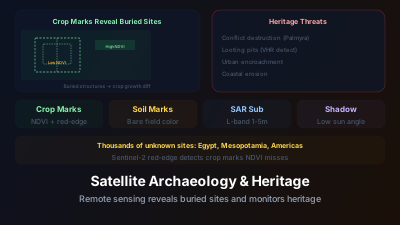
Quick Answer: Satellites detect archaeological features through crop marks (buried structures affect soil moisture and crop growth, creating visible patterns in NDVI), soil marks (disturbed soil has different reflectance), shadow marks (subtle elevation differences visible in oblique light), and SAR penetration of dry sand revealing buried structures in arid regions. Sentinel-2's red-edge bands are particularly useful for detecting subtle vegetation stress over buried walls and ditches. Heritage site monitoring uses change detection to identify threats: urban encroachment, looting pits, conflict damage, and environmental degradation. After the destruction of Palmyra by ISIS, satellite imagery documented the damage and guided reconstruction planning. Space archaeology has flagged large numbers of candidate sites across Egypt, Mesopotamia, and the Americas, but each detection is a hypothesis until it is confirmed in the field — imagery is no longer the scarce resource, ground verification is.
In 2011, archaeologist Sarah Parcak used infrared satellite imagery to identify what appeared to be 17 previously unknown pyramids, 1,000 tombs and 3,000 ancient settlements in Egypt — features invisible on the ground but revealed through subtle spectral differences in satellite data. The candidates still had to be checked on the ground, and Egyptian antiquities authorities were cautious about the announcement at the time. But the survey demonstrated the underlying point: satellite remote sensing changes the scale at which archaeological prospection can be attempted.
Satellite archaeology exploits a simple principle: human activity modifies the landscape in ways that persist for centuries or millennia, and these modifications affect how the surface interacts with electromagnetic radiation — even when the features themselves are buried.
How do buried sites become visible from space?
Buried archaeology shows up through four indirect signatures: crop marks (differential plant stress over buried structures), soil marks (disturbed soil reflectance in bare fields), shadow marks (subtle earthworks under low sun angles), and radar penetration of dry sand. None of these images the buried feature directly — each records how the feature changes the surface above it.
Crop Marks
The most productive indicator of buried archaeology in agricultural landscapes:
Buried walls and foundations: Stone or brick remains beneath crop fields impede root penetration and reduce soil moisture. Crops growing above buried walls experience mild water stress, producing slightly lower NDVI and earlier senescence compared to surrounding crops.
Buried ditches and pits: Filled-in ditches retain more moisture and provide deeper soil for roots. Crops above buried ditches grow more vigorously, producing higher NDVI and later senescence.
The result: in the right conditions (typically during mild drought stress), the plan of an entire buried settlement can appear as a pattern of crop vigor variations visible from satellite altitude.
Timing matters: Crop marks are most visible during dry spells in the growing season when differential water stress is most pronounced. A perfectly timed Sentinel-2 image during a brief dry period can reveal features invisible at other times.
Soil Marks
In bare or recently plowed fields:
- Disturbed archaeological soils (darker, higher organic content) contrast against natural subsoil
- Demolished building materials (lighter stone, brick fragments) contrast against darker natural soil
- These color differences are subtle but detectable in multispectral imagery
Shadow Marks
Slight elevation differences caused by buried or partially buried structures cast shadows visible in low sun-angle imagery:
- Earthworks (banks, mounds, ring ditches) a few tens of centimeters high
- Best detected in satellite imagery acquired during winter or at high latitudes where sun angles are low
SAR Subsurface Detection
In hyperarid environments (Sahara, Arabian Peninsula), L-band and P-band SAR can penetrate dry sand to depths of 1-5 meters, revealing:
- Buried river channels (paleochannels) that guided ancient settlement patterns
- Subsurface structures (walls, foundations) beneath sand cover
- Ancient road networks
Penetration depends on wavelength: L-band operates at a wavelength of about 23 cm, long enough to pass through dry, fine-grained material where shorter C- and X-band signals scatter at the surface. As NASA Earthdata puts it, "scientists and archaeologists are using SAR data to help uncover lost cities and urban-type infrastructures hidden over time by dense vegetation or desert sands." This capability was first demonstrated by the Space Shuttle SIR-A/B/C missions, which revealed ancient drainage networks beneath the Sahara. For background on radar imaging itself, see the complete guide to synthetic aperture radar.
Why is Sentinel-2 useful for archaeology?
Sentinel-2 combines the three things archaeological prospection needs: red-edge bands sensitive to subtle crop stress, a 5-day revisit that catches the brief windows when crop marks appear, and a free archive reaching back to 2015 for temporal browsing. No other freely available optical mission offers that combination.
Red-edge bands (B5, B6, B7): More sensitive to subtle chlorophyll variations than traditional NDVI. Detect crop marks that standard red/NIR NDVI misses — the same bands used for chlorophyll and red-edge analysis in agriculture.
20m resolution: Resolves archaeological features of ~20m or larger — sufficient for detecting settlement outlines, field systems, and major structures.
Temporal density: 5-day revisit increases the probability of capturing the brief temporal window when crop marks are optimally visible.
SWIR bands: Sensitive to soil moisture differences that reveal buried features in bare soil conditions.
Free archive: Systematic imagery from 2015-present, distributed through the Copernicus Data Space Ecosystem, enables temporal browsing to find optimal conditions for each site.
How are heritage sites monitored for threats?
Monitoring works by comparing images of the same site over time and flagging what has changed: new construction at the site boundary, fresh looting pits, conflict damage, or advancing erosion. Because the threats are ongoing rather than one-off, repeat change detection at a fixed interval — not a single inspection — is the standard approach.
Conflict Damage Assessment
Satellite imagery documented destruction of cultural heritage during conflicts in Syria, Iraq, Yemen, and Mali:
Palmyra, Syria: Before-and-after satellite imagery documented the destruction of the Temple of Bel, Temple of Baalshamin, and monumental arch by ISIS in 2015-2016. This imagery became key evidence for cultural heritage crime prosecution and reconstruction planning.
Mosul, Iraq: Satellite monitoring tracked the progressive destruction of archaeological sites and religious buildings during ISIS occupation.
Looting Detection
Systematic looting creates characteristic patterns visible in satellite imagery:
- Looting pits: Small (1-5m) excavation holes visible in VHR imagery. Hundreds to thousands of pits at major sites.
- Temporal monitoring: Comparing images over time reveals when looting episodes occur and at what intensity
- Correlation with conflict: Looting intensity often increases during conflict and instability
Urban Encroachment
Many archaeological sites are threatened by expanding urban development:
- Building construction on or adjacent to protected sites
- Road construction through archaeological landscapes
- Agricultural intensification (deep plowing) over buried remains
Satellite change detection monitors these threats at regular intervals, alerting heritage authorities to emerging problems.
Environmental Threats
- Coastal erosion threatening shoreline heritage sites (measurable from satellite shoreline change detection)
- Flooding damage to archaeological sites (SAR flood mapping)
- Vegetation growth damaging structural remains (NDVI monitoring)
- Land subsidence affecting built heritage (InSAR)
Discovery Applications
Landscape-Scale Survey
Satellite imagery enables archaeological survey at scales impossible with ground methods:
- Systematic survey of entire regions for previously unknown sites
- Pattern recognition across landscapes (ancient road networks, irrigation systems, field boundaries)
- Landscape connectivity analysis (how did ancient settlements relate to water sources, trade routes, terrain?)
Multi-Temporal Browsing
Different features become visible under different conditions:
- Crop marks visible only during specific weather conditions
- Soil marks visible only when fields are bare
- Shadow marks visible only at low sun angles
Browsing through years of satellite imagery for the same area maximizes the chance of finding optimal revelation conditions.
Machine Learning for Site Detection
Emerging approaches use deep learning to automatically detect potential archaeological features:
- CNNs trained on known site locations and their spectral/spatial signatures
- Applied wall-to-wall across large areas to identify candidate sites
- Results require archaeological verification but dramatically reduce the search space
Archaeological Detection Methods: Satellite Capability Reference
| Feature Type | Detection Method | Best Sensor/Band | Optimal Timing | Minimum Size Detectable |
|---|---|---|---|---|
| Buried walls (crop mark) | NDVI deficit over stone foundations | Sentinel-2 Red Edge (B5–B7) | Dry spell during growing season | ~20 m (settlement scale) |
| Buried ditches (crop mark) | NDVI surplus over filled ditches | Sentinel-2 NIR (B8) | Mild drought stress conditions | ~10–20 m width |
| Soil marks (bare fields) | Spectral color difference in plowed soil | Sentinel-2 SWIR + visible | Winter/fallow season, bare ground | ~5–10 m |
| Earthworks and mounds | DEM hillshade / shadow mark | AW3D30, Copernicus DEM, LiDAR | Low sun angle imagery | Set by the vertical precision of the elevation model — global DEMs miss most low earthworks; airborne LiDAR does not |
| Buried channels (arid) | SAR subsurface penetration | L-band SAR (ALOS-2), P-band | Hyperarid conditions (dry sand) | Channel must be wide relative to pixel size, and burial shallow relative to penetration depth |
| Looting pits | High-contrast small holes in VHR | Commercial VHR (0.3–0.5 m) | Any cloud-free date | ~1–3 m diameter |
| Conflict damage | Before/after change detection | Sentinel-2 or VHR optical | Immediately after event | Building-scale (5 m+) |
| Urban encroachment | Land cover change NDBI / NDVI | Sentinel-2 multi-temporal | Annual comparison | Structures > 10 m |
Scale of discovery: The constraint on satellite archaeology has shifted. Imagery is no longer the scarce resource — free Sentinel-2 covers the whole planet on a fixed cycle, commercial VHR can be tasked, and machine-assisted screening can flag candidate anomalies across large areas far faster than an analyst reading scenes by hand. What has not scaled is ground verification. Every satellite candidate is a hypothesis until someone confirms it in the field, and that step still runs at the pace of excavation permits, funding, and field seasons.
Limitations
Resolution constraints: Most archaeological features are small (individual structures: 5-20m; individual walls: <1m). Sentinel-2 at 10-20m resolution detects settlement-scale patterns but not individual structures. VHR commercial imagery (0.3-0.5m) provides building-level detail but at significant cost.
Condition dependency: Crop marks are visible only under specific soil moisture and crop growth conditions. A site that's clearly visible in one image may be completely invisible in another acquired a week later.
False positives: Geological features, modern agricultural patterns, and soil variation can mimic archaeological signatures. Every satellite detection requires ground verification.
Ethical concerns: Publishing precise locations of previously unknown archaeological sites can attract looters. Responsible disclosure practices are essential.
Satellite archaeology operates at the intersection of technology and cultural heritage, using 21st-century sensors to reveal and protect the material record of human civilization. The combination of free Sentinel-2 data for routine monitoring and targeted VHR imagery for detailed investigation provides a cost-effective framework for managing the world's archaeological heritage — much of which remains undiscovered, unmapped, and unprotected.

Remote sensing specialist with 10+ years in satellite data processing and AI. Founder of Off-Nadir Lab. Ph.D. in Informatics (Yokohama National University, 2026). Master's in Earth System Science and Technology (Kyushu University). Co-author, Remote Sensing Encyclopedia. More about the author →