
The Landsat Program: A Complete Guide to 50+ Years of Earth Observation
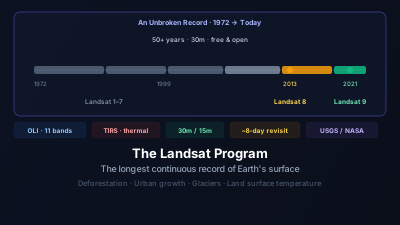
Quick Answer: Landsat is a joint USGS/NASA program providing the longest unbroken record of Earth's land surface — continuous since 1972. The current satellites, Landsat 8 (2013) and Landsat 9 (2021), carry the OLI imager (11 bands, 30m, 15m panchromatic) and the TIRS thermal sensor, with a combined 8-day revisit. The 50+ year, free and open archive is the global reference for long-term studies of deforestation, urban growth, glacier retreat, and land cover change. Landsat's strength is its multi-decadal consistency and thermal bands; Sentinel-2 offers finer 10m detail and more frequent revisit, which is why the two are often combined in the HLS product.
Why Landsat Still Matters After 50 Years
Most satellites you read about are a few years old. Landsat is different: it is the longest continuous record of Earth's land surface ever captured from space, beginning with Landsat 1 in 1972 and running without interruption to today. No other civilian program comes close to that span at this resolution.
That continuity is the whole point. If you want to know how a city, forest, glacier, or coastline has actually changed over decades — not modeled, but observed — Landsat is usually the only dataset that reaches that far back at 30m resolution. A 1985 Landsat scene and a 2025 Landsat scene can be compared directly, which makes the archive irreplaceable for climate and land-change science.
And since 2008, the entire archive has been free and open under USGS policy. That single decision turned Landsat from an expensive niche product into the backbone of global Earth observation.
The Current Satellites: Landsat 8 and Landsat 9
Two satellites are operational today, working together on offset orbits:
| Landsat 8 | Landsat 9 | |
|---|---|---|
| Launched | February 2013 | September 2021 |
| Imager | OLI | OLI-2 |
| Thermal | TIRS | TIRS-2 |
| Revisit (each) | 16 days | 16 days |
| Combined revisit | ~8 days | ~8 days |
| Orbit | 705 km, sun-synchronous | 705 km, sun-synchronous |
Because Landsat 8 and 9 are offset by 8 days, together they image any given location roughly every 8 days. They replaced the aging Landsat 7 (which suffered a scan-line corrector failure in 2003) and continue the unbroken record.
What the Sensors Measure
Each satellite carries two instruments:
OLI (Operational Land Imager) — captures 9 spectral bands in the visible, near-infrared, and shortwave infrared:
| Band | Wavelength | Primary use |
|---|---|---|
| 1 — Coastal/Aerosol | 0.43–0.45 µm | Water clarity, aerosols |
| 2 — Blue | 0.45–0.51 µm | Bathymetry, soil/vegetation |
| 3 — Green | 0.53–0.59 µm | Vegetation vigor |
| 4 — Red | 0.64–0.67 µm | Chlorophyll absorption |
| 5 — NIR | 0.85–0.88 µm | Vegetation structure, NDVI |
| 6 — SWIR-1 | 1.57–1.65 µm | Moisture, burn mapping |
| 7 — SWIR-2 | 2.11–2.29 µm | Geology, fire scars |
| 8 — Panchromatic | 0.50–0.68 µm | 15m sharpening |
| 9 — Cirrus | 1.36–1.38 µm | Thin-cloud detection |
TIRS (Thermal Infrared Sensor) — adds two thermal bands (10.6–12.5 µm) at 100m resolution, used to derive land surface temperature for urban heat islands, evapotranspiration, and volcanic and wildfire monitoring. This thermal capability is something Sentinel-2 lacks entirely.
Most bands are 30m, the panchromatic band is 15m, and the thermal bands are collected at 100m (resampled to 30m for delivery).
What 30m Over 50 Years Lets You Do
Landsat's resolution is moderate, but its consistency is unmatched. That combination makes it the default choice for long-baseline change studies:
| Application | Why Landsat fits |
|---|---|
| Deforestation & forest loss | The 1972-onward archive underpins global products like Global Forest Watch. See Deforestation Monitoring. |
| Urban expansion | Decades of consistent imagery reveal how cities sprawl. See Tracking Urban Sprawl with Satellite Time Series. |
| Glacier & ice retreat | Multi-decade baselines quantify long-term loss. See Glacier Retreat Monitoring. |
| Land surface temperature | TIRS thermal bands map heat directly. See Land Surface Temperature. |
| Burn severity | SWIR bands and NBR map fire scars. See Mapping Burn Severity After Wildfires. |
Landsat vs Sentinel-2: Complementary, Not Competing
These two optical workhorses are often compared, but they are best understood as complementary:
| Landsat 8/9 | Sentinel-2 | |
|---|---|---|
| Resolution | 30m (15m pan) | 10m / 20m / 60m |
| Revisit (combined) | ~8 days | ~5 days |
| Thermal bands | Yes (TIRS) | No |
| Red-edge bands | No | Yes (3 bands) |
| Archive depth | Since 1972 | Since 2015 |
| Operator | USGS / NASA (USA) | ESA / EU (Copernicus) |
Use Landsat when you need the long historical baseline or thermal data; use Sentinel-2 when you need finer spatial detail or more frequent observations. For a fuller breakdown, see Sentinel-2 vs Landsat 9.
The best part: you often don't have to choose. NASA's Harmonized Landsat Sentinel (HLS) product reconciles both into a single 30m time series with an effective 2-3 day revisit — read Harmonized Landsat Sentinel (HLS) to see how that works.
What's Next: Landsat Next
NASA and the USGS are developing Landsat Next, planned for the late 2020s, which would replace the single-satellite model with a constellation of three observatories carrying 26 spectral bands at improved resolution and a 6-day revisit. The goal, as always, is continuity — extending the unbroken record another generation while adding the spectral and temporal richness that modern monitoring demands.
Key Takeaways
- Landsat is the longest continuous Earth-surface record — unbroken since 1972, free and open since 2008.
- Landsat 8 and 9 together provide an ~8-day revisit at 30m, with 15m panchromatic sharpening.
- The OLI imager covers visible-to-SWIR bands; the TIRS thermal sensor adds land surface temperature — a capability Sentinel-2 lacks.
- Landsat's edge is multi-decadal consistency and thermal data; Sentinel-2's edge is finer resolution and faster revisit.
- Combine both via HLS when you want dense, harmonized optical time series.
Landsat is operated jointly by the USGS and NASA. All Landsat data is distributed free and open under USGS policy.

Remote sensing specialist with 10+ years in satellite data processing and AI. Founder of Off-Nadir Lab. Master's in Earth System Science and Technology (Kyushu University). Co-author, Remote Sensing Encyclopedia. More about the author →