
Harmonized Landsat Sentinel (HLS): One Consistent Time Series from Two Sensors
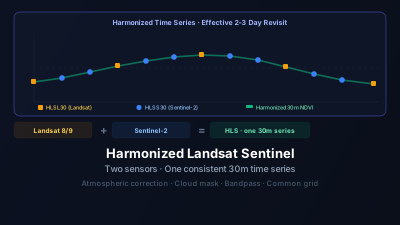
Quick Answer: Harmonized Landsat Sentinel (HLS) is a NASA product that combines Landsat 8/9 and Sentinel-2 surface reflectance into one consistent 30m dataset. By applying atmospheric correction, cloud masking, spectral bandpass adjustment, and a common Sentinel-2 MGRS grid, HLS lets you treat images from different satellites as a single interchangeable time series — delivering an effective 2-3 day revisit instead of the 5-16 days either sensor offers alone. The two products are HLSL30 (from Landsat) and HLSS30 (from Sentinel-2), both at 30m. HLS is ideal when you need dense, cloud-resilient temporal coverage for agriculture, phenology, and change monitoring.
What Is HLS, and Why Does It Exist?
If you monitor a single place over time with optical satellites, you hit a wall fast: clouds. Sentinel-2 revisits every 5 days, Landsat every 16 days — but subtract the cloudy passes and you may get only a handful of usable scenes per month. Miss the two-week window when a crop emerges, a field floods, or a forest is cleared, and the event is gone before your next clear image.
Harmonized Landsat Sentinel (HLS) solves this by merging two satellite families into one consistent time series. Landsat 8/9 and Sentinel-2 observe the same wavelengths at similar resolution, but their data isn't directly comparable out of the box — different atmospheric processing, slightly different band wavelengths, and different grids. HLS is a NASA product (from the Marshall Space Flight Center IMPACT team) that reconciles all of these so that a Landsat image and a Sentinel-2 image taken three days apart can be stacked and compared as if they came from the same instrument.
The payoff: a 2-3 day effective revisit at 30m resolution, globally, for free.
The Two HLS Products: HLSL30 and HLSS30
HLS ships as two parallel products on a shared 30m grid:
| Product | Source sensor | Native resolution | Resampled to | Bands |
|---|---|---|---|---|
| HLSL30 | Landsat 8/9 OLI | 30m | 30m | Coastal, Blue, Green, Red, NIR, SWIR1, SWIR2, Cirrus, + thermal |
| HLSS30 | Sentinel-2 MSI | 10-20m | 30m | Coastal, Blue, Green, Red, Red-Edge ×3, NIR, SWIR1, SWIR2, Cirrus |
Both are delivered as Cloud-Optimized GeoTIFFs, tiled to the Sentinel-2 MGRS military grid, with surface reflectance values and a quality-assessment (Fmask) band for clouds, cloud shadow, snow, and water. Because Sentinel-2 carries red-edge bands that Landsat lacks, HLSS30 has a few extra bands — but the common bands are harmonized to be interchangeable.
How Harmonization Actually Works
Turning two sensor archives into one usable dataset takes four processing steps:
- Atmospheric correction. Both archives are converted to surface reflectance (removing haze and atmospheric scattering) using the LaSRC algorithm, so a "0.3 NIR" means the same thing in both.
- Cloud and shadow masking. A consistent Fmask flags clouds, shadows, snow, and water in every scene, so you can filter contaminated pixels the same way regardless of source.
- Spectral bandpass adjustment. Landsat and Sentinel-2 "red" bands are centered on slightly different wavelengths. HLS applies a linear bandpass adjustment so the values line up.
- Common gridding and BRDF normalization. Everything is reprojected to the Sentinel-2 MGRS grid and normalized for view-angle effects (BRDF), removing brightness differences caused by how the sensor was looking at the scene.
The result is a stack where the satellite that took each image no longer matters for analysis — only the date does.
When HLS Beats a Single Sensor
HLS is not always the right choice. Here's where the fused time series earns its keep:
| Use case | Why HLS helps |
|---|---|
| Crop & phenology monitoring | Capturing green-up, peak, and senescence needs frequent observations; doubling cadence catches transitions a single sensor misses. |
| Flood & rapid disaster response | More passes means a higher chance of a clear image soon after the event. |
| Cloud-prone regions (tropics, monsoon) | Two sensors give twice the lottery tickets against persistent cloud cover. |
| Consistent multi-year change detection | A harmonized record avoids artificial "jumps" when you switch sensors mid-series. |
When you should not reach for HLS:
- You need sub-30m detail — use native Sentinel-2 (10m) instead.
- You need same-day, all-weather coverage — only SAR (Sentinel-1) sees through clouds; see SAR vs Optical: Choosing the Right Sensor.
- You need a multi-decadal baseline before 2013 — the native Landsat archive reaches back to 1972, while HLS starts with Landsat 8.
HLS, NDVI, and Index Time Series
Because HLS bands are harmonized, spectral indices computed from them are directly comparable across sensors. An NDVI of 0.7 from an HLSL30 scene and an NDVI of 0.7 from an HLSS30 scene three days later represent genuinely the same vegetation state — not an artifact of different instruments. That consistency is exactly what makes HLS valuable for the kind of vegetation index time series and anomaly detection that single-sensor records struggle to support cleanly.
For a deeper look at why combining sensors outperforms any one of them, see Multi-Index Satellite Monitoring and SAR-Optical Data Fusion Techniques.
Using HLS in Off-Nadir Delta
Off-Nadir Delta includes HLS among its optical data sources, so you can pull a harmonized Landsat + Sentinel-2 time series for any area you draw on the map — no manual reprojection, atmospheric correction, or grid alignment required. Combined with the platform's area-monitoring tools, that lets you build a dense, cloud-resilient index history and get alerted when values deviate from their seasonal baseline. To see how continuous monitoring works end to end, read How to Monitor Any Area with Satellite Time Series.
Key Takeaways
- HLS = Landsat 8/9 + Sentinel-2 reconciled into one consistent 30m surface-reflectance dataset.
- HLSL30 comes from Landsat, HLSS30 from Sentinel-2; both share the Sentinel-2 MGRS grid and a common quality mask.
- Harmonization means atmospheric correction, cloud masking, bandpass adjustment, and BRDF normalization — so indices are comparable across sensors.
- The real benefit is temporal density: an effective 2-3 day revisit that dramatically improves cloud-prone and time-sensitive monitoring.
- Reach for native Sentinel-2 when you need 10m detail, and SAR when you need to see through clouds.
HLS data is produced by NASA and distributed under an open data policy. Landsat is a joint USGS/NASA program; Sentinel-2 is part of the EU Copernicus programme (ESA).

Remote sensing specialist with 10+ years in satellite data processing and AI. Founder of Off-Nadir Lab. Master's in Earth System Science and Technology (Kyushu University). Co-author, Remote Sensing Encyclopedia. More about the author →