Port Congestion and Supply-Chain Risk: What Satellites See That Shipping Data Misses
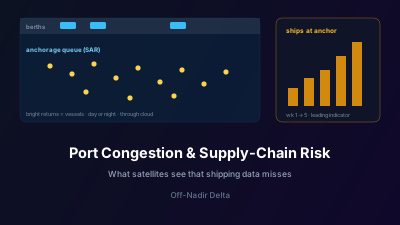
Quick Answer: Port congestion is one of the earliest visible signs of supply-chain disruption, and satellites catch it before it reaches a shipping schedule. AIS position data is useful but incomplete: it depends on vessels broadcasting, and it says little about how long they wait. Satellite imagery is independent of what a ship transmits — Sentinel-1 SAR detects vessels day or night and through cloud, so you can count the ships queued at anchor, measure how the queue grows week over week, and watch berth occupancy directly. For a risk or logistics team, the value is lead time: a swelling anchorage is a leading indicator of delay, visible on open imagery before it shows up as a late container.
When a port backs up, the cost travels down every supply chain that touches it — but the news usually arrives late, as a missed delivery or a spot-rate spike. The physical signal is earlier and plainer: ships pile up at anchor waiting for a berth. That queue is visible from space days before it becomes a schedule problem.
This post is about reading that signal. It covers what satellite imagery sees that vessel-tracking data does not, which measurements actually indicate congestion, and how a supply-chain or risk team can watch a port without a GIS install.
Why watch a port with satellites when AIS already tracks ships?
Because AIS tells you where broadcasting ships are, not how a port is performing, and it has gaps. The Automatic Identification System is a transponder network: vessels transmit position and identity, and that feed is genuinely useful for routing and identity. But it depends on ships choosing to broadcast and on reception, so coverage thins in congested anchorages and disappears entirely for vessels that go dark. And a stream of positions does not directly answer the operational question — how many ships are waiting, and for how long.
Satellite imagery answers that question independently of what any ship transmits. A radar or optical scene is a census of everything physically present in the port at that moment, broadcasting or not. Combining the two is the strongest approach — AIS for identity and intent, imagery for ground truth on how full the port actually is. That imagery-plus-signal pairing is the core of maritime domain awareness.
What does congestion actually look like from orbit?
It looks like an anchorage filling with waiting ships and berths that stay occupied longer than usual. Three measurements capture most of it:
- Anchorage queue count. The number of vessels sitting in the designated waiting areas outside the port. A queue that grows week over week is the clearest single indicator that throughput has fallen behind arrivals.
- Berth occupancy. How many quay positions are filled, and whether ships are turning over or lingering. Long dwell at berth points to slow handling — labour, equipment, or landside bottlenecks.
- Yard and landside state. For container terminals, stack density in the yard; for bulk, the fill state of nearby storage. A full yard blocks discharge even when berths are free.
Each is a count or an area you can read directly off a scene and, more importantly, track over time. As the supply-chain monitoring primer shows, the same family of proxies — vessel counts, storage fill, activity levels — reads economic and operational tempo across many industries.
Which sensor should you use — radar or optical?
Radar for reliability, optical for confirmation, because a queue you can only see on clear afternoons is not a monitor. Ships appear in Sentinel-1 SAR as bright returns against the radar-dark water, and because SAR is "all-weather, day-and-night" (ESA Sentinel-1), it counts the anchorage through cloud and at night — exactly when optical fails and often when congestion is worst. That is why SAR sees through clouds matters operationally here, and why the same signature drives ship monitoring. Sentinel-2 optical then confirms vessel type and berth activity in clear daylight, at 10 m with a five-day revisit (ESA Sentinel-2). Use SAR as the dependable counter and optical as the visual check.
At ~10 m, open imagery reliably resolves the presence and count of ocean-going vessels and the state of berths; it will not read a hull number or distinguish small craft. That is the right resolution for congestion — you are measuring a queue, not identifying a specific ship.
How do you turn scenes into a risk indicator?
You convert each pass into a count, build a time series, and compare it to the port's own baseline. A single scene showing forty ships at anchor means little without context; forty against a normal of twelve, rising for three straight weeks, is a signal. The method is the same time-series area monitoring used elsewhere: define the anchorage and berth areas, count vessels each pass, and flag when the count steps outside the port's usual band — the ±2σ logic that separates a real build-up from ordinary week-to-week variation, explained in unsupervised anomaly detection.
For a risk team the output is lead time. A swelling anchorage is a leading indicator: it precedes the schedule slip, the diverted vessel, and the rate spike that a purely financial or logistics feed reports only after the fact. Tie the count to the events that explain it — a storm closure, a labour action, a canal restriction — and you have both the what and the why, the pairing behind geopolitical and event intelligence.
Who uses this, and for what decision?
Anyone whose cost or exposure depends on a port clearing on time. Logistics and procurement teams use anchorage trends to anticipate delay and reroute before a berth window is missed. Insurers and reinsurers read congestion as an exposure signal for cargo and business-interruption risk, extending the imagery-in-insurance toolkit from damage assessment to operational risk. Commodity and credit analysts read chokepoint queues — a strait, a canal, a major export terminal — as a demand-and-flow indicator. In every case the decision is the same shape: act on the leading physical signal rather than the lagging paperwork.
How to watch a port without code or a GIS install
Draw the anchorage and the berths, pick the vessel-count signal, and let it track. Off-Nadir Delta runs area monitoring and SAR vessel detection in the browser, so you can watch a port's queue build over weeks and get an anomaly flag when it steps outside baseline — no scripting, no per-image contracts, on openly licensed data you can cite in a report. When a flag fires, open the scenes to confirm, or ask the Delta Agent what event is driving the build-up and which sensor confirms it.
Try it
Pick a port that matters to your operations or exposure — a container gateway, a bulk terminal, a chokepoint anchorage — draw the waiting area, and watch the count. The queue at anchor is one of the earliest, hardest-to-hide signals in the whole supply chain, and it is sitting in open imagery, waiting to be counted.
Off-Nadir Delta uses open, openly licensed satellite data for situational awareness and operational risk, not for tracking or targeting individual vessels or people. Vessel counts are indicators to be confirmed against imagery, not certified traffic records. Off-Nadir Delta is an independent project and is not affiliated with any organization or institution.

Remote sensing specialist with 10+ years in satellite data processing and AI. Founder of Off-Nadir Lab. Ph.D. in Informatics (Yokohama National University, 2026). Master's in Earth System Science and Technology (Kyushu University). Co-author, Remote Sensing Encyclopedia. More about the author →