Why SAR Can See Through Clouds (And Why That Matters More Than You Think)
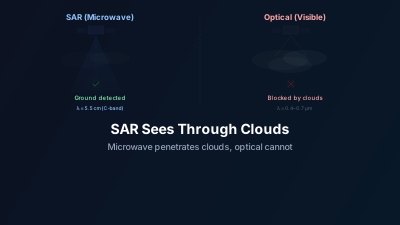
Quick Answer: SAR operates at microwave wavelengths (centimeters) that are thousands of times longer than visible light (nanometers). Cloud droplets are typically 10-15 micrometers — too small to scatter microwave radiation. This is why SAR provides reliable data regardless of weather, making it indispensable for tropical monitoring and disaster response.
The Cloud Problem in Remote Sensing
Anyone who has worked with optical satellite imagery knows the frustration. You need a clear image of a tropical forest, a flood event during a storm, or agricultural fields during monsoon season — and every scene is covered in clouds.
This problem is acute in satellite oceanography. Sea surface temperature retrieval from infrared sensors is essentially impossible under cloud cover, and in the humid tropics, cloud-free days over a given point can be genuinely rare — in the worst-affected equatorial regions, a usable optical view is the exception rather than the rule.
SAR doesn't have this problem. But the explanation for why is more interesting than most people realize.
It's About Wavelength, Not Power
The common explanation — "radar goes through clouds" — is technically correct but misses the mechanism. It's not that SAR signals are particularly powerful or that they punch through clouds by force. The key is the relationship between wavelength and particle size.
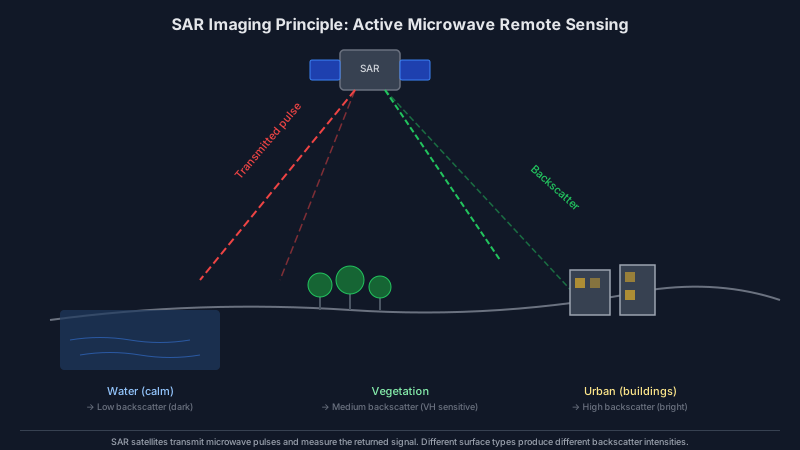
Scattering occurs when radiation encounters particles comparable to its wavelength. This is called Mie scattering when the particle size is roughly equal to the wavelength, and Rayleigh scattering when particles are much smaller.
Here's where the numbers matter:
| Parameter | Typical Size |
|---|---|
| Visible light wavelength | 0.4 – 0.7 μm |
| Cloud droplet diameter | 10 – 15 μm |
| Raindrop diameter | 1,000 – 5,000 μm |
| Sentinel-1 C-band wavelength | 56,000 μm (5.6 cm) |
| NISAR L-band wavelength | 240,000 μm (~24 cm) |
Cloud droplets are 15-35× larger than visible light wavelengths — enough to cause significant scattering. But those same droplets are roughly 4,000× smaller than C-band radar wavelengths. At that ratio, the clouds are essentially invisible to the microwave signal.
Rain Is a Different Story
This is where it gets nuanced, and where many introductory texts oversimplify.
Heavy rain can affect SAR signals, particularly at shorter wavelengths. Raindrops (1-5 mm diameter) are much larger than cloud droplets, and X-band SAR (~3 cm wavelength) can experience noticeable attenuation during intense rainfall.
For C-band (Sentinel-1), moderate rain has minimal impact, but extreme precipitation events can introduce some signal degradation. L-band (NISAR) is essentially unaffected by any realistic rainfall.
Rain artifacts are rarely a significant issue for land applications. Over ocean surfaces, rain cells can sometimes appear as bright patches due to the roughening of the sea surface — which is actually a feature rather than a bug for meteorological applications.
Why This Matters for Flood Mapping
The practical implications are significant. Floods are caused by storms. Storms bring clouds. By the time clouds clear and optical sensors can observe the affected area, floodwaters may have already receded.
SAR can image a flood during the storm that caused it. For emergency responders who need to know which roads are passable and which communities are isolated, that timing difference — hours to days — can be critical.
Sentinel-1's 6-12 day revisit cycle means there's a reasonable chance of having a pre-flood baseline image available. Compare the pre-flood and post-flood SAR scenes, and areas where backscatter has dramatically decreased (indicating smooth water replacing rough land) delineate the flood extent.
The Tradeoff
Nothing in remote sensing is free. SAR's cloud-penetration ability comes with its own set of challenges:
- No natural color: SAR doesn't produce the intuitive RGB images that optical sensors provide
- Speckle noise: The coherent nature of radar creates a grainy texture that requires filtering
- Geometric distortions: Foreshortening, layover, and shadow effects in mountainous terrain
- Interpretation complexity: Understanding what SAR is actually measuring requires training
These aren't minor inconveniences — they're fundamental to the imaging physics. But for the specific use case of "I need to see the ground regardless of weather," SAR remains unmatched.
How Much Cloud Cover Affects SAR in Practice
The difference isn't theoretical — it shows up directly in how many usable observations you end up with.
For optical sensors, the number of acquisitions and the number of usable acquisitions are two very different quantities. Sentinel-2 overflies every point on a fixed schedule, but in equatorial regions — Sumatra, the Congo Basin, northern Amazonia — a large share of those passes return a scene that is mostly cloud. The gap between nominal revisit and effective revisit widens the wetter the climate, and it is worst exactly during the rainy seasons when the events you want to catch are most likely to happen.
Sentinel-1's C-band experience is different. Cloud cover has no meaningful equivalent in microwave terms: attenuation by cloud liquid water at C-band is negligible compared with the surface backscatter signal, so a cloudy pass and a clear pass return the same quality of data. The only weather-related degradation worth worrying about at C-band comes from intense convective rainfall, and even then the effect over land is small. For SAR, nominal revisit and effective revisit are essentially the same number.
The practical implication for monitoring programs: If you are trying to detect an event — a flood, a deforestation clearing, a construction start — that could occur at any time and is likely obscured by clouds, SAR is the sensor that won't miss it. An optical-only monitoring system over a tropical forest has a meaningful probability of missing an event that occurs during the cloud season and recovers before the next clear image. SAR has no such gap.
Practical Takeaway
If you're monitoring an area with persistent cloud cover — tropical forests, monsoon regions, high-latitude winter areas — SAR should be your primary data source, not a backup plan. Build your workflow around it.
For time-critical applications like disaster response, don't wait for the clouds to clear. Access Sentinel-1 data and start your analysis while optical users are still waiting for a clear sky.

Remote sensing specialist with 10+ years in satellite data processing and AI. Founder of Off-Nadir Lab. Ph.D. in Informatics (Yokohama National University, 2026). Master's in Earth System Science and Technology (Kyushu University). Co-author, Remote Sensing Encyclopedia. More about the author →