Why This Sensor? How the Delta Agent Explains Its Imagery-Tasking Choices
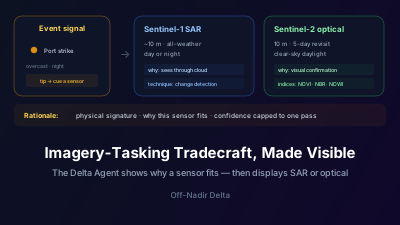
Quick Answer: The Delta Agent now explains the imagery-tasking tradecraft behind every event it surfaces. Each finding carries a one-line rationale — the physical signature to look for and why a sensor fits: Sentinel-1 SAR (~10 m, all-weather, day or night) for structures, vehicles, ships and flooding, or Sentinel-2 optical (10 m resolution, 5-day revisit, cloud-limited) for visual confirmation — plus the key confidence caveat. You can display either sensor in one click with before/after scenes over the area, and a structured collection assessment states which candidates were excluded and why. The goal is to make sensor selection legible at the point of action, not hidden behind a label.
When an event breaks, the hard question is not where to look — it is which sensor will actually show it. The Delta Agent now answers that out loud: for every event it surfaces, it states the physical signature to look for, why a particular sensor fits, and where its own confidence is capped. You then display Sentinel-1 SAR or Sentinel-2 optical over the area in one click.
This post explains the imagery-tasking reasoning that drives that choice, and what changed in Off-Nadir Delta to make it visible.
What is imagery-tasking tradecraft?
Imagery-tasking tradecraft is the reasoning that connects an event to the sensor and technique that can actually observe it. It asks four things: what physical signature would be present (a crater, a flooded road, a new revetment, a berthed ship), which sensor's resolution and band can resolve it, the best collection technique, and the residual gap. A good answer names the sensor and the reason — not just "task a satellite."
A core part of that reasoning is mensuration — matching object size to the resolution you need. The widely used rule of thumb, formalized in the National Imagery Interpretability Rating Scale (NIIRS), is that detecting that an object is present needs a ground sample distance (GSD) near its smallest meaningful dimension; recognizing its class needs roughly one-sixth to one-eighth of that; identifying the exact type needs about one-twelfth to one-sixteenth. A ~3.5 m-wide tank is therefore merely detectable at ~1–2 m, recognizable as armor near ~0.5 m, and identifiable by variant only near ~0.25 m. Stating whether imagery can detect versus identify — and never claiming identification from detection-grade pixels — is the difference between a careful brief and an over-read. See the glossary for GSD and related terms.
Why does the right sensor depend on the event?
Because radar and optical sensors fail in opposite conditions. Sentinel-2 is a multispectral optical imager at 10 m resolution with a 5-day revisit (ESA Sentinel-2) — excellent for visual confirmation and spectral indices, but blind at night and blocked by cloud. Sentinel-1 is a C-band synthetic-aperture radar that supplies "all-weather, day-and-night" imagery (ESA Sentinel-1) at roughly 10 m, so it sees through cloud and darkness — the right tool for a strike at 3 a.m. under overcast.
For confirming a news event, the practical trade-off looks like this:
| Question about the event | Sentinel-1 SAR | Sentinel-2 optical |
|---|---|---|
| Works at night / through cloud? | Yes — radar, ~10 m | No — needs daylight and clear sky |
| Strongest for | Structural change, vehicles, ships, flood extent | Visual confirmation, burn scars, true-colour context |
| Revisit | ~6 days (two-satellite constellation) | 5 days (ESA-stated) |
| Technique edge | Coherent change detection (sub-resolution change) | Spectral indices: NDVI, NBR, NDWI |
| Main limitation | Harder to interpret by eye | Cloud and darkness |
The deeper SAR advantage is technique. Coherent change detection compares the phase stability of two radar passes and reveals disturbance — tracks, digging, blast effects — even when the individual objects sit below the pixel size. That is why SAR can confirm change through clouds when optical sees nothing. For the full decision framework, see SAR vs optical: choosing the right sensor.
What does the Delta Agent now show for each event?
Every finding the agent returns now carries a one-line rationale: the physical signature to look for and why the recommended sensor and action fit, plus the key confidence caveat or collection gap. Previously this reasoning was compressed into a single label — "Display (Sentinel-1 SAR)" — with no stated why. Now the tradecraft sits directly under the recommendation, at the point where you decide whether to act.
A rationale reads like a desk officer's note. For a reported port strike under cloud, it might say: "Look for new dark burn scars and displaced hulls; Sentinel-1 SAR resolves berth-scale change through cloud where optical is blocked; confidence capped to a single post-event pass." That one line tells you what the imagery should reveal, why SAR rather than optical, and how far to trust a single observation — the reasoning an analyst would otherwise have to reconstruct.
Can I display Sentinel-1 SAR or Sentinel-2 optical in one click?
Yes — both sensors are now offered as candidates, not a single auto-pick. The "Display on map" panel on each finding shows an Optical button and a SAR button side by side. The agent's recommended sensor is highlighted, but you choose: pick SAR to see through cloud, or optical for a clean visual, regardless of the default.
Each button searches for real scenes over the event's area and groups them as before-event, on the event day, and after-event passes, so you can load a pre-event baseline and a post-event scene to compare. When no clear post-event pass exists yet, the panel says so and estimates the next likely revisit from the observed cadence — honest about what is not yet collectable rather than implying imagery exists. (Sentinel-1 SAR and Sentinel-2 optical display are both available on every plan, including Free. Displaying imagery is metered separately from asking a question.)
What is a collection assessment, and why does it matter?
Whenever the agent returns specific events, it now also writes a structured collection assessment — the cross-event tradecraft that turns a list of cards into a tasking judgment. It covers three things in a few labelled lines: collection fit (which sensor and technique each priority event rewards, and why), excluded candidates (what it ruled out — below the resolution regime, no persistent physical signature, or lower collection value), and gaps and confidence (weather, revisit, or geometry limits, and where confidence is capped).
Exclusion reasoning is the part analysts most often miss in automated output. Knowing why an event was left off the imaging list — "nocturnal small-arms activity has no persistent signature at 10 m" — is as valuable as knowing what made the list. Surfacing it makes the agent's selection auditable instead of a black box.
How does this fit tip-and-cue and situational awareness?
It closes the tip-and-cue loop. In GEOINT, tip-and-cue means one source cues collection by another: an open-source signal tips you that something happened, and you cue a sensor to observe it. The Delta Agent reads geolocated open-source event signals — the same Delta Signals layer behind the situational-awareness dashboard — and now makes the cue explicit: it names the sensor, the signature, and the technique, then hands you the one-click display to actually look.
The workflow is short. Ask the agent an intelligence question; read each finding's rationale to see why a sensor fits; check the collection assessment for what was excluded and where confidence is thin; then display SAR or optical before/after scenes over the area. The reasoning that used to live only in an analyst's head is now on the screen, next to the button. Tip-and-cue is one move inside the broader geospatial OSINT loop — collect, geolocate, corroborate, cue, and caveat.
How does the agent handle uncertainty?
It treats likelihood and analytic confidence as separate axes and says so. Following the spirit of established analytic-confidence standards (ICD 203 estimative language), the agent caps confidence when a judgment rests on a single pass, oblique radar geometry, a degraded GSD, or a long inferential chain — and lowers it, rather than raising it, when an observation is equally consistent with a decoy or staged activity. A rationale will flag "single post-event pass, no baseline to rule out a decoy" instead of asserting certainty.
This honesty is deliberate. Over-promising what 10 m imagery can show — claiming to see people, small vehicles, or weapons that the resolution cannot resolve — is the classic, costly error. The agent describes only what the available regime can resolve and states the residual gap plainly. For why resolution sets that ceiling, see the four types of satellite image resolution.
Try it
Open the Delta Agent or the map and ask an intelligence question about an area or event you follow. Read the rationale under each finding, scan the collection assessment, and display Sentinel-1 SAR or Sentinel-2 optical over the area to confirm what the signal reports. The point is not just an answer — it is the reasoning that lets you trust, or challenge, the sensor choice.
The Delta Agent reasons over publicly available open-source event signals for situational awareness only — not targeting or surveillance of individuals. Off-Nadir Delta is an independent project and is not affiliated with any organization or institution. Sensor specifications are drawn from the European Space Agency's published Sentinel-1 and Sentinel-2 mission documentation.

Remote sensing specialist with 10+ years in satellite data processing and AI. Founder of Off-Nadir Lab. Ph.D. in Informatics (Yokohama National University, 2026). Master's in Earth System Science and Technology (Kyushu University). Co-author, Remote Sensing Encyclopedia. More about the author →