
4 Types of Resolution in Remote Sensing, Explained
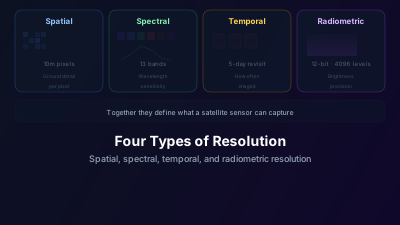
Quick Answer: Satellite imagery has four types of resolution: spatial (pixel size on the ground), spectral (number and width of wavelength bands), temporal (how often the same area is revisited), and radiometric (how many brightness levels the sensor distinguishes). For most Earth observation tasks, temporal and spectral resolution matter more than raw spatial resolution.
Resolution Is Not Just About Pixel Size
When people say "high-resolution satellite imagery," they almost always mean spatial resolution — the size of a single pixel on the ground. A 10-meter pixel versus a 0.3-meter pixel is an obvious, intuitive difference.
But spatial resolution is only one of four resolution types — NASA lists radiometric, spatial, spectral and temporal (NASA Earthdata) — and in many practical applications, it's not the most important one. Projects fail when they chase the highest spatial resolution available while the analysis actually needed better temporal coverage or more spectral bands.
1. Spatial Resolution
What it means: The area on the ground that one pixel represents.
| Satellite | Spatial Resolution |
|---|---|
| Sentinel-2 | 10m (visible/NIR), 20m (red edge/SWIR) — SentiWiki |
| Sentinel-1 SAR | 5 m × 20 m single look (IW mode) — SentiWiki |
| Landsat 8/9 | 30m (multispectral), 15m (pan), 100m (thermal) — USGS |
| Commercial VHR | Sub-metre to a few metres, depending on the system |
At 10m resolution, you can distinguish field boundaries, forest edges, and major land cover types. At 0.3m, you can identify individual cars and building footprints.
When spatial resolution is critical: Urban mapping at building level, infrastructure monitoring, damage assessment of individual structures, vehicle detection.
When it doesn't matter much: Regional vegetation trends, ocean color analysis, atmospheric studies, large-area land cover classification. A 10m pixel is more than sufficient for these tasks, and the extra data volume of higher resolution just slows you down.
The quickest way to calibrate these numbers is to look at a place you know: start from the Sentinel-2 viewer and open the area in the workspace (free account) to see it at 10 m.
2. Spectral Resolution
What it means: The number, width, and placement of wavelength bands the sensor captures.
This is where satellite imagery differs fundamentally from a photograph. A camera captures three broad bands (red, green, blue). Sentinel-2 captures 13 bands from visible through shortwave infrared, each tuned to reveal specific surface properties (SentiWiki).
| Band Region | What It Reveals | Example |
|---|---|---|
| Blue (B2, ~490 nm) | Water penetration, coastal mapping | Shallow bathymetry |
| Red (B4, ~665 nm) | Chlorophyll absorption | Vegetation health via NDVI |
| Red Edge (B5–B7, ~704–785 nm) | Vegetation stress | Early crop disease detection |
| NIR (B8, ~833 nm) | Vegetation structure | Biomass estimation, water boundaries |
| SWIR (B11 ~1610 nm, B12 ~2190 nm) | Moisture content | Soil moisture, burn severity, mineral mapping |
Wavelengths are band centres; they differ by a few nanometres between Sentinel-2A, 2B and 2C.
Why this matters more than you think: Two satellites could have identical spatial resolution, but if one has SWIR bands and the other doesn't, their analytical capabilities are fundamentally different. SWIR bands enable soil moisture estimation, geological mapping, and burn severity assessment that visible/NIR bands simply cannot provide.
Sentinel-2's spectral resolution is a key reason it dominates environmental monitoring despite having "only" 10m spatial resolution. Those 13 carefully placed bands enable a range of analysis that a sub-metre sensor carrying only visible and near-infrared bands cannot match.
3. Temporal Resolution
What it means: How often the sensor captures the same location on Earth.
| Satellite | Revisit Time |
|---|---|
| Sentinel-2 (two-satellite pair, currently 2B + 2C) | 5 days at the equator; 10 days per satellite — SentiWiki |
| Sentinel-1 (two-satellite pair, currently 1C + 1D) | 6 days; 12 days per satellite — SentiWiki |
| Landsat 8 + 9 combined | 8 days; 16 days per satellite — USGS |
| Commercial constellations | Varies by constellation and tasking |
Sentinel-2C replaced 2A in the operational pair on 21 January 2025. On Sentinel-1, 1B stopped delivering data in December 2021; 1C has been operational since May 2025, and since Sentinel-1A's operational duties ended on 29 June 2026 the pair has been 1C and 1D (ESA).
For many applications, temporal resolution is the most limiting factor:
Agriculture: Crop growth stages change on weekly timescales. Miss a critical observation window (flowering, early stress), and the analysis loses value regardless of spatial resolution.
Disaster response: After a flood or earthquake, you need the first available image — hours and days matter more than pixel size.
Change detection: Detecting deforestation, urban expansion, or seasonal patterns requires consistent repeat observations. A single very-high-resolution image tells you what an area looks like today, but not how it's changing.
Cloud interference: Over persistently cloudy regions such as much of the tropics, a large share of optical observations are cloud-contaminated, so the number of usable views is far lower than the nominal revisit suggests — and the longer the revisit, the longer the wait for a clear one. This is why SAR (which penetrates clouds) is so valuable in tropical monitoring.
4. Radiometric Resolution
What it means: The number of brightness levels the sensor can distinguish — essentially, the precision of each measurement.
| Sensor | Radiometric Resolution |
|---|---|
| Sentinel-2 | 12-bit (4,096 levels) — SentiWiki |
| Landsat 8 | 12-bit (4,096 levels) — USGS |
| Landsat 9 | 14-bit (16,384 levels) — USGS |
| Older Landsat (1–7) | 8-bit (256 levels) — USGS |
Higher radiometric resolution means the sensor can distinguish subtle differences in reflected or emitted energy. This matters for:
- Water quality: Detecting slight differences in chlorophyll concentration across a lake
- Shadow analysis: Distinguishing between deep shadow and dark surfaces
- Quantitative analysis: Any application that requires precise reflectance values rather than just visual interpretation
In practice, modern sensors (12-bit or better) have sufficient radiometric resolution for almost all applications. This was more of a limitation with older 8-bit sensors where dark areas like shadows and deep water all collapsed into the same few pixel values.
The Tradeoff Triangle
Satellite engineers face a fundamental tradeoff: you cannot maximize all four resolutions simultaneously. Higher spatial resolution means a narrower swath (less area covered per pass), which reduces temporal resolution. More spectral bands require longer integration times, which can limit spatial resolution or coverage rate.
This is why different satellites exist for different purposes:
| Priority | Best Fit |
|---|---|
| High spatial, few bands | Commercial VHR for defense/mapping |
| Many bands, moderate spatial | Sentinel-2 for environmental monitoring |
| All-weather, moderate spatial | Sentinel-1 SAR for flood/disaster/ice |
| Very high temporal | Geostationary satellites for weather |
What You Can Actually Detect at Each Spatial Resolution
This is the table most beginner resources omit — what features are actually detectable at each resolution level:
| Spatial Resolution | Minimum Detectable Feature | Typical Application | Example Satellite |
|---|---|---|---|
| 0.3–0.5 m | Individual cars, building details, tree canopy gaps | Defense, precision mapping, urban 3D | Commercial VHR |
| 1–3 m | Road lanes, small buildings, individual trees | Urban planning, infrastructure inspection | Commercial high-resolution |
| 3–5 m | Large buildings, agricultural plots, small ponds | Agricultural field monitoring, coastal | Commercial smallsat constellations |
| 10 m | Field boundaries, forest patches, city blocks | Vegetation indices, land cover | Sentinel-2 (VIS/NIR) — SentiWiki |
| 20–30 m | Large fields, land use zones, urban/rural boundary | Regional land cover, Landsat archive | Landsat 8/9 (USGS), Sentinel-2 SWIR |
| ~300 m | River systems, large water bodies, coastlines | Regional drought monitoring, ocean | Sentinel-3 OLCI full resolution — SentiWiki |
| 375 m–1 km | Major land cover types, fire hotspots | Global daily monitoring, fire detection | VIIRS 375 m (NASA FIRMS), MODIS 250 m–1 km (NASA) |
| ~1–2 km and coarser | Continental-scale patterns, atmospheric plumes | Weather, fire and smoke over whole regions | Geostationary imagers such as GOES ABI and Meteosat SEVIRI (NASA FIRMS FAQ) |
Geostationary pixels are finest directly below the satellite and grow toward the edge of the disk; in exchange, an imager such as GOES ABI can capture a full-disk image every 10 minutes (NOAA NESDIS).
The practical implication: A 10 m pixel covers 100 m² of ground, so the arithmetic is easy. If your objective is to detect drought stress across 10-hectare crop fields, Sentinel-2 gives you about 1,000 pixels per field — far more than sufficient. If you want to monitor individual tree health in a 500 m² orchard, 10 m gives you 5 pixels total and you need sub-5m commercial data.
A 10-meter pixel is equivalent to a 10×10 m square on the ground. An average sedan is about 4×2 m — completely invisible. A basketball court (28×15 m) shows as 4 pixels. A city block (100×100 m) resolves as 100 pixels. That mental model — counting how many pixels your feature occupies — is the fastest way to assess whether a given resolution is adequate for your task.
Practical Decision Framework
When starting a new satellite monitoring project, ask these questions in order:
- What change timescale am I observing? This determines temporal resolution needs
- What surface property do I need to measure? This determines spectral resolution (and whether you need SAR or optical)
- What is the smallest feature I need to detect? This determines spatial resolution
- Do I need to work in cloudy regions? If yes, SAR becomes essential regardless of other considerations
Most beginners start with question 3 (spatial resolution) and work backwards. Experienced analysts start with questions 1 and 2.
Off-Nadir Delta provides access to Sentinel-1 SAR and Sentinel-2 optical data, so the radar and optical sides of these trade-offs can be compared over the same area.
Related reading
Temporal resolution is usually quoted as a nominal revisit figure, which is not the same as when you can actually expect an image of a specific place. When can a satellite next image this place covers turning a repeat cycle into an access window, and why cloud makes the optical figure optimistic.

Remote sensing specialist with 10+ years in satellite data processing and AI. Founder of Off-Nadir Lab. Ph.D. in Informatics (Yokohama National University, 2026). Master's in Earth System Science and Technology (Kyushu University). Co-author, Remote Sensing Encyclopedia. More about the author →