
DEM Comparison: SRTM vs ALOS vs Copernicus DEM
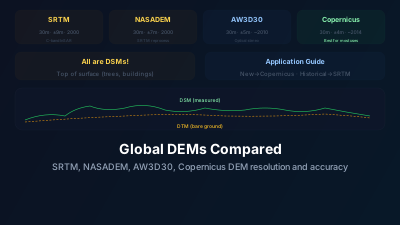
Quick Answer: Four global DEMs are freely available: SRTM (30m, 2000, ±9m vertical), ALOS World 3D (30m, ~2010, ±5m), Copernicus DEM (30m, ~2012-2015, ±4m), and NASADEM (30m, improved SRTM). The Copernicus DEM (based on TanDEM-X) is the most accurate and most recent for most applications. SRTM remains useful for historical elevation reference and change detection. All are Digital Surface Models (DSMs) — they measure the top of the surface including buildings and trees, not bare earth. For forestry, this 'canopy-top' measurement is a feature; for hydrology, it's a limitation requiring canopy/building removal. Choice depends on: required accuracy, temporal reference, coverage (SRTM limited to ±60°; Copernicus DEM is near-global), and application.
"Which DEM should I use?" is one of the most common questions in geospatial analysis, and the answer has changed significantly over the past five years. For nearly two decades, SRTM was the default global elevation dataset. Today, the Copernicus DEM has largely taken that position — but SRTM isn't obsolete, and the choice depends on what you're trying to do.
The Free Global DEMs
SRTM (Shuttle Radar Topography Mission)
- Source: Space Shuttle Endeavour, single 11-day mission in February 2000
- Technology: C-band InSAR (single-pass interferometry with two antennas)
- Resolution: 1 arc-second (~30m) globally; 3 arc-second (~90m) historically
- Coverage: 60°N to 56°S (no polar coverage)
- Vertical accuracy: ±9m (90% linear error) globally; ±6m in flat terrain
- Epoch: February 2000
Strengths: Well-characterized, extensively validated, consistent global coverage within its latitude range. The "known quantity" in the DEM world.
Weaknesses: 25-year-old data. Significant void areas (steep terrain, water bodies). Stripe artifacts in some regions. DSM, not DTM (includes vegetation and building heights).
NASADEM
- Source: Reprocessed SRTM data with improved algorithms
- Resolution: 1 arc-second (~30m)
- Coverage: Same as SRTM
- Improvements: Void filling using ASTER and ICESat data; reduced noise; improved water body handling
- Epoch: Still February 2000 (same raw data)
NASADEM is essentially SRTM done better. If you would have used SRTM, use NASADEM instead — it's strictly superior for the same epoch.
ALOS World 3D (AW3D30)
- Source: ALOS PRISM (optical stereo satellite)
- Technology: Optical stereophotogrammetry
- Resolution: 1 arc-second (~30m); commercial 5m version available
- Coverage: Near-global (polar gaps)
- Vertical accuracy: ±5m (RMSE) globally
- Epoch: Approximately 2006-2011
Strengths: Better accuracy than SRTM, especially in steep terrain. Optical-derived, so no radar-specific artifacts (layover, foreshortening).
Weaknesses: Cloud-affected areas may have lower quality. Some regions filled with SRTM data.
Copernicus DEM (GLO-30)
- Source: TanDEM-X mission (DLR/Airbus)
- Technology: X-band single-pass InSAR
- Resolution: 1 arc-second (~30m); commercial 10m and 30m versions
- Coverage: Near-global (including polar regions)
- Vertical accuracy: ±4m (RMSE) globally; ±2m in flat/moderate terrain
- Epoch: Approximately 2012-2015
Strengths: Best accuracy of any free global DEM. Most recent epoch. Near-global coverage including high latitudes. Fewer voids than SRTM. Edited to reduce artifacts.
Weaknesses: Relatively new, so less extensively validated in all environments than SRTM. Still a DSM (includes canopy/buildings).
DSM vs. DTM: The Canopy Problem
All four global DEMs are Digital Surface Models (DSMs) — they measure the elevation of the highest surface, which includes tree canopies, buildings, and other above-ground features.
In forests: The DSM measures the canopy top, not the ground below. A 30m tall forest on flat terrain will appear as a 30m hill in the DSM. For hydrology (flow routing, watershed delineation), this creates significant errors.
In cities: Buildings appear as elevated features, affecting slope and aspect calculations.
In open terrain: DSM ≈ DTM (the surface IS the ground). All four DEMs work well for bare or sparsely vegetated terrain.
Getting a DTM from a DSM
Options for removing canopy and buildings:
- ICESat-2 / GEDI LiDAR: Provide ground elevation samples that can be used to correct DSMs
- Canopy height subtraction: DSM − canopy height map = approximate DTM
- Morphological filtering: Algorithms that attempt to separate ground from above-ground features
- National DTMs: Many countries have LiDAR-derived DTMs at higher resolution and accuracy than global DSMs
Comparison by Application
Hydrology (Watershed, Flow Direction)
Best choice: Copernicus DEM (most accurate) + hydrological conditioning (pit filling, stream burning)
Caveat: All global DSMs produce significant errors in forested areas. If your watershed is forested, consider using a national LiDAR-derived DTM if available.
Orthorectification (Terrain Correction)
Best choice: Copernicus DEM (most accurate, most recent)
For SAR terrain correction (radiometric terrain correction of Sentinel-1), the DEM accuracy directly affects the quality of the result. The Copernicus DEM's superior accuracy produces the best orthorectification.
Change Detection (Before/After)
Best choice: SRTM for the "before" epoch (2000); Copernicus DEM for the "after" epoch (~2014)
Differencing DEMs from different epochs reveals elevation changes — useful for glacier volume change, mining volume estimation, and landslide detection. Note that systematic differences between DEM sources can introduce artifacts.
Slope and Aspect Analysis
Best choice: Copernicus DEM (best accuracy = most reliable slope/aspect)
Slope errors are amplified by DEM errors — a 9m vertical error (SRTM) over a 30m pixel produces up to ~17° slope error. The Copernicus DEM's 4m accuracy halves this error.
Visualization (3D Terrain)
Any DEM works for visualization. SRTM is common because it's widely supported and familiar. Copernicus DEM provides slightly better visual detail.
Historical Analysis
SRTM/NASADEM: The only option for ~2000 elevation baseline. Useful for glaciology, coastal change, and other applications requiring historical reference.
Practical Tips
Check the void mask: All DEMs have data gaps (voids). Always check whether your area of interest has complete coverage. Void-filled versions exist but filled areas have lower accuracy.
Dropping a downloaded tile into the GeoTIFF viewer is a quick way to look at it before building it into a workflow.
Understand the CRS: Global DEMs are typically in geographic coordinates (WGS84) with elevations referenced to EGM96 or EGM2008 geoid. If your project uses ellipsoidal heights, conversion is needed.
Resolution isn't everything: A 30m DEM with ±4m vertical accuracy (Copernicus) is more useful for most applications than a 30m DEM with ±9m accuracy (SRTM), even though the spatial resolution is identical.
National DEMs may be better: Many countries have LiDAR-derived DEMs at 1-5m resolution with sub-meter vertical accuracy. These are far superior to any global DEM for local applications. Check your country's national mapping agency before defaulting to a global product.
DEM Accuracy in Practice: Where the Published Number Stops Applying
The vertical accuracies quoted above are global summary statistics. They describe how a DEM performs averaged over every terrain type on Earth, which is not how anyone uses one. The error you actually get depends on the terrain and land cover under your area of interest, and it moves in predictable directions:
- Flat, open terrain: the best case, and roughly where the published global figure comes from. Errors here are usually smaller than the headline number.
- Forest: the worst case for every global DEM, because none of them measure the ground. Expect a systematic positive bias — the surface sits somewhere between the ground and the canopy top — that scales with canopy height rather than being random noise.
- Steep slopes: radar-derived DEMs (SRTM, Copernicus) suffer layover and foreshortening; optical stereo (AW3D30) suffers matching failures in shadowed slopes. Either way, error grows sharply with slope and can dwarf the global specification.
- Dense urban areas: buildings are included in the surface, so "error" here is partly a definition problem — the DEM is measuring rooftops correctly and your analysis wants the street.
- High latitudes: a coverage question before an accuracy question. SRTM/NASADEM simply stop near ±60°; the Copernicus DEM is near-global.
Why forests cause the largest errors: all global radar-derived DEMs partially penetrate the upper canopy at their respective wavelengths, so the measured elevation is neither the ground nor the canopy top but somewhere in between — a systematic positive bias, not random scatter. ALOS AW3D30 (optical stereo) measures the canopy top more consistently, which is more faithful as a DSM but worse if you wanted a DTM. Correction schemes that subtract an estimated canopy contribution exist, but the correction is itself uncertain and biome-specific.
A practical calibration exercise: before using any global DEM for a critical application, sample it at a set of known elevation control points (GPS benchmarks, spot heights from topographic maps) spread across the terrain types in your area. The mean error reveals systematic bias; the standard deviation reveals random error. It is a short exercise, and it tells you far more about the DEM's fitness for your site than any published global figure can.
The Copernicus DEM should be the default choice for most new projects. It's the most accurate, most recent, has the best coverage, and is freely available. SRTM retains value for historical reference and for established workflows. The key is understanding what each DEM actually measures (surface, not ground), its accuracy limitations, and how those limitations affect your specific application.
Related reading
One concrete reason the choice of elevation model matters: SAR layover and shadow fractions are computed directly from a DEM, so the model's posting and vintage set the resolution of that answer. How much of a SAR scene is actually usable works through the calculation and notes where a DEM predating a terrain change becomes the weak link.
Frequently asked questions
Which free global DEMs are available?
Four 30 m global DEMs are freely available: SRTM (2000, about ±9 m vertical accuracy), NASADEM (an improved reprocessing of SRTM), ALOS World 3D / AW3D30 (about ±5 m), and Copernicus DEM GLO-30 (about ±4 m). All are widely used for terrain analysis and orthorectification.
Which global DEM is the most accurate and most recent?
For most applications the Copernicus DEM (GLO-30), derived from the TanDEM-X mission, is both the most accurate and the most recent. SRTM remains valuable as a year-2000 reference for historical elevation and change detection.
What is the difference between a DSM and a DTM?
A Digital Surface Model (DSM) records the top of the surface, including buildings and tree canopy, while a Digital Terrain Model (DTM) represents the bare earth beneath them. All four free global DEMs are DSMs, so canopy and structures are included in the elevation.
Which DEM should I use for hydrology versus forestry?
Hydrology (watershed delineation, flow direction) generally needs bare-earth elevation, so a DSM must have canopy and buildings removed to behave like a DTM. In forestry the canopy-top measurement of a DSM is a feature, since it captures vegetation height information.
Do these DEMs cover the whole planet?
Coverage differs. SRTM is limited to roughly ±60° latitude, so it misses high-latitude regions, whereas the Copernicus DEM is near-global. Coverage, required accuracy, and the acquisition date should all factor into DEM choice.

Remote sensing specialist with 10+ years in satellite data processing and AI. Founder of Off-Nadir Lab. Ph.D. in Informatics (Yokohama National University, 2026). Master's in Earth System Science and Technology (Kyushu University). Co-author, Remote Sensing Encyclopedia. More about the author →