
Atmospheric Correction: Why Raw Satellite Images Need Processing
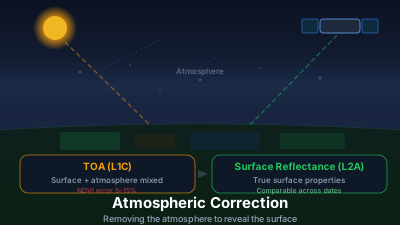
Quick Answer: Earth's atmosphere scatters and absorbs light before it reaches a satellite sensor, distorting the surface reflectance values. Atmospheric correction removes these effects, converting Top-of-Atmosphere (TOA) reflectance to Bottom-of-Atmosphere (BOA) or surface reflectance. This step is essential for multi-temporal analysis, cross-sensor comparison, and accurate vegetation indices. Sentinel-2 Level-2A products come pre-corrected; Landsat Collection 2 includes surface reflectance. Skipping it leaves NDVI systematically depressed — scattering inflates the red band proportionally more than the NIR band — by an amount that tracks the aerosol load on the day of acquisition, which is enough to make an unchanged field look like a real ecological change between two dates.
Atmospheric haze alone can move a vegetation time series far enough to look like an ecological event. If a July scene over a healthy temperate forest carries substantially more aerosol loading than the June scene it is compared against, uncorrected NDVI can drop sharply between the two dates while the canopy itself is unchanged. The forest hasn't changed. The atmosphere has.
That failure mode is the everyday argument for atmospheric correction.
What the Atmosphere Does to Light
Sunlight travels through the atmosphere twice in the remote sensing process: once on the way down to Earth's surface, and once on the way back up to the satellite sensor. During each pass, two things happen:
Scattering: Atmospheric molecules and aerosols redirect light in random directions. Blue light scatters more than red (that's why the sky is blue). This adds a "path radiance" — light that never touched the ground but still enters the sensor. The result is a brightness offset that's strongest in shorter wavelengths.
Absorption: Water vapor, ozone, CO₂, and other gases absorb specific wavelengths. Ozone absorbs UV; water vapor absorbs portions of the near-infrared and shortwave infrared. This reduces the signal from the surface.
Combined, these effects mean what the satellite records isn't what the surface actually reflected. It's a mixture of surface signal, atmospheric path radiance, and absorption losses.
TOA vs. BOA: The Two Reflectance Levels
Top-of-Atmosphere (TOA) reflectance — sometimes called Level-1C for Sentinel-2 — is what the sensor actually measured. It includes atmospheric contributions. This is the "raw" product (after geometric and radiometric correction, but before atmospheric correction).
Bottom-of-Atmosphere (BOA) reflectance — Level-2A for Sentinel-2 — is the estimated surface reflectance after removing atmospheric effects. This is what the ground actually reflected.
The difference matters more than most people realize:
| Metric | TOA (uncorrected) | BOA (corrected) |
|---|---|---|
| Blue band reflectance | Significantly inflated | Accurate |
| NDVI bias | Systematically depressed, by an amount that varies with the atmosphere on the day | Small residual error |
| Multi-date comparability | Poor | Good |
| Cross-sensor comparability | Unreliable | Reliable |
When Does It Matter Most?
Multi-Temporal Analysis
If you're comparing the same location across different dates — which includes any change detection, time-series monitoring, or seasonal analysis — atmospheric correction is non-negotiable. Atmospheric conditions vary between acquisitions. Without correction, you're conflating atmospheric variability with actual surface changes.
Vegetation Indices
NDVI uses the red and NIR bands. Atmospheric scattering adds more noise to the red band than the NIR band, which inflates the denominator (Red + NIR) disproportionately. The result: uncorrected NDVI is systematically lower than the true value, and the error varies with atmospheric conditions.
For single-date NDVI as a rough visual indicator, the error might be tolerable. For quantitative analysis — say, correlating NDVI with crop yield — the error is not acceptable.
Cross-Sensor Comparison
Comparing reflectance values between different sensors (Sentinel-2 and Landsat, for example) requires surface reflectance. Different sensors have different spectral response functions and different atmospheric paths. Only after atmospheric correction do the numbers become physically comparable.
How Atmospheric Correction Works
The general approach involves estimating the atmospheric conditions at the time of image acquisition, then modeling how those conditions affected the measured radiance.
Key inputs to the correction:
- Aerosol optical thickness: How much particulate matter (dust, smoke, pollution) is in the atmosphere
- Water vapor content: Affects absorption in NIR and SWIR bands
- Ozone concentration: Affects UV and visible bands
- Sun and sensor geometry: Solar zenith angle, sensor viewing angle, relative azimuth
For Sentinel-2, ESA's Sen2Cor processor handles this automatically to produce Level-2A products. It uses a combination of dense dark vegetation (DDV) targets and atmospheric modeling to estimate aerosol loading, then applies a radiative transfer code to correct each pixel.
Landsat Collection 2 surface reflectance uses the LaSRC algorithm (Landsat Surface Reflectance Code), which follows a similar approach with different implementation details.
Land vs. Water: Different Processors for Different Targets
Standard processors like Sen2Cor and LaSRC are tuned for land surfaces, where the ground reflects enough signal that atmospheric path radiance is a relatively modest fraction of the total. Over water, the surface is so dark that atmospheric scattering can dominate the measured signal, and these land-oriented processors often fail or produce negative reflectance.
Aquatic applications therefore use specialized processors. ACOLITE is optimized for dark water targets and handles sun glint and adjacency effects (light from nearby bright land contaminating water pixels); it supports Sentinel-2, Landsat, and several other sensors. C2RCC (Case 2 Regional CoastColour) is another common choice for coastal and inland waters. Underlying many operational processors is 6S (Second Simulation of the Satellite Signal in the Solar Spectrum), a general-purpose radiative transfer code that computes correction coefficients for any sensor given aerosol, water vapor, and ozone inputs. The practical takeaway: if your target is water, reach for a water-specific processor rather than the default land product.
How Much Does Correction Actually Change the Numbers?
The correction is strongly wavelength-dependent, and the ordering is always the same. The blue band is corrected hardest, because Rayleigh and aerosol scattering are strongest at short wavelengths and because the surface itself is usually dark there — the path signal is a large fraction of what the sensor measures. Green and red are corrected less. The near-infrared moves least of all, because the atmosphere is comparatively transparent there and vegetation is very bright, so the surface dominates the measurement.
For NDVI, those two effects work in the same direction. Scattering inflates the red band proportionally more than the NIR band, which shrinks the numerator and pads the denominator of the index. Uncorrected NDVI is therefore systematically lower than the true surface value, and the size of the gap tracks the aerosol load on the day of acquisition rather than anything about the crop.
The multi-date scenario: if a June scene is clear and a July scene carries wildfire smoke or urban pollution, the uncorrected NDVI difference between them over an unchanged field can be large enough to look like a real ecological event. Correcting both scenes to surface reflectance removes most of that artefact, leaving a residual that is small compared with genuine seasonal change. This is exactly the kind of false change signal that opened this article.
The size of the correction also depends heavily on the target and the setting:
| Condition | Atmospheric effect | Correction reliability |
|---|---|---|
| Dark water body | Path radiance dominates the TOA signal | Land processors unusable; needs ACOLITE or C2RCC |
| Heavy wildfire smoke (very high aerosol) | Large inflation in the visible bands, greatest in the blue | Unreliable — atmospheric model is pushed past its limits |
| High-altitude site (> 3,000 m) | Thinner atmosphere, less scattering, small NDVI shift | Excellent |
| Desert / bright surface | Low proportional effect; small NDVI shift | Good (strong surface signal) |
| Coastal / maritime air | Salt-aerosol scattering; moderate NDVI shift | Good |
The pattern is consistent: the darker the surface and the heavier the aerosol load, the larger the correction and the less you can trust it. Bright, high, dry scenes need the least correction; dark water and smoke-filled skies need the most — and are where automated processing is most likely to break down.
When You Can Skip It
There are legitimate cases where atmospheric correction isn't necessary:
Single-date visual interpretation: If you're just looking at an image to identify features visually, TOA data is fine. Your eyes are remarkably good at adapting to overall brightness and contrast.
SAR data: Radar signals in the microwave range are minimally affected by the atmosphere (except in extreme rain events at higher frequencies). Atmospheric correction doesn't apply to Sentinel-1 SAR data.
Relative comparisons within a single scene: If you're comparing two fields in the same image, the atmospheric effect is nearly uniform across the scene (assuming a small area). The relative difference between the fields is preserved even without correction.
Thermal applications: Thermal atmospheric correction exists but is a different process (atmospheric profiles rather than aerosol correction). For relative thermal comparisons, it's sometimes bypassed.
Common Pitfalls
Assuming Level-2A is always better: Sen2Cor can fail in specific conditions — dense urban areas with unusual spectral signatures, coastal zones where water and land interact, or scenes with thin cirrus clouds. Always sanity-check the corrected product.
Over-correcting: Aggressive aerosol retrieval can produce negative reflectance values in dark targets (deep water, shadows). If you see negative values, the correction has overcorrected.
Ignoring terrain effects: In mountainous areas, topographic shadows and illumination variations add another layer of complexity. Standard atmospheric correction doesn't handle terrain effects — that requires additional topographic normalization.
Mixing corrected and uncorrected data: Never compare TOA reflectance from one date with BOA reflectance from another. It sounds obvious, but it happens easily in automated workflows where one scene was processed to Level-2A and another wasn't available yet.
The Bottom Line
Atmospheric correction transforms satellite measurements from "what the sensor saw" to "what the surface reflected." For any quantitative analysis — time series, change detection, vegetation indices, cross-sensor comparison — it's a prerequisite, not an option.
The good news: for the most commonly used free satellite datasets (Sentinel-2 Level-2A, Landsat Collection 2 Surface Reflectance), the correction is already done for you. Use these products as your default, and you'll avoid the most common source of error in satellite data analysis.

Remote sensing specialist with 10+ years in satellite data processing and AI. Founder of Off-Nadir Lab. Ph.D. in Informatics (Yokohama National University, 2026). Master's in Earth System Science and Technology (Kyushu University). Co-author, Remote Sensing Encyclopedia. More about the author →