Sentinel-2: The Complete Guide to Europe's Free Multispectral Satellite
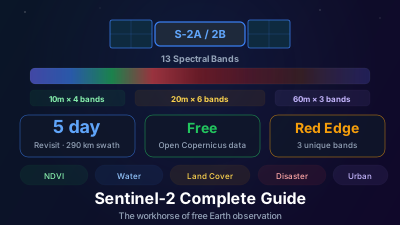
Quick Answer: Sentinel-2 is a twin-satellite mission (2A/2B) under the EU Copernicus program providing free, global, 10-meter multispectral imagery every 5 days. Its 13 bands span visible through shortwave infrared, enabling vegetation health monitoring (NDVI), water quality assessment, land cover mapping, and disaster response. Data is freely available through the Copernicus Data Space Ecosystem, AWS, and other cloud platforms. It has become the default choice for most non-commercial Earth observation projects.
For learning remote sensing, Sentinel-2 is the natural single dataset to start with. Free, global, 10-meter resolution, 13 spectral bands, 5-day revisit. Before the mission launched in 2015, this combination would have been a premium commercial product. Today it's available to anyone with an internet connection.
Mission Overview
Sentinel-2 is part of the European Union's Copernicus Earth observation program, managed by the European Space Agency (ESA). ESA's Sentinel Online describes it as "a constellation of two identical satellites in the same orbit" that "images land and coastal areas at high spatial resolution in the optical domain." The satellites launched so far:
- Sentinel-2A: Launched June 23, 2015
- Sentinel-2B: Launched March 7, 2017
- Sentinel-2C: Launched September 5, 2024, ensuring continuity of the mission
Flying in the same sun-synchronous orbit but offset by 180°, the operating pair achieves a 5-day revisit cycle at the equator (less at higher latitudes — as short as 2–3 days at 45°N).
Each satellite carries the MultiSpectral Instrument (MSI), a pushbroom sensor that images a 290-kilometer-wide swath. The equatorial crossing time is approximately 10:30 AM local solar time (descending node), chosen to balance solar illumination with minimal cloud cover.
The 13 Bands
What makes Sentinel-2 particularly useful is its band configuration. Unlike Landsat, which was designed primarily for land applications, Sentinel-2's bands were specifically chosen to serve agriculture, forestry, and environmental monitoring:
| Band | Central λ (nm) | Bandwidth (nm) | Resolution | Primary Use |
|---|---|---|---|---|
| B1 | 443 | 20 | 60 m | Coastal aerosol |
| B2 | 490 | 65 | 10 m | Blue |
| B3 | 560 | 35 | 10 m | Green |
| B4 | 665 | 30 | 10 m | Red |
| B5 | 705 | 15 | 20 m | Red edge 1 |
| B6 | 740 | 15 | 20 m | Red edge 2 |
| B7 | 783 | 20 | 20 m | Red edge 3 |
| B8 | 842 | 115 | 10 m | NIR |
| B8A | 865 | 20 | 20 m | NIR narrow |
| B9 | 945 | 20 | 60 m | Water vapor |
| B10 | 1375 | 30 | 60 m | Cirrus detection |
| B11 | 1610 | 90 | 20 m | SWIR 1 |
| B12 | 2190 | 180 | 20 m | SWIR 2 |
The Four 10-Meter Bands
Bands 2, 3, 4, and 8 (Blue, Green, Red, NIR) are the workhorses. At 10-meter resolution, they're detailed enough to distinguish individual agricultural fields, detect small water bodies, and map urban features at the block level.
The combination of Red (B4) and NIR (B8) gives you NDVI. Add Green (B3), and you can compute several additional vegetation indices. For a great many routine tasks — vegetation condition, water extent, visual interpretation — these four bands are all you ever touch.
The Red Edge Advantage
Bands 5, 6, and 7 — the "red edge" bands at 20-meter resolution — are where Sentinel-2 truly differentiates itself. The red edge region (700–780 nm) is where vegetation reflectance transitions sharply from low (chlorophyll absorption) to high (leaf structure reflection).
These three narrow bands sample this transition zone, enabling:
- Early detection of vegetation stress before visible symptoms appear
- Better discrimination between crop types
- More accurate chlorophyll and nitrogen content estimation
Landsat doesn't have red edge bands. Neither do most commercial satellites. This makes Sentinel-2 uniquely valuable for precision agriculture.
SWIR Bands
Bands 11 and 12 at 20 meters provide shortwave infrared information critical for:
- Moisture detection: Wet surfaces absorb SWIR, so moisture differences are clearly visible
- Burn scar mapping: The Normalized Burn Ratio uses NIR and SWIR
- Snow/ice discrimination: Snow is bright in visible but dark in SWIR
- Mineral identification: Clay and iron oxide have diagnostic SWIR absorption features
- Cloud/snow separation: Both appear bright in visible, but clouds are bright in SWIR while snow is dark
Which Processing Level Should You Use?
Level-2A, in almost every case. It's the only level corrected for atmospheric effects, which means its values represent actual surface reflectance rather than what the sensor saw through the atmosphere. Sentinel-2 data comes in three processing levels:
Level-0: Raw instrument data. Not distributed to users.
Level-1C: Top-of-atmosphere (TOA) reflectance. Radiometrically calibrated and geometrically corrected, orthorectified to a global reference grid. This is what the sensor measured after accounting for solar geometry.
Level-2A: Bottom-of-atmosphere (BOA) surface reflectance. Atmospherically corrected using ESA's Sen2Cor processor. Also includes a Scene Classification Map (SCL) that identifies clouds, cloud shadows, vegetation, water, and other surface types.
Use Level-2A for any quantitative analysis. Level-1C is appropriate only when you need the raw measurement or when Level-2A isn't available.
The Scene Classification Map
The SCL band in Level-2A products is underappreciated. It provides a per-pixel classification:
| Value | Class |
|---|---|
| 0 | No data |
| 1 | Saturated or defective |
| 2 | Dark area pixels |
| 3 | Cloud shadows |
| 4 | Vegetation |
| 5 | Bare soils |
| 6 | Water |
| 7 | Cloud low probability |
| 8 | Cloud medium probability |
| 9 | Cloud high probability |
| 10 | Thin cirrus |
| 11 | Snow/ice |
This classification enables automated cloud masking without running your own algorithms. Filter pixels with SCL values 3, 8, 9, or 10 to remove clouds and shadows.
Where Can You Download Sentinel-2 Data?
From several free channels. ESA's official portal, the Copernicus Data Space Ecosystem, carries the full archive; cloud mirrors on AWS, Google Earth Engine, and Microsoft Planetary Computer serve the same data in analysis-ready form. All are free — the choice comes down to your workflow:
- Copernicus Data Space Ecosystem: ESA's official portal, full archive
- AWS Earth Search: STAC-compatible access through Element 84, widely used in cloud-native workflows
- Google Earth Engine: Pre-processed collections ready for analysis
- Microsoft Planetary Computer: STAC catalog with integrated processing
The data is open access under the Copernicus license — free for all purposes including commercial use, with the attribution requirement: "Contains modified Copernicus Sentinel data [YEAR]." For how Sentinel-2 fits alongside the other open archives, see the overview of free satellite data sources.
Practical Applications
Vegetation Monitoring
NDVI time series from Sentinel-2 track crop growth, detect stress, and estimate yield. The 5-day revisit captures critical phenological stages. The red edge bands add sensitivity that standard NDVI misses.
Water Bodies
NIR absorption by water makes it straightforward to map lakes, rivers, and coastal features. The Modified Normalized Difference Water Index (MNDWI) using Green and SWIR bands provides even cleaner water body delineation.
Land Cover Mapping
The 13-band spectral richness supports detailed land cover classification. Combining visible, NIR, red edge, and SWIR bands, supervised classifiers can separate a considerably more detailed class scheme than three-band imagery allows — though how many classes hold up depends on how spectrally distinct they are at your site and on the quality of your training data.
Disaster Response
Post-disaster imagery for flood extent mapping (water vs. land), wildfire damage assessment (NBR), and earthquake building damage (texture changes). The 5-day revisit ensures timely acquisition.
Urban Analysis
At 10 meters, individual city blocks are visible. NDBI (Normalized Difference Built-up Index) using SWIR and NIR distinguishes built-up areas from vegetation. Time series reveal urban expansion patterns.
Limitations
No satellite is perfect:
- Clouds: Optical sensors can't see through clouds. In tropical regions, cloud-free composites may require 2–3 months of data
- Night: No nighttime observations (the sun needs to be up)
- 20/60m bands: Not all bands are at 10 meters. Red edge and SWIR are 20 m; atmospheric bands are 60 m
- Temporal gaps: Despite 5-day revisit, cloud cover can create weeks-long gaps in usable data for specific locations
- No thermal band: Cannot measure surface temperature (use Landsat or MODIS for thermal)
How Does Sentinel-2 Compare to Landsat?
Sentinel-2 offers finer resolution (10 m vs 30 m), a faster revisit (5 days vs 8), and red edge bands; Landsat counters with a five-decade archive and thermal bands. Both are freely available, but they differ in important ways:
| Feature | Sentinel-2 | Landsat 8/9 |
|---|---|---|
| Spatial resolution | 10/20/60 m | 15/30/100 m |
| Spectral bands | 13 | 11 |
| Red edge bands | Yes (3 bands) | No |
| Revisit | 5 days | 8 days (both) |
| Swath width | 290 km | 185 km |
| Thermal band | No | Yes |
| Archive start | 2015 | 1972 (Landsat series) |
For current monitoring with high temporal frequency, Sentinel-2 is generally the better choice. For long-term historical analysis or when thermal information is needed, Landsat is irreplaceable.
In practice, many projects combine both — using Landsat's longer archive for historical context and Sentinel-2's better resolution and revisit for current monitoring. The Harmonized Landsat Sentinel-2 (HLS) products do exactly this, merging the two into a single consistent time series.
Sentinel-2 has democratized satellite remote sensing more than any other single mission. A decade ago, 10-meter multispectral data with 5-day revisit was a premium product. Today, it's the baseline that everyone starts from — and you can browse it directly in the Sentinel-2 viewer without downloading a single file.

Remote sensing specialist with 10+ years in satellite data processing and AI. Founder of Off-Nadir Lab. Ph.D. in Informatics (Yokohama National University, 2026). Master's in Earth System Science and Technology (Kyushu University). Co-author, Remote Sensing Encyclopedia. More about the author →