
Supply Chain Monitoring from Space: How Satellites Track Global Commerce
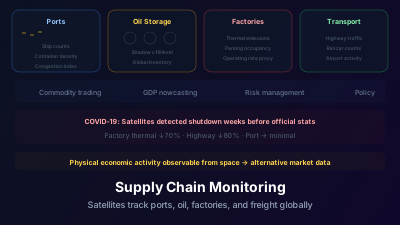
Quick Answer: Satellites provide independent, near-real-time indicators of economic activity by monitoring physical infrastructure: port congestion (ship counts at anchorage), factory activity (thermal emissions, parking lot occupancy), commodity stockpiles (oil tank shadow analysis for fill levels, grain pile volumes), and transportation flows (truck counts, rail car activity). During COVID-19, satellite data provided the earliest indications of Chinese economic recovery by showing factory restart through thermal signatures and trucking activity. These 'alternative data' signals complement traditional economic statistics with higher temporal frequency and global coverage. Limitations: satellite indicators are proxies, not direct measurements of economic output.
In early February 2020, satellite imagery showed something remarkable: China's industrial heartland had gone dark. Thermal emissions from factories dropped sharply, highway traffic thinned, and port activity slowed well below normal levels. Weeks before official economic statistics confirmed it, satellite data revealed the scale of China's COVID-19 lockdown on industrial activity.
Then, equally remarkably, satellite data showed the recovery — factory by factory, port by port — providing real-time economic intelligence that traditional statistics couldn't match.
What Satellites Reveal About Commerce
Port Activity
Ports are the physical nodes of global trade, and their activity levels are observable from space:
Ship counts: The number of vessels at anchor, at berth, or waiting to enter port. High anchorage counts indicate congestion — either demand surge or port capacity problems. During the 2021 supply chain crisis, satellite imagery showed record numbers of container ships waiting at Los Angeles/Long Beach.
Container yard density: Satellite imagery measures how full container stacking areas are. Full yards indicate throughput bottlenecks.
Vessel dwell time: Tracking individual ships via AIS combined with port imagery reveals how long vessels wait before being loaded/unloaded — a direct measure of port efficiency.
Cargo type: Tankers at oil terminals vs. container ships at container ports vs. bulk carriers at grain terminals — vessel type indicates commodity flows.
Oil Storage
Global oil inventory is a closely watched economic indicator. Satellites estimate it:
Floating roof tank fill levels: Large oil storage tanks have floating roofs that rise and fall with oil level. The shadow cast by the roof inside the tank rim is visible in satellite imagery. Shadow width indicates roof height, which indicates fill level.
Crude oil floating storage: Tankers used for floating storage (anchored with full cargo rather than making deliveries) indicate oversupply. Easily tracked via AIS and satellite imagery.
Refinery activity: Thermal signatures from refinery processing units indicate operating rates. Flaring activity visible in nighttime imagery.
Industrial Activity
Factory thermal emissions: Operating factories emit heat from production processes. Thermal satellite data (MODIS, VIIRS, Landsat thermal) detects whether industrial facilities are running.
Parking lot occupancy: Employee parking lots at factories and commercial facilities indicate workforce activity levels. Full lots during working hours = operating facility. Empty lots = shutdown or reduced operations.
Construction activity: New factory construction, facility expansion, and infrastructure development track capital investment.
Agricultural Commodities
Grain stockpile volumes: Open-air grain piles at elevators and storage facilities have measurable volumes from satellite-derived 3D models.
Crop condition: Satellite vegetation indices forecast crop yields months before harvest, enabling commodity price prediction.
Livestock: Large feedlot operations are visible in satellite imagery; herd size estimation is possible at very high resolution.
Transportation
Highway traffic density: Vehicle counts on major highways from VHR satellite imagery or SAR. Significant reductions indicate economic disruption; increases indicate recovery.
Rail car counts: Railway yards and sidings with full or empty rail cars indicate freight volumes.
Airport activity: Aircraft counts at airports, both commercial and cargo, track aviation and air freight volumes.
Methods
Change Detection
Compare current observations against baseline (normal activity levels):
- Current port ship count vs. monthly average → congestion indicator
- Current factory thermal signature vs. historical average → operating rate
- Current parking lot occupancy vs. normal business hours → economic activity
Time Series Analysis
Track indicators over time to identify trends:
- Weekly ship counts at major ports → trade volume trends
- Monthly thermal emissions from industrial zones → manufacturing output
- Seasonal crop condition vs. historical average → yield forecasts
Cross-Referencing
Combine multiple satellite indicators with traditional data:
- Port activity + AIS vessel tracking + shipping schedules → trade flow estimation
- Factory thermal + parking lot + trucking activity → industrial production estimate
- Crop satellite indices + weather data + historical yields → commodity supply forecast
Applications
Commodity Trading
Satellite-derived supply indicators inform trading decisions:
- Oil inventory levels → crude oil price direction
- Crop condition → grain futures positioning
- Mining output estimates → metals market analysis
Several hedge funds and commodity trading firms maintain dedicated satellite intelligence teams.
Economic Forecasting
"Nowcasting" economic activity using satellite data:
- GDP estimates from nighttime light intensity (strong correlation established in research)
- Manufacturing PMI predictions from industrial thermal signatures
- Trade volume estimates from port activity
These satellite indicators complement official statistics with higher frequency and lower reporting lag.
Risk Management
Supply chain risk identification:
- Port congestion alerts → rerouting decisions
- Factory shutdown detection → supply disruption warnings
- Natural disaster impact on transportation → logistics replanning
Government and Policy
- Sanctions compliance monitoring (are sanctioned facilities operating?)
- Trade policy impact assessment (are tariffs affecting trade flows?)
- Disaster economic impact estimation (how much economic activity was disrupted?)
Reference: Satellite Indicators and Economic Signal Strength
Not all satellite-derived economic indicators are equally trustworthy. Vendors publish accuracy figures for their own products, but these are rarely independently reproducible and rarely transfer to another region or period, so the useful thing to internalise is the ranking and the reason for it — how directly the observable is coupled to the quantity you actually care about:
| Economic Indicator | Satellite Proxy | Signal Strength | Why | Key Limitation |
|---|---|---|---|---|
| Global oil inventory | Floating roof tank shadow analysis | Strong | The roof height is physically the fill level — a direct geometric measurement | Open-top tanks only; underground storage invisible |
| Crop production | NDVI seasonal composite | Strong | Canopy vigour is causally upstream of yield | Only total biomass; species confusion |
| Port trade volume | Ship count at berth + anchorage | Moderate | Counts hulls, not tonnage | Ship size variation (one Capesize = 20 Handysize) |
| Factory activity | Thermal anomaly + parking occupancy | Moderate | Shows whether a plant runs, not how much it makes | Seasonal variation, multiple products per facility |
| Retail activity | Parking lot vehicle counts (VHR) | Moderate | Footfall proxy only; says nothing about basket size | Requires 30–50 cm imagery; weather-dependent |
| Nighttime lights → GDP | VIIRS DNB luminosity | Moderate | Well-established relationship in the literature, but coarse | Saturation in dense urban areas; not all GDP emits light |
| Grain stockpile volume | Pile shadow height analysis | Moderate | Geometric, but only for the fraction stored outdoors | Covered storage invisible |
| Mining production rate | Pit expansion + shipping | Weak–Moderate | Volume moved says little about metal produced | Ore grade unknown from space |
The COVID-19 case: through January and February 2020, satellite-observed industrial and transport activity across China fell visibly, and it did so before official statistics for the period were published. This is the most-cited real-world demonstration of satellite economic intelligence, and the reason is structural rather than lucky: the physical proxy is observed continuously, while the statistic is compiled, revised and released on a fixed calendar. The lead time comes from the reporting lag, not from the satellite seeing anything the statistical agency could not.
Accuracy and Limitations
Proxy, not measurement: Satellite indicators correlate with economic activity but don't directly measure it. A full parking lot suggests a factory is operating, but doesn't tell you what it's producing or how efficiently.
Temporal gaps: Satellite observations are periodic (not continuous). Between observations, activity can change. AIS and other continuous data sources fill some gaps but not all.
Scale of inference: Ship counts at ports don't directly translate to trade volumes — ship sizes vary enormously. A single large container ship carries more cargo than twenty smaller vessels.
Weather dependence: Optical observations are prevented by clouds. SAR provides weather-independent monitoring but with less interpretive detail.
Cost: While Sentinel-2 provides free monitoring for large-scale indicators, detailed analysis (parking lot vehicles, individual factory assessment) requires commercial VHR imagery at significant cost.
Despite these limitations, satellite-based economic intelligence has become a mainstream component of financial analysis and supply chain management. The key insight is that physical economic activity — moving goods, operating factories, storing commodities — happens in the observable world, and satellites observe the world continuously. Converting those observations into actionable economic intelligence is a matter of consistent methodology, ground-truth calibration, and appropriate uncertainty quantification.
Related reading
For a focused, operational treatment of the port signal — reading the anchorage queue as a leading indicator of delay, and watching a specific port without code — see port congestion and supply-chain risk.

Remote sensing specialist with 10+ years in satellite data processing and AI. Founder of Off-Nadir Lab. Ph.D. in Informatics (Yokohama National University, 2026). Master's in Earth System Science and Technology (Kyushu University). Co-author, Remote Sensing Encyclopedia. More about the author →